Category: friday feature
Autographed Die Casts-A Fan Favorite!
While the preferred autographed item per sport varies, for many sports, the item is obvious. Hockey has pucks, golf has golf balls, baseball has…well, baseballs, other times the autographed item of choice isn’t as obvious. In auto racing there are several items people like to get autographed. These include such things as helmet visors, crew shirts, and hats, but one of the most autographed items by drivers are 1:24 die cast replica cars.
Fans get autographed die casts in one of two ways. The first way is to purchase an unsigned die cast, and have the driver sign it, at a race, signing or sponsor event. The first two examples are Greg Biffle die casts from his days at Roush Racing sponsored by Granger. An employee of Granger was able to get these two die casts signed by Biffle. The first is a Cup Series #16 Ford die cast. The die cast is signed in black, and signed on the hood, as some drivers prefer to hand sign the hood at these events.
The second Greg Biffle Granger die cast was also signed at the same event. This die cast is a #60 Roush Ford from the Busch Series. Like the #16, it is also signed on the hood.
This is a Ron Capps NAPA 1:24 die cast. I purchased the die cast at the 2013 NHRA Route 66 Nationals, and got it signed by him during Saturday qualifying. Like the previous two, it was signed on the hood area in black ink.
The other way fans get autographed die casts is buying them pre-signed. Drivers will sign the windshield, and then it will be added to the die casts. These die casts will come with COA’s. An example is this Carl Edwards #99 UPS die cast. Carl Edwards has signed the die cast windshield in silver ink.
This is a Jack Beckman Infinite Hero Challenge Funny Car pre-signed die cast from 2014. Like the Carl Edwards die cast, it is signed on the windshield in silver ink, and comes with authentication.
Next week, a video of miscellaneous items in my collections.
Yet Another Look at Driver Suit Blog Favorite TJ Zizzo
Editor’s Note: I have another project to attend to this week, so I’m going to repost a TJ Zizzo feature from last year.
By David G. Firestone
TJ Zizzo is the driver, he’s based in Lincolnshire Illinois, I’m based in Evanston, I’ve purchased a number of items from him.
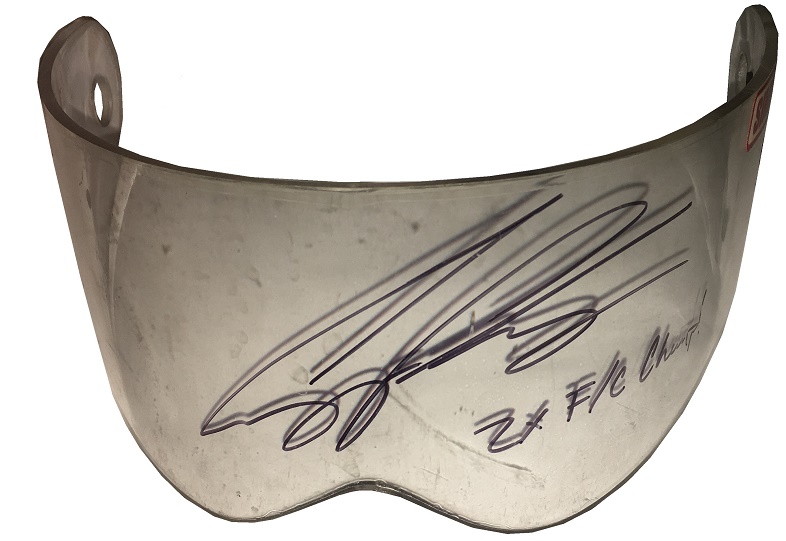
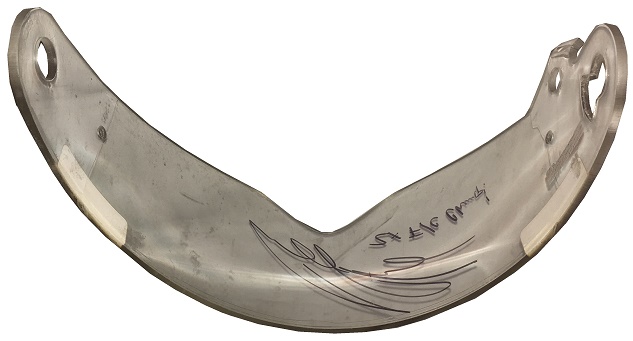
One of the things that I got was a visor. When I purchased it back in 2014, I’d been wanting to get an NHRA visor from some time, and I got one that had the modification I’ve been seeing. The visor shows some light use.
I asked TJ why he had this modification, and he said that he wants to focus on the task at hand. He said that drag racing drivers can notice things, birds, scoreboards, women in the crowd, etc in the car in the moments leading up to the race, and this modification helps the driver by giving him tunnel vision. Tunnel vision is seen by the majority of people as a bad thing, but in something like drag racing, where intense focus for a brief period of time is a mandate, tunnel vision is a good thing. Top fuel dragsters have 10,000 horsepower and can go from 0 to 325 mph in less than 3 seconds. When you are behind the wheel of a car with that much power, you need to focus on the race as much as possible. TJ wears this style of visor because, the less he can see out of the helmet, the more he can focus on the race. TJ even said that this visor is much less covered than his current version, which looks something like this…
In 2014, at the U.S. Nationals, TJ suffered a major engine explosion. He still has the blower drive seen flying in the video. I was amazed how heavy it was. He has one shelf in his new shop that has the pieces of the engine, and the damage suffered, from a fan’s stand point. The manifold that blew was made of solid magnesium and was heavy duty. The crankshaft in question was not only broken, but was slightly bent near the break. I wound up getting one of the rear tires from that race. Rear tires from top fuel dragsters are 3 feet tall by 17 inches wide. I’m planning on getting a glass to and making a coffee table at some point. The level of wear on the tires is amazing, with large patches of damage from the explosion. TJ also signed it and personalized it to me!
I also got a front tire, which is 22 inches tall, by 3 inches wide.
I’m not sure when it was raced, but it does show wear and it has ZIZZO written on the tread. To give an idea the size difference between the two, here are the two of them together in my office…
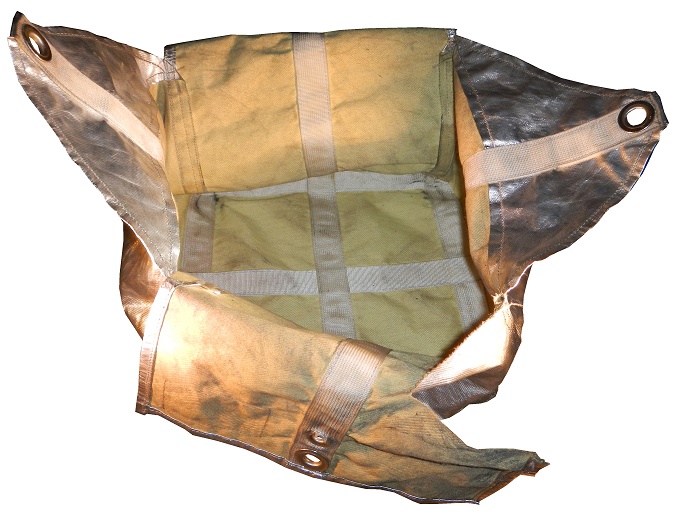
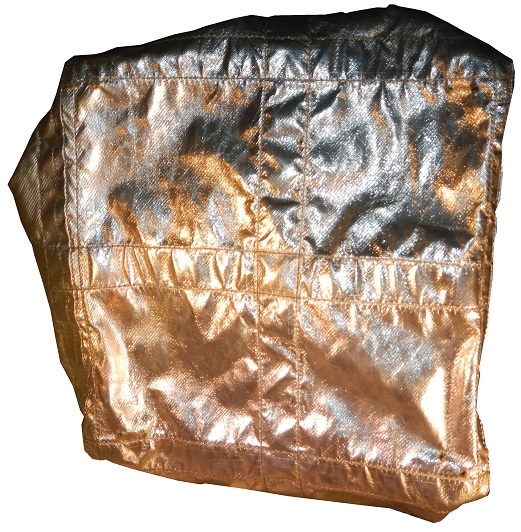
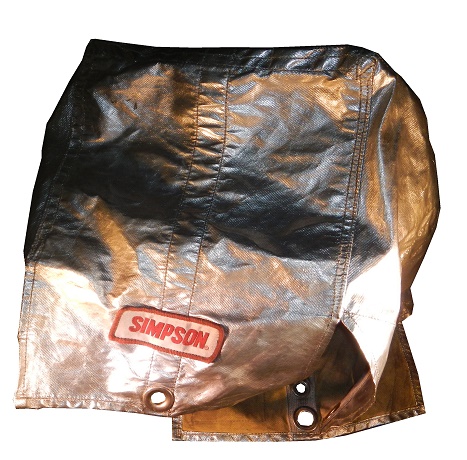
One of my big gets was a TJ Zizzo Peak parachute. Zizzo ran two of these chutes on the back of his dragster from 2010 to 2013., and this example is 12 feet by 12 feet. It shows a decent amount of wear, with stains and holes.
There is a hole in the center that allows the chute to be deployed, and there is an inventory tag placed here as well.
On the cables connecting the chute to the car, there is some extra protection. This is necessary because on top fuel dragsters, the engine is very close to the parachute attachment, and in the event of a fire, the chute will still be able to function. TJ’s example shows some wear on the silver layer.
One thing that a lot of non drag racing fans don’t realize is that many drivers pack their own chutes. Race car drivers are control freaks, and so this makes sense. The logic a few drivers use is that if I mess it up, I don’t have anyone to blame for it except myself.
The pilot chute is attached here as well. Pilot chutes are universally used to deploy parachutes. When the cords are pulled, and the chute is released, the pilot chute deploys, which catches air and pulls the primary chute behind it. The chutes are strapped to a bar at the back of the car, the straps pre-covered in Nomex to prevent fire damage, then packed into a bag, before the race.
I’ve discussed the importance of spark plugs, and their prevalence in the auto racing memorabilia market before, so I won’t go into that again. I will show one of TJ Zizzo’s race-used spark plugs, which he managed to autograph. Given the size of the plug, that isn’t easy to sign.
Next week, I will discuss autographed die casts.
Yet Another Look at Driver Suit Blog Favorite TJ Zizzo
Editor’s Note: I have another project to attend to this week, so I’m going to repost a TJ Zizzo feature from last year.
By David G. Firestone
TJ Zizzo is the driver, he’s based in Lincolnshire Illinois, I’m based in Evanston, I’ve purchased a number of items from him.
One of the things that I got was a visor. When I purchased it back in 2014, I’d been wanting to get an NHRA visor from some time, and I got one that had the modification I’ve been seeing. The visor shows some light use.
I asked TJ why he had this modification, and he said that he wants to focus on the task at hand. He said that drag racing drivers can notice things, birds, scoreboards, women in the crowd, etc in the car in the moments leading up to the race, and this modification helps the driver by giving him tunnel vision. Tunnel vision is seen by the majority of people as a bad thing, but in something like drag racing, where intense focus for a brief period of time is a mandate, tunnel vision is a good thing. Top fuel dragsters have 10,000 horsepower and can go from 0 to 325 mph in less than 3 seconds. When you are behind the wheel of a car with that much power, you need to focus on the race as much as possible. TJ wears this style of visor because, the less he can see out of the helmet, the more he can focus on the race. TJ even said that this visor is much less covered than his current version, which looks something like this…
In 2014, at the U.S. Nationals, TJ suffered a major engine explosion. He still has the blower drive seen flying in the video. I was amazed how heavy it was. He has one shelf in his new shop that has the pieces of the engine, and the damage suffered, from a fan’s stand point. The manifold that blew was made of solid magnesium and was heavy duty. The crankshaft in question was not only broken, but was slightly bent near the break. I wound up getting one of the rear tires from that race. Rear tires from top fuel dragsters are 3 feet tall by 17 inches wide. I’m planning on getting a glass to and making a coffee table at some point. The level of wear on the tires is amazing, with large patches of damage from the explosion. TJ also signed it and personalized it to me!
I also got a front tire, which is 22 inches tall, by 3 inches wide.
I’m not sure when it was raced, but it does show wear and it has ZIZZO written on the tread. To give an idea the size difference between the two, here are the two of them together in my office…
One of my big gets was a TJ Zizzo Peak parachute. Zizzo ran two of these chutes on the back of his dragster from 2010 to 2013., and this example is 12 feet by 12 feet. It shows a decent amount of wear, with stains and holes.
There is a hole in the center that allows the chute to be deployed, and there is an inventory tag placed here as well.
On the cables connecting the chute to the car, there is some extra protection. This is necessary because on top fuel dragsters, the engine is very close to the parachute attachment, and in the event of a fire, the chute will still be able to function. TJ’s example shows some wear on the silver layer.
One thing that a lot of non drag racing fans don’t realize is that many drivers pack their own chutes. Race car drivers are control freaks, and so this makes sense. The logic a few drivers use is that if I mess it up, I don’t have anyone to blame for it except myself.
The pilot chute is attached here as well. Pilot chutes are universally used to deploy parachutes. When the cords are pulled, and the chute is released, the pilot chute deploys, which catches air and pulls the primary chute behind it. The chutes are strapped to a bar at the back of the car, the straps pre-covered in Nomex to prevent fire damage, then packed into a bag, before the race.
I’ve discussed the importance of spark plugs, and their prevalence in the auto racing memorabilia market before, so I won’t go into that again. I will show one of TJ Zizzo’s race-used spark plugs, which he managed to autograph. Given the size of the plug, that isn’t easy to sign.
Next week, I will discuss autographed die casts.
Another Example of a Pit Crew Helmet…
Hailing from Chesapeake, Virginia, Ashton Lewis Jr. was an American driver with a lot of success on road courses. He raced in the Barber Saab Pro Series in 1992, before getting a scholarship in the British Formula Ford Championship. He made his Xfinity Series debut in 1993, and raced until 2006.
In 2004, Ashton raced for Lewis Motorsports, owned by his family. He had a decent season, scoring 3 top 5’s and 8 top 10’s in 34 races. He also finished 6499 of 6684 laps for a lap completed percentage of 97.2%. During that season, one of his crew members wore this Simpson helmet. The helmet is in decent condition, with the radio removed. The left side shows some scratches.
Near the front on the left side is where the microphone was. There are some small holes where it was removed.
The front doesn’t have a face shield, but it does have a visor to keep the sun out of the wearer’s eyes.
The right side does show some scratches as well.
The back has a lot of scratches, and one very large black scuff mark.
The top shows some minor scratches.
The inside has fire resistant padding, and the radio equipment has been removed.
Next week, a Driver Suit Blog favorite returns!
Fun Collecting Autographs
Getting autographs in person, be it at races, conventions, or other signings is fun. I’ve been doing it for over 30 years. I’ve met a lot of athletes in this fashion. For some, autographs are a hobby, for others, they are a business. I personally love collecting autographs.
It’s not uncommon for people to bring items to sports events to sign. Fans bring baseballs to batting practice to get autographs. I’ve done this myself on several occasions. I’ve also brought items to car shows and conventions to get signed. A few years ago, I brought this motorcycle helmet to the NHRA Route 66 Nationals. It was signed by Robby Gordon when I bought it, I still have it and it’s in great condition.
The left side is signed by Clay Millican,Tony Schumacher, Tommy Johnson Jr, and Ron Capps.
There are no signatures on the front.
The right side is signed by Terry McMillian.
There are no signatures on the back.
It was signed by Robby Gordon when I bought it, and his signature is on the back of the top. At the front of the top is the signature of Shirley Muldowney.
The inside of the helmet doesn’t show wear.
Ok…with that out of the way, let’s move on to…
TAILGATING TIME!
If you want a delicious, filling recipe that will always go with watching racing, you’d be hard pressed to find a better one than…
Lasagna
8 Servings
Instructions:
1 large finely chopped onions
1 clove minced garlic
1/4 cup olive oil
1 1/2 lb ground beef
Black pepper
Oregano
1 28 ounce can Italian-style tomatoes
6 ounces salt-free ketchup
1/3 cup water
1 1/4 lb ricotta cheese
1 8 ounce package lasagna noodles, cooked according to directions
1/2 lb mozzarella cheese, sliced.
1/2 cup grated Romano or Parmesan cheese.
Instructions:
1-Cook onion and garlic in oil until soft and yellow.
2-Add meat and continue cooking until meat is thoroughly browned
3-Add seasonings, tomatoes, ketchup, and water, and simmer until thickened, about 2 hours.
4-Arrange 1/3 of the cooked noodles in a 13 by 9 1/2 inch baking pan.
5-Top with 1/3 each, mozzarella, ricotta, and meat sauce.
6-Repeat procedure twice.
7-Sprinkle Romano or Parmesan over top layer.
8-Bake in a preheated 350 degree oven for 30 minutes, cut into squares, and serve.
We’ll stay with the helmet theme for next week.
Same Suit, Different Stories Part 2
It’s amazing how many used firesuits are on the market in this day in age. Every one of them tells a story. Some are worn by professional racing champions. Some are worn by weekend warriors. Interestingly, some people who acquire these suits to sell don’t know the true back story behind the suit itself. This week, I will discuss a suit almost identical to last week’s, but with a different back story that is very believable.
While BMW is considered a luxury car brand, they are involved in Australian GT, DTM, IMSA, GT Racing, and FIA Formula E. They have a decent amount of success in the sport, and are a fixture at sports car races around the world. Since they are fielding their own teams, the need for drivers is there. So, like many teams, they field new talent from racing schools such as Skip Barber.
John “Skip” Barber III is a former F1 and SCCA driver.While we won 3 SCCA National Championships in a row, his F1 and IndyCar careers were not stellar. After his racing career ended, he taught four students to race in 1975. 45 years later, Skip Barber Racing Schools owns 130 cars and operates at over 30 tracks over North America. Given the need for racing talent, and the number of different series that BMW races for, it doesn’t seem too far fetched that BMW would work with Skip Barber. That partnership resulted in this single-layer OMP firesuit in decent condition.
The collar has a Velcro strap, and an OMP patch on the strap.
The cowl has a small flag tag marked 50 sewn into it.
The right chest features a BMW logo sewn into it.
The left chest is unadorned.
The front torso features a black stripe over a red stripe.
The suit has an unadorned white belt.
The legs are unadorned, and have standard cuffs.
The shoulders have black over red stripes.
The sleeves have OMP patches sewn into the upper area, but are otherwise unadorned.
The back is unadorned.
The back of the neck has the warranty label sewn into it.
The back torso is unadorned.
Next week, I’ll discuss an autographed racing helmet.
Same Suit, Different Stories Part 1
It’s amazing how many used firesuits are on the market in this day in age. Every one of them tells a story. Some are worn by professional racing champions. Some are worn by weekend warriors. Interestingly, some people who acquire these suits to sell don’t know the true back story behind the suit itself. This is evident that in the next couple weeks, I’m going to discuss two identical suits with different back stories from the sellers.
One of America’s most well-known sports car races in America is the 12 Hours of Sebring. Located in Sebring, Florida, it was opened on the defunct Hendricks Army Airfield in 1950. The race lasts 12 hours, has several different classes racing, and has had many well-known race winners including Juan Manuel Fangio, Dan Gurney, Mario Andretti, A. J. Foyt, Bobby Rahal, Arie Luyendyk, Scott Sharp, Wayne Taylor, and Scott Pruett.
While BMW is considered a luxury car brand, they are involved in Australian GT, DTM, IMSA, GT Racing, and FIA Formula E. They have won the 12 Hours of Sebring in 1975, and 1999. At some point in the 1980’s, one of their teams came outfitted in this cream colored single-layer OMP suit. The suit shows some wear, and while I can’t match it 100%, there is an undated photo showing three crew members wearing this same suit design.
The collar has a Velcro strap, and an OMP patch on the strap.
The cowl has a small unreadable flag tag sewn into it.
The right chest features a BMW logo sewn into it.
The left chest features GOODYEAR, JEB’S HELMETS, and SKF BEARINGS sewn onto them.
The front torso features a black stripe over a red stripe. There is some damage to the red stripe.
The suit has an unadorned white belt.
The legs are unadorned, and have standard cuffs.
The shoulders have black over red stripes.
The sleeves have OMP patches sewn into the upper area, but are otherwise unadorned.
The back is unadorned.
The back of the neck has the warranty label sewn in an off-center manner.
The back torso is unadorned.
Next week, I’ll discuss an almost identical suit with a different, yet believable back story.
A Great Series Needs a Great Logo-2020 Edition!
By David G. Firestone
NASCAR has a lengthy history in the United States. Founded in 1948, 72 years ago, NASCAR has taken stock car racing to new heights. Once a regional promotion, NASCAR is now an international powerhouse. NASCAR and their various series have logo histories that are interesting.
Let’s start with NASCAR itself.
The first NASCAR logo features a track-inspired oval design, with checkered flags, and two streamlined cars heading toward each other. NASCAR INTERNATIONAL is printed in black on the greenish-yellow oval.
A newer version of the logo is introduced. The oval is gone, the colors have changed from black and greenish-yellow to blue and white. The checkered flags have a much more pronounced, and a line motif is added to the back ground. NASCAR is on top of the cars, INTERNATIONAL is underneath them.
A brand new logo is introduced in 1978. A rectangle with NASCAR in white lettering, with various different colors in the negative space replaces the old school NASCAR International logo. A series of colored vertical bricks are on the left side of the logo.
A much more toned down version of the previous logo, with different font is introduced during 2017, with much fanfare.
The Monster Energy NASCAR Cup Series has a unique tradition that stretches back to the 1970’s, the Series Logo. Series Logos are now commonplace in most forms of racing The evolution of the NASCAR Sprint Cup Series logo over the years in interesting.
This logo is designed in classic 1970’s design, and can be seen on driver suits, as this Dale Earnhardt Sr. example from 1980 clearly shows.
The “1 Car” logo was a major redesign, and features a logo, with NASCAR GRAND NATIONAL SERIES embroidered, and a 1980’s car. Very visible on driver suits from the era.
A simple Winston logo, which, while underwhelming is very visible on this Bobby Hillin Jr. Suit, and this photo of Dale Earnhardt Sr. from 1992…and look who is next to him!
Again an underwhelming yet attractive series logo. The interesting thing about logos from 1993-2001 is that there are two designs, red with white lettering that displayed better on light driver suits, and white with red lettering that displayed better on dark colored driver suits. Though the rule was rather ambiguous for a while.
This design went through some changes when Winston changed the design of their packaging. Starting in 1998, Winston went from a rounder typeface to a narrower and straighter typeface, as a young Tony Stewart is modeling.
Every team and driver ran the NASCAR 50th Anniversary logo on their cars and driver suits. Not bad at all.
A square design with an oval logo was used from 2000-2001, with the color-flipping returning. At this point, the discussion of who would replace Winston started, as due to legislation, cigarettes would not be allowed to sponsor auto racing within the next few years.
The transitional oval logo. The Busch Grand National series had adopted an oval logo in 1995, and since the series would change sponsorships in 2004, this new logo would be the bridge between the old and the new.
New sponsor, new colors, new shape. Nextell Communications took over in 2004 and it became the Nextell Cup Series. This logo would remain constant until Sprint and Nextell merged, which led to:
Same color scheme, same shape, same basic design.
The logo has become a marketing point for NASCAR teams and NASCAR itself. Die casts, driver uniform coats, t-shirts, pit crew shirts, and many other items carry these logos.
Monster Energy takes over the series sponsorship from Sprint, initially for only one season, though two seasons were eventually announced. The new Monster Energy NASCAR Cup Series has a logo based on the new Xfinity Series. It’s a black rectangle, with the current Monster Energy NASCAR Cup Series.
Starting in 2020, the Cup Series took a different direction with its sponsorship. Instead of one company sponsoring the Cup Series with exclusive rights for their field, four companies, Busch Beer, Coca Cola, Geico, and Xfinity sponsor the new Cup Series. Another welcome change is that the exclusivity aspect of the sponsorship is gone.
Now on to the NASCAR Xfinity Series
These two logos were used for the Busch Grand National series. The plain Busch logo worked better and was used more often than the Busch Beer Series logo.
An oval logo with the sponsor name, and GRAND NATIONAL SERIES added below. It was very marketable and worked quite well as a logo.
Grand National Series has been removed, and some minor redesigns to BUSCH and the NASCAR logo as well. 2006 featured the 25th Anniversary logo.
Complete redesign for the NASCAR Nationwide Series which began when Nationwide took over the titular sponsorship of the series. Uneven oval with a Nationwide logo, and a NASCAR logo, with a new overall design and color scheme.
Xfinity takes over the series sponsorship, and release an off-center oval logo, black outline with cutting edge designs on the black outline. The center is white, and features a NASCAR Xfinity Series logo.
With the new NASCAR logo came a new Xfinity Series logo, this one a black square with red designs and a NASCAR Xfinity Series logo replaces the oval.
Last but certainly not least the NASCAR Gander Outdoors Truck Series.
For the first season, the Truck Series was referred to as the “Super Truck Series by Craftsman.” It featured a decidedly early 1990’s logo. It lasted for only one season.
The Craftsman Truck Series is a better name and the logo, while still bearing a 1990’s style design, is more refined and professional.
The entire logo is inside the oval, some minor color and typeface changes are present as well. 2005 featured the 10th Anniversary logo.
The same off-center oval design as the Nationwide Series and Sprint Cup logos, with a sponsor redesign for Camping World, who took over for Craftsman after 2009.
Gander Mountain takes over from Camping World. They are both owned by the same company. This results in a new name, The NASCAR Gander Outdoors Truck Series, and a logo, this one with a black rectangle, outlined in blue, with a blue rectangle with white lettering.
The series makes a slight change, going from the NASCAR Gander Outdoors Truck Series to the NASCAR Gander RV & Outdoors Truck Series, complete with new logo, adding RV into the logo.
Next week, the first of a couple of random suits.
Safety in Racing Covers Every Aspect of Racing…
Founded in Charlotte, North Carolina in 1978, A & A Truck and Auto Center, Inc. or AATAC was at one point a prime supplier of tow truck and wreckers for auto racing. Though the company hasn’t been around since 2003, their website still exists.
In addition to wreckers, AATAC also supplied skilled workers who were contracted to clean off the car and debris from the track. Not only did this help the tracks, it also brought AATAC publicity and exposure. As was the rule at the time, AATAC workers wore firesuits. One such example was worn by a worker named Chris Rodgers at least in 2000, but possibly from 2001-2003. This single-layer Simpson firesuit shows some use, and custom modifications.
The collar doesn’t have a Velcro closure.
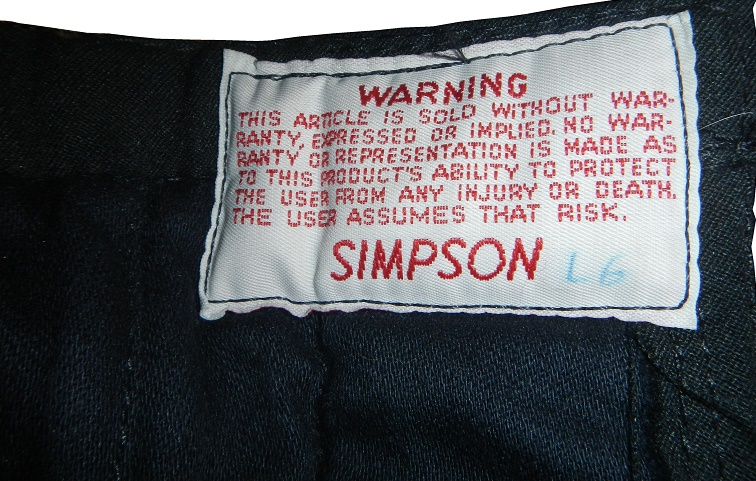
The cowl features a vintage Simpson warranty tag.
What dates this suit in 2000 is the two logos on the right front chest. The Winston Cup and Busch Grand National Series logos. Both are of the vintage from that time frame.
The left chest features a NASCAR logo, a AAA logo, and CHRIS ROGERS embroidered.
The front torso features a blue AATAC logo on a white stripe between the red material.
The belt separates the blue legs from the red torso. It is unadorned.
The legs are unadorned, from a logo perspective. There is a tool pouch sewn in to the legs. The legs have standard cuffs.
The shoulders have white epaulets with AATAC logos embroidered in blue.
The red sleeves have SIMPSON and PENNZOIL WORLD OF OUTLAWS logos embroidered.
The back of the suit doesn’t show that much wear.
What also dates this suit to at least 2000 is the ARCA Bondo/Mar-Hyde Series patch haphazardly sewn into the back near the AAA near the neck. The last year of the series being the ARCA Bondo/Mar-Hyde Series was 2000, after which it became the ARCA RE/MAX Series.
The back of the torso features the same AATAC blue over white logo as the front.
Next week, the Series Logo feature returns!