A Costume of a Firesuit

By David G. Firestone

While racing suits are primarily designed to protect driver from fire, their outer designs have become the focus to the majority of people, and it’s not hard to see why. The amount of effort it takes to get all of the sponsors fair placement for visibility is staggering.

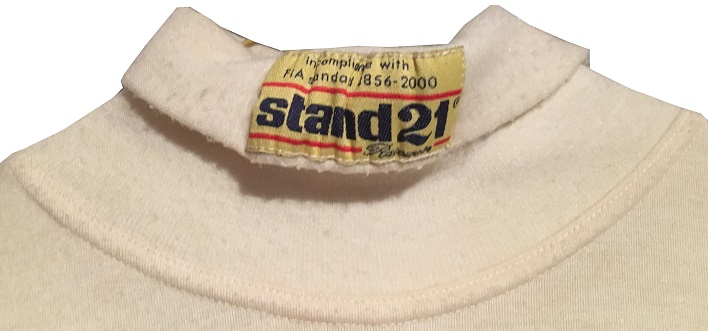
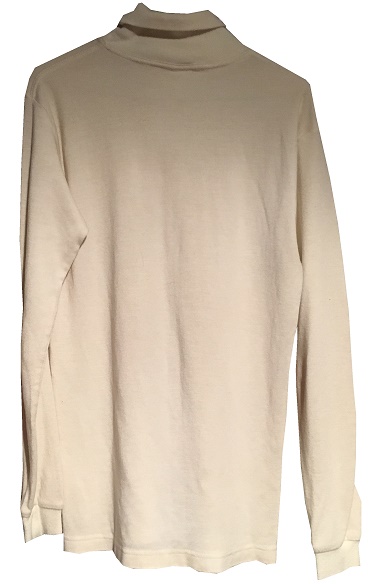
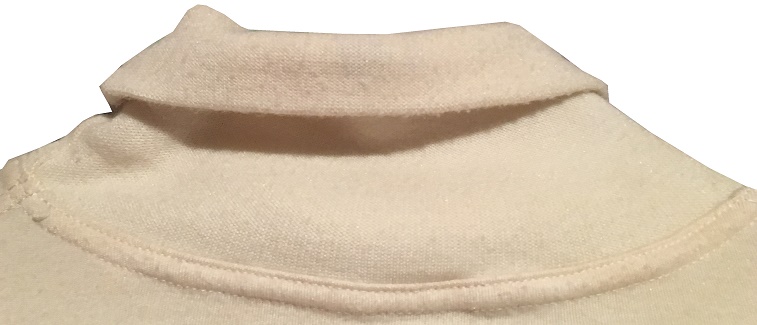
Racing has a place in pop culture. Racing has been featured in music, movies, television, and internet media. For some productions, they place a lot of effort into costume design. Lower end productions will acquire a jumpsuit, and place patches on it, as this white suit made by Red Kap. The suit doesn’t show any real wear.The collar has no adornment, and doesn’t close. It’s designed to be folded like a polo shirt.A Red Kap tag is in the cowl with JS written in Sharpie above it.The right chest features a VALVOLINE patch, a GOODGUYS HOT RODS and STREET RODS patch, and an NGK SPARK PLUGS patch sewn into it.The left chest features a GOODYEAR patch, an STP patch, and a blue star.The suit has no belt.The legs are unadorned, with no special cuffs.The suit has no epaulets, and the right shoulder has a GOODYEAR patch, identical to the one on the left chest, sewn into it.The right sleeve has an NGK SPARK PLUGS patch sewn into the upper part, and the end of the sleeve is unadorned. The suit has no epaulets, and the left shoulder is unadorned.The left sleeve is unadorned. The back of the suit is almost unadorned, with the exception of a VALVOLINE patch on the lower back.

What gets me about this suit is the fact that there was clearly a lot of effort put into the design of this suit. The patches are sewn in to the suit, and they are all auto racing related. Yet the random placement of the patches baffles me. If the small patches weren’t so spread out, this suit would look a lot better. I get that whatever this suit was used for was on a budget, but a little research would have been better, but the effort does deserve to be respected.

Next week, we go off topic.

Beckman’s Back For 2019

By David G. Firestone

I’ve discussed Jack Beckman on The Driver Suit Blog many times. He is a great driver, he connects with the fans, and he was kind enough to grant me an interview last year. I’ve been into the Infinite Hero Challenge Coin program since the beginning, and love collecting them. Well, I’m back with another profile of the coins for 2018.
Launched in 2011, The Infinite Hero Foundation “…is to combat the most difficult front line issues – mental and physical – facing returning military heroes and their families.” Military personnel returning from overseas deployment face long term employment, mental and physical problems that the majority of Americans don’t understand. They work with other non-profit veterans groups and give out grants to help service men and women cope with these long term problems.
In April 2014, they started appearing on the side of Jack Beckman’s funny car. The late Terry Chandler, who also sponsors Tommy Johnson Jr.’s Make a Wish Foundation Funny Car, is the financial backer of the car. She pays for Infinite Hero to race on the sides of the car. This also began the NHRA coin program. When Jack Beckman gets into his funny car to race, he carries Infinite Hero Challenge Coins in the pocket of his driver suit. Once the race is over, he will autograph them and sell them at the track and on eBay. They cost $100 with all proceeds going to the Infinite Hero Foundation.

The 2014 design is quite thick, and has a ridged edge. One side featured “Courage, Honor, Virtue, Heroism,” around a globe design with an Oakley logo. Oakley is a partner with the Infinite Hero Foundation. The other side features an Infinite Hero Foundation logo with purple enamel. The coin was placed in a round, flat plastic container, with black foam braces. The coin lacks the blue enamel that the coin that comes with the glasses coin, and future coins, and has a very plain look. I do like the plain look. Jack used was identical to the one sold in stores. Jack autographed the plastic case. In 2014, this 1/24 scale die cast was produced. It is a full replica of Beckman’s funny car. Valvoline was a primary sponsor, and this was the only season Infinite Hero and Valvoline were together on the car. It’s also the only time that Infinite Hero Challenge appeared on the older Dodge funny car body. In 2015, the current body was introduced, and Pennzoil replaced Valvoline. Jack has autographed the windshield. A redesigned coin of the same size was introduced for 2015. The Oakley logos are gone. One side features a design similar to the globe design, but the globe design has been replaced with an American Flag design. “Courage, Honor, Virtue, Heroism” has been replaced with “Duty, Honor, Innovation, Courage.” The new emblem on the reverse side has one of the across bands removed. The new packaging is an upgrade, with the circular plastic cylinder replaced with an attractive box. It comes with a card that Jack Beckman autographed, and on the reverse it has the Infinite Hero Foundation Pledge. The first one is from The CARQUEST Auto Parts NHRA Nationals at Phoenix on February 22, 2015, where Jack was eliminated in the first round. The second one is from the Summit Racing Equipment NHRA Nationals in Norwalk, Ohio, where Beckman won the event, beating Courtney Force in the final round. Also in 2015, these hero cards were produced. Hero cards are given away at racing events and driver appearances. They have Jack’s picture, and information about the driver, team, and the Infinite Hero Challenge. For 2016, the coins got a major makeover. The Infinite Hero logo is now bigger. The words “Reimagine” and “Recovery” are stamped near the logo, and on the opposite side, a picture of Jack’s funny car replaces the flag motif. It should also be noted that the coin is slightly smaller, because it isn’t as tight in the coin case as the previous version. The Infinite Hero Pledge accompanies the coin. Also changed from 2016, Jack doesn’t sign the box and the pledge, he just signs the pledge. The 2017 Infinite Hero coin is slightly larger than the 2016 coin, and fits snugly in the box. The pledge piece remains unchanged. The coin itself has a plain pewter Infinite Hero Challenge logo on one side, and a blue enameled claw stripe design with a hex nut design on the border. Hero cards are given away at racing events and driver appearances. They have Jack’s picture, and information about the driver, team, and the Infinite Hero Challenge. For 2016-2017, a new card design was introduced. It has updated information, as well as the updated paint scheme introduced at the beginning of the season. Recently, I took a number of selfies with race car drivers, and made them into a book, and got them signed. This is me with Jack Beckman. Hector Arana signed the upper-left corner.This year’s design is done in memory of the late Terry Chandler, who passed away from cancer prior to the 2017 event. The front has a heart design with Chandler’s initials. The back of the coin has the Infinite Hero logo, with blue enamel. Jack also autographed a copy of the Infinite Hero pledge. For 2018, a new Hero card design  was released.

The 2019 coin design features the features the Air Force seal, with SGR “FAST” JACK BECKMAN INFINITE HERO FUNNY CAR engraved on the outside. The standard Infinite Hero challenge logo is on the reverse. This was autographed by Jack at the Route 66 Nationals.

Jack Beckman is a great driver, who races for a great sponsor, and supports a great cause. He has been really amazing not just to me, not just to to The Driver Suit Blog, but to the NHRA and their fan base. I’m glad he’s going to be racing for The Infinite Hero Challenge until 2020. As long as he is selling them, I will continue buying the Infinite Hero Challenge Coins, and promoting them on The Driver Suit Blog. I can’t wait to see next year’s coin design.
Next week, a suit that was used for something other than racing.

Drag Racing’s Greatest Families-The Pedregon Family

Drag Racing’s Greatest Families-The Pedregon Family

By David G. Firestone

Before we dive into this weeks Friday Feature, I want to discuss why I reposted an old article last week. As happens sometimes, I had to deal with a couple of minor things last week, and I didn’t have enough time to get to the Friday Feature. I hate doing things this way, but real life gets in the way. Now on to the Pedregon Brothers!

When “Flaming” Frank Pedregon passed away in 1981, he had no idea his sons would become some of the most respected drivers in Funny Car. Fast forward to 2019, and one son Tony has 43 event wins, fourth on the all time win list, and two championships, and the other Cruz has 33, and two championships, including the only Funny Car championship not won by John Force in the 1990’s. The Pedregons have gone down as one the greatest families in the history of drag racing.

The first brother to have real success in Funny Car was Cruz. He started racing in 1987 in a top alcohol dragster, moved to top alcohol funny car, then to top fuel in 1991, and in 1992 won the Funny Car championship. The biggest rivalry in drag racing in the 1990’s was John Force vs. Cruz Pedregon. Both were driving Pontiac Firebirds for a while, with Cruz driving this Interstate Batteries/Hot Rod car, represented by this 1/32 die-cast.

John Force was not going to be denied, and decided to get in Cruz’s head by hiring Tony as a driver. By 1993, both Pedregon brothers were racing in full time funny cars Tony and John did not have the best of relationships. Both John and Tony were racing the same design car, but Tony would have to, on occasion, throw a race for John. This is a 1:24 scale mock-up of his Castol funny car from his days with John Force.

In 1998, Tony won 2 events, one at Texas, the other at Denver. During that season, he wore these Simpson Holeshot drag boots.

These boots are unlike most racing shoes because they are designed to cover both the shoe, and the end of the leg of the driver suit. Why would funny car drivers wear such boots? Well, to answer that, let’s look at the design of the inside of a funny car. This is a Ron Capps diecast, but it shows how the car is set up.

The driver sits almost on top of the rear axle, with the 10,000 horsepower engine, and nitromethane fuel tank directly in front. Should there be an engine explosion, which isn’t uncommon, the fire would blow back into the driver. There are firewalls in place, but those can’t always be counted on to protect the driver from the full effects of fire in the time it takes to get a funny car stops. That’s where these boots come in. They will give that little extra bit of help to the driver in exiting the car.  They are rated 15, not bad for 1998 standards, but would have a 20 rating in 2019. Both boots have been signed by Pedregon and he added the inscription “’98.”

In 2002, the Pedregon brothers formed Cruz Pedregon Racing, Inc., and both have had driver duties. This visor was used by one of the brothers, and autographed by both. It’s designed for a Simpson Bandit-style helmet.

The Pedregon brothers didn’t use “The Clydesdale Effect” with this visor. I asked Cruz if he uses The Clydesdale Effect, and this was his response:

“I did, but honestly, to me, if your susceptible to that, you probably have something else going on. Part of your God given ability to focus, to me should be, even if something is in your vision, your focus should be the thing you are focused on, not things on the outside. I did try that at one time, and all it did was verify that I’m really screwed up.”

I also came across this Cruz Pedregon race-used visor. It’s a Simpson visor, which shows a number of scratches, and scuff marks, and Cruz has autographed the visor with the inscription “2X FC CHAMP!.”

The last item is a parachute bag used by Frank Pedregon Jr. It’s designed to hold the parachute on the back of the car, and was from the car when Frank hit Scotty Canon.

Next week, Driver Suit Blog favorite Jack Beckman gets the spotlight!

Collar Guard…Not a Product, but a Safety Feature-Revisited

1-lajoie-collar

By David G. Firestone

Like shoulder epaulets, the collar of a driver suit has made a transition. It has gone from safety accessory to fashion piece, but unlike the epaulet, it is not only ornamental. Because the collar is still a piece of safety equipment. It goes without saying that fire is an ever present danger in auto racing. The collar protects the neck from burns. This may seem minor, but many people who die from burns die from infection. When the skin is compromised, it can’t stop germs from getting inside the body, and as such makes infection a serious risk during burn injuries.
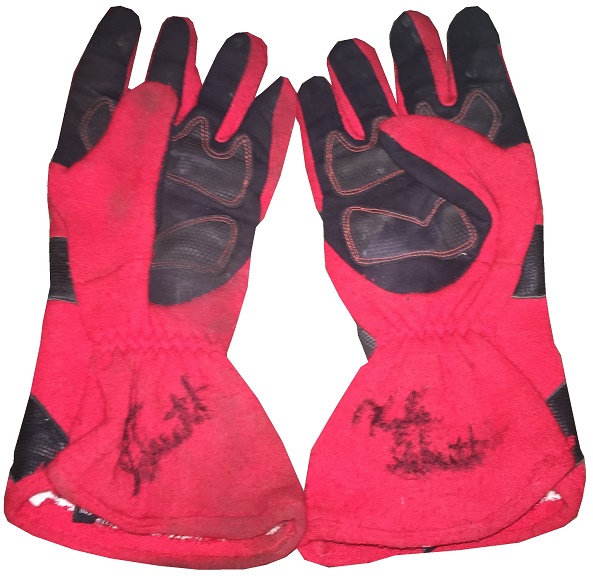
But the fashion aspect of collars is interesting as well. With the standard alignment of sponsors on the top of the suit, the Series logo, tire manufacturer logo, car manufacturer logo, and other sponsor logos are on the top, and the primary sponsor logos are present on the collar and epaulets. This Randy Lajoie example shows how the suit appears during an televised interview:

1-lajoie-f

Note a couple of things: First, the fabric on the collar overlaps just a bit here, but when the driver wears it, it meets perfectly at the center of the neck. Second, it allows the driver to breathe easily. Comfort Vs. Safety is a constant debate. This is one kind of collar, the other kind of collar is what I call the Velcro collar, as shown in this Alex Barron suit from 1998:36-barron-collar

The Velcro collar is exactly what it sounds like, a collar with a strap which Velcros shut. This provides a little more protection in case of fire. It also has another use, as sponsor ads are popular to put on the front of the Velcro strap. This has been used quite often over the years…41-craven-collarbarber-collar

This is due to the fact that for quite some time the open face helmet was used, and the collar provided extra fire protection where the helmet failed. In this day in age, helmets come standard with Nomex socks on the bottom, so the collar, while still a key safety feature, is not as critical. But for sponsor logo placement, it really can’t be beat.

If the collar does not have a Velcro closure, then the primary sponsor logo is sewn into either side of the collar. Like the Lajoie example above, or this Mike Skinner example below, this can be used very effectively as a place for sponsor logos.31-skinner-collar

Like most other aspects of the driver suit, the choice of Velcro or not comes down to driver preference. Kyle Bush, as well as older brother Kurt favor the Velcro style, whereas Tony Stewart and Carl Edwards prefer the non-Velcro variety. Many pit crew shirts have a similar design to the driver design as well.

2019 Throwbacks Ranked!

By David G. Firestone

The throwback race is behind us. You know what that means. I’m going to rank all of the 2019 throwback schemes. As in previous years, the top ranked scheme will be the winner of the Paint Scheme for Best Throwback Scheme. Let’s get going!
1. Austin Dillon #3 DOW Salutes Veterans Chevy Camaro-Black and gold works well, especially on a throwback. This is a great scheme, with a great color scheme, and I can’t give this less than an A.

2. Brad Keselowski #2 Miller Throwback Ford Mustang-The Miller scheme had a unique look, and while I preferred the standard Miller Genuine Draft scheme, this is still a great scheme. A

3. William Byron #24 City Chevrolet/Hendrick Autoguard Chevy CamaroCole’s City Chevrolet Lumina is my favorite car in Days Of Thunder. This is a great replica, and it looks really good. This is getting an A.

4. BJ McLeod #51 Jacob Companies Throwback Chevy Camaro-An underrated NASCAR movie with a lot of great cars, this is a faithful replica of the #7 Chicken Pit/Zenon Ford Thunderbird. This is an amazing look, and I give it an A.

5. Chase Elliott #9 NAPA Throwback Chevy Camaro-You could put all of Bill Elliott’s pre-1999 schemes in a hat, pick one out at random, and be guaranteed to pick a great scheme. 1981 was a great scheme, and this faithful throwback is an amazing representation. I love this scheme! A

6. Landon Cassill #00 StarCom Fiber Throwback Chevy Camaro-I always love metallic siver, and the Coors Light look is a great look. I also like the design as a whole. This is getting an A.

7. Alex Bowman #88 Axalta Throwback Chevy Camaro-The Tim Richmond Folgers scheme was a great scheme, and it’s nice that Axalta is doing a faithful throwback. This is a great look. A

8. Austin Dillon #3 American Ethanol Throwback Chevy Camaro-Dale’s Olympic scheme was a great scheme. This somewhat faithful replica looks really good, and I can’t really say anything bad. A

9. William Byron #24 City Chevrolet/Hendrick Autoguard Chevy CamaroCole’s City Chevrolet Lumina is my favorite car in Days Of Thunder. This is a great replica, and it looks really good. This is getting an A.

10. JJ Yeley #52 Jacob Companies Throwback Chevy Camaro-This is a good look, and I can’t say anything bad about it. A

11. David Ragan #38 Thanks DW Ford Mustang-Darrell’s chrome scheme was a bold look that would look just as awesome today. While I think that metallic silver isn’t chrome, I do love this look, and I think this scheme is great. A

12. Denny Hamlin #11 FedEx Throwback Toyota Camry-Darrell’s 1990’s Parts America scheme was a great scheme. It looked amazing, and still holds up today! This is a great throwback scheme, and I can’t give this less than an A!

13. Ricky Stenhouse #17 Fastenal Throwback Ford Mustang-Darrell’s 1990’s Parts America scheme was a great scheme. It looked amazing, and still holds up today! This is a great throwback scheme, and I can’t give this less than an A!

14. Matt DiBenedetto #95 Procore Thanks DW Throwback Toyota CamryFaithful 1970’s schemes always look awesome, and this is no exception. This is an amazing look, and I love everything about this scheme! A

15. Erik Jones #20 SportClips Throwback Toyota Camry-This is a smooth, simple look, and it’s a great look. The black works, the red works, and the scheme works. A

16. Garrett Smithley #54 AQRE Throwback Chevy Camaro-Not the scheme I was expecting, but this is a good look, and it’s a faithful replica. I give this an A.

17. Daniel Hemric #8 Caterpillar Throwback Chevy Camaro-This is a great scheme, not just because it looks awesome, but because I like how throwbacks are evolving in NASCAR. It used to be that throwbacks were either old schemes, or based on old schemes. Nowadays, everything from cans to trucks are being used. This example is based on an old Caterpillar tractor from the 1920’s. This looks amazing! A

18. David Ragan #38 Shriners Hospitals for Children Throwback Ford MustangDavid Pearson’s 1969 Torino Cobra is a great look, and this is a great throwback. I can’t give this less than an A.

19. Ryan Preece #47 Kroger Throwback Chevy CamaroI love this throwback! The shade of red works, the design looks great, and the car just looks awesome. I love good throwbacks, and this is a good throwback. A

20. Michael McDowell #34 Dockside Logistics Ford Mustang-This was a very unique scheme back in the day, and I like this faithful representation. This is a good look, and I like the silver door numbers. A

21. Ryan Blaney #12 Pennzoil Throwback Ford Mustang-Mike’s old Pennzoil scheme was simple, it was attractive, and it worked. This faithful replica works well, and earns an A.

22. Jimmie Johnson #48 Ally Throwback Throwback Chevy Camaro-This is so much better than his current Ally scheme, and it’s a faithful replica. This is a great scheme. A

23. Paul Menard #21 Motorcraft Throwback Ford MustangGlen’s 1956 Ford Fairlane had a great look, and this faithful replica is a great look. This is an amazing look, and I can’t give this less than an A.

24. Kyle Busch #18 Snickers Throwback Toyota Camry-The white design is a unique look, and it’s a good throwback. I like this, and I’m giving it an A.

25. Corey LaJoie #32 Keen Parts/Corvette Parts Throwback Ford Mustang-Jarrett’s Nestle scheme is an interesting throwback choice, but it’s well done, very faithful, and earns an A as a result.

26. Matt Tifft #36 Hilker Glass Throwback Ford Mustang-This is a bold look that isn’t over done. It’s also a faithful throwback. This is a great look, and I give it an A.

27. Martin Truex Jr. #19 Bass Pro Shops Throwback Toyota Camry-I’m not always a fan of Bass Pro Shops throwbacks, some are better than others. That being said, this scheme is a good look, with a great color scheme. This scheme gets an A.

28. Darrell Wallace Jr. #43 Victory Junction Throwback Chevy CamaroSpree was never one of my favorite sponsors. That said, after some time, I do see what they were doing with their scheme. This is a faithful representation of the old Spree scheme, and It works very well. A

29. Daniel Suarez #41 Haas Throwback Ford Mustang-The third Tony Stewart Championship throwback scheme is based on his 2005 Home Depot scheme, which is the best of the three. It’s faithful, and it has a great look, and that will always earn an A.

30. Aric Almirola #10 Smithfield Throwback Ford Mustang-For Tony Stewart’s Hall of Fame election, Stewart-Haas Racing’s cars are being painted in the colors of Tony’s Cup Championship schemes. The first from 2002, is based on Tony’s Home Depot. It’s a faithful replica, so that’s good, and I do like the Home Depot’s shade of orange. All things considered, this gets an A.

31 Clint Bowyer #14 Rush Truck Centers/Mobil 1 Ford Mustang-This second Tony Stewart Throwback is based on his 2011 Office Depot/Mobil 1 Chevy. Like the #10, it’s a faithful replica, with correct colors. I liked the design back then, and I like this now, so this gets an A.

32. Paul Menard #21 Quaker State/Menards Steve Kinser Throwback Ford MustangIt’s a good throwback, with a great design, and that will always earn an A.

33. Matt DiBenedetto #95 Toyota Throwback Toyota Camry-It’s a smooth look, it has a great color scheme, and that will always earn an A.

34. Reed Sorenson #77 Motor Racing Network Throwback Chevy Camaro-A fauxback, but a good one. Blue and gold works well, and the design is simple. I give this an A.

35. Kurt Busch #1 Star Nursery Throwback Chevy Camaro-My only complaint is the forced black spot for the Monster Energy logo. Other than that, this is a really great throwback. A-

36. Kurt Busch #1 Chevrolet Accessories Throwback Chevy Camaro-The black Monster Energy area looks out of place. This is visually distracting and takes away. The scheme looks good, but the black takes it from an A to an A-.

37. Ryan Newman #6 Oscar Meyer/Velveeta Throwback Ford Mustang-Full disclosure, I loved the old Mark Martin Valvoline design. This new version with Oscar Meyer and Velveeta colors is not as great. The red, white, and blue design works well. Red, green and white doesn’t work as well. It’s still decent, so I’ll give it a B+.

38. Kyle Larson #42 Clover Throwback Chevy Camaro-I never liked the green Kodiak scheme, I always preferred the white scheme. This is a faithful replication, but it doesn’t pop as much as some of the others. I’ll give this a B.

39. Joey Logano #22 Shell/Pennzoil Throwback Ford Mustang-I was not a fan of the Harvick Shell/Pennzoil scheme, and I’m not a fan of this throwback. There are other Shell schemes that could work, but this is just a meh scheme. I’ll give it a C.

Next week, I revisit an older article.

PBR…Not the Beer, Power Boat Racing Revisited

By David G. Firestone

Admittedly, I’m not a big fan of boat racing. I’ll watch it if it’s on, but I’m not seeking it out. Boat racing isn’t much, compared to auto racing, in terms of fan bases. The American Power Boat Association will never be on the level of NASCAR or the NHRA. I’ve had a powerboat suit in the past, but I haven’t found anything in the boat racing category for some time…until now.

Created in 1903 by an act of the New York legislature, The American Power Boat Association, or APBA, acts under the Monacco-based Union Internationale Motonautique, the world governing body for powerboating. The APBA promotes powerboating across the country.

In 1993, veteran powerboater Bob Idoni raced the Spirit of Numancia in the Super Boat category, with Fernando Souza. While I haven’t been able to find a lot of information about the season, I was able to find out that he won the 1993 Cape Coral race, the final race of the season in Cape Coral, Florida, in the Super Boat category. For that season, this Simpson double-layer firesuit was made. I’m not 100% sure what Numancia” refers to, though I’m guessing it may be the city where Fernando Souza hails from. The suit shows light use. The collar is cream with black outlines. There is no adoration, and there is a Velcro-closure.The standard Simpson warranty label is in the cowl. There is a small flag tag that reads “6/93” indicating when the suit was made.On the right chest, there is a TAG HEUER WATCHES patch, a SIMPSON patch, and an American Flag patch sewn.On the left chest there is SPIRIT OF NUMANCIA and BOB IDONI embroidered.The front torso is unadorned.The belt is the same cream with black outlines as the collar. The belt is otherwise unadorned.The legs have NUMANCIA embroidered. The cuffs are standard cuffs.

The shoulder epaulets are the same cream outlined in black as the belt and collar, and are unadorned. The right sleeve is unadorned. The left sleeve features a SIMPSON patch. The back of the suit shows some very light use.While the back of the neck is unadorned, the area just below the neck has FUTURE SUIT 504 embroidered. This is, from what I have been able to determine, an inventory thing.A large SPIRIT OF NUMANCIA logo is embroidered in the upper section of the back torso.Next week, the throwback scheme grades for 2019.

PBR…Not the Beer, Power Boat Racing Revisited

By David G. Firestone

Admittedly, I’m not a big fan of boat racing. I’ll watch it if it’s on, but I’m not seeking it out. Boat racing isn’t much, compared to auto racing, in terms of fan bases. The American Power Boat Association will never be on the level of NASCAR or the NHRA. I’ve had a powerboat suit in the past, but I haven’t found anything in the boat racing category for some time…until now.

Created in 1903 by an act of the New York legislature, The American Power Boat Association, or APBA, acts under the Monacco-based Union Internationale Motonautique, the world governing body for powerboating. The APBA promotes powerboating across the country.

In 1993, veteran powerboater Bob Idoni raced the Spirit of Numancia in the Super Boat category, with Fernando Souza. While I haven’t been able to find a lot of information about the season, I was able to find out that he won the 1993 Cape Coral race, the final race of the season in Cape Coral, Florida, in the Super Boat category. For that season, this Simpson double-layer firesuit was made. I’m not 100% sure what Numancia” refers to, though I’m guessing it may be the city where Fernando Souza hails from. The suit shows light use. The collar is cream with black outlines. There is no adoration, and there is a Velcro-closure.The standard Simpson warranty label is in the cowl. There is a small flag tag that reads “6/93” indicating when the suit was made.On the right chest, there is a TAG HEUER WATCHES patch, a SIMPSON patch, and an American Flag patch sewn.On the left chest there is SPIRIT OF NUMANCIA and BOB IDONI embroidered.The front torso is unadorned.The belt is the same cream with black outlines as the collar. The belt is otherwise unadorned.The legs have NUMANCIA embroidered. The cuffs are standard cuffs.

The shoulder epaulets are the same cream outlined in black as the belt and collar, and are unadorned. The right sleeve is unadorned. The left sleeve features a SIMPSON patch. The back of the suit shows some very light use.While the back of the neck is unadorned, the area just below the neck has FUTURE SUIT 504 embroidered. This is, from what I have been able to determine, an inventory thing.A large SPIRIT OF NUMANCIA logo is embroidered in the upper section of the back torso.Next week, the throwback scheme grades for 2019.

A Couple Of Random Items This Week

By David G. Firestone

I’ve decided that this week, I’ll get a few items I’ve been putting off out of the way. I’ve got a couple things, a Jeff Gordon orthopedic brace, and a Furniture Row Racing crew issued t-shirt. Let’s start with the Jeff Gordon Brace.

2001 was a banner year for Jeff Gordon. With six wins, 18 top 5’s, and 24 top 10’s, Gordon handily won the Winston Cup Championship, his final championship. 2001 was also the year marred by the death of Dale Earnhardt.

The scrutiny that the 2001 Pepsi 400 fell under was intense. The first race at Daytona since Earnhardt’s death was a spectacular race with a great finish. Jeff Gordon started 5th, but during lap 143, he was involved in “the big one.” He wound up finishing 37th, three laps down. During that race, he wore this orthopedic brace for unspecified reasons, which he threw in anger after the race. Gordon wore this brace for some time, and it shows a decent amount of wear. Let’s switch gears. At the end of 2018 season, Furniture Row Racing ceased operations, due to a lack of funding. As is the case with such teams, their equipment is sold off. This is an example of a t-shirt issued to crew members. Shirts that are sold to the public aren’t this great.  The shirt is unworn, and doesn’t show any wear.The shirt is made by Bella Canvas, and is a size M. There is a tag in the cowl.The front torso features a FURNITURE ROW logo.The sleeves feature TOYOTA, FURNITURE ROW, DENVER MATTRESS, BASS PRO SHOPS, 5-HOUR ENERGY, and AUTO OWNERS INSURACE logos printed on the top, and nothing in television position. The back torso features TOYOTA, FURNITURE ROW, BASS PRO SHOPS, 5-HOUR ENERGY, and DENVER MATTRESS logos printed on the torso. With those finally out of the way, next week, a boating firesuit!

Parts and Recreation Revisited

By David G. Firestone

I know I promised to do an orthopedic brace piece, that will take place next week. You can’t collect racing memorabilia without talking about equipment. The parts and pieces that make the car go, are just as important, and interesting as most other racing memorabilia.

One incarnation that Don Garlitts worked with before he settled on Swamp Rat XIV was Swamp Rat VIII. Swamp Rat VIII was built in 1964. Swamp Rat VIII was designed to use the Dodge 426 Elephant Hemi engine. The 426 was a lot harder to tune than the old 392, so Garlitts did not have a good year, though once he figured it out, it was an impressive car. The 426 Hemi was such a good design, it is still the car used by the NHRA to this day, in Top Fuel and Funny Car. Garlitts cut the car in half, and used the front half to make Swamp Rat X. In 2005, Garlitts rebuilt the car, and in 2006, took it to a few vintage races.  This is a set of spark plugs pulled from that recreated car. The set of 8 plugs comes in a Styrofoam case, which has been autographed by Garlitts. Each plug shows some wear, some more than others. This is a spark plug from Morgan Lucas Racing.In 1970, Johnny Rutherford raced an Eagle chassis with an Offenhauser engine. He didn’t score a win, and had 3 DNS’s. These plugs came from that Offenhauser engine. They have been mounted to a wood display, with a small paper sign. When the race is on, a thousand things can go wrong with the car, especially the engine. One of the most common pieces of equipment to go wrong is with pistons. Top fuel and funny car pistons generate 1,250 horsepower each. If they aren’t aligned right, aren’t lubricated enough, or something is wrong, that can cost the driver a win or even a championship. This example is a piston head used and autographed by Brandon Bernstein. It was only used for one run, but shows some light use, and is in good condition. Now let’s look at an interesting Del Worsham piston from 2002. The story behind this piston is interesting. At the 2002 Checker Schuck’s Kragen Nationals at Firebird International Raceway, Del Worsham beat John Force in the final. Worsham temporarily denied Force his 100th event win. This mangled piston wrecked the engine block during that run. The piston chewed the block and itself up during that final run. Part of the piston arm is still wedged inside the piston, and one side is almost completely gone. Brainerd International Raceway in Brainerd, Minnesota isn’t known as a place where records get broken. In 2015, the big highlight for funny car at Brainerd was Del Worsham vs. Matt Hagan in an elimination round. During that run, Hagan ran a blistering 3.879 second elapsed time. This piston head came from Hagan’s car during that historic run. This piston shaft was used and autographed by Bob Vandergriff. Valve springs help the opening and closing of the valves at the speed the engine requires. These are three examples, one from Cruz Pedregon, and two from Paul Lee. On the subject of Paul Lee, these are what are known as manifold burst panels. These are specifically design to burst when the pressure in the manifold gets too high. They are meant to sacrifice themselves to save the engine. I also have this head gasket from Paul Lee. NHRA engines are sealed systems, under a lot of pressure and heat. Expansion of engine parts will occur, and copper head gaskets are used to keep the seal intact. They will expand with the rest of the engine. This is an example Paul Lee’s funny car. It is bent, and shows staining from race wear. This is a head gasket from Morgan Lucas. It shows decent wear. At Route 66 in 2014, I got this ignition coil from Morgan Lucas Racing. Ignition coils are used to turn on cars in general, but this MSD 8142 is designed to fire up these 11,000 horsepower engines, which need a lot of electricity to start and operate. I was fortunate enough to have Tony Schumacher and Ron Capps autograph it in person. I have this timing belt from Bob Tasca’s Motorcraft Funny car, this one used in his first qualifying session at the Ford Thunder Valley Nationals in Bristol Tennessee. This run he had a 4.15 second, 306 MPH run. This thing is HUGE, measuring over 64 inches in circumference and 3 inches across. Pistons in an engine need things to function. An example are valves, and valve springs. The valves move in conjunction with the movement of the pistons. One set introduces fuel and air into the engine, and the other set removes exhaust from the engine. These examples are from Bob Tasca’s funny car. This burnt hose cover is a perfect example of why Nomex is the go-to material for driver suits. This Nomex hose cover went through a serious fire, and was burnt. Nomex isn’t fireproof, it’s fire retardant, which means it will burn, but much slower than most fabrics. It will burn, but will protect whatever it is covering from fire damage for a brief time. The easy way to see if the material has been compromised is if the fabric is discolored. Notice the areas of light on the black fabric, that means that area of the fabric has been compromised. This Jimmie Johnson spark plug is part of a display which features other parts, specifically a piece of the track bar, a lifter, a valve spring, and a piece of sheet metal. Part of the plug has been modified to make the plug useless. Interestingly, sometimes oil was sold to collectors, as is evidenced by this display of oil from Kyle Busch’s #18 Toyota Camry when he won the 2009 Shelby 427 at Las Vegas. The package is about 5 inches long by 3 inches wide. Inside the box is the display. It has a small oil drum with a small amount of motor oil. The oil has a thick viscosity, which is needed because of the wear that Cup engines produce during a race. The COA comes in the box, and states that this is #359 of 504. Let’s switch from engines to wheels. I have a brake rotor used by John Andretti in the 1998 Bank of America 500 at Charlotte, which has been signed by Richard Petty. In 2014, at the U.S. Nationals, TJ suffered a major engine explosion. He still has the blower drive seen flying in the video. I wound up getting one of the rear tires from that race. Rear tires from top fuel dragsters are 3 feet tall by 17 inches wide. I’m planning on getting a glass to and making a coffee table at some point. The level of wear on the tires is amazing, with large patches of damage from the explosion. TJ also signed it and personalized it to me! I also got a front tire, which is 22 inches tall, by 3 inches wide. These tire covers are meant to protect the tires from the shade. Why is this important? Well tires are 36 inches tall by 17 inches wide. These races often take place in bright sunlight on hot days. If there was no shades, tire pressures could be very uneven, and as a direct result, the tire wouldn’t race as well, and there could be safety issued. These are designed and marketed by Jeg’s. These are designed for top fuel dragsters. Funny cars have a square piece that covers the wheel on the body. Tires can be purchased whole, but since they can weigh as much as 90 pounds, they are often cut up and the pieces are sold, like sheet metal. This example, used by Kevin Harvick in the 2002 Daytona 500 is an example. it gives a good example of the thickness of the tire. Race-used lug nuts go hand in hand with tires. Lug nuts are used once, and then sold after the race, such as these Tony Stewart examples. Lug nuts are Super glued to the rim, and one of these still has superglue residue on it. Moving away from the wheels, this is a parachute bag used by Frank Pedregon Jr. It’s designed to hold the parachute on the back of the car, and was from the car when Frank hit Scotty Canon. One of the best tools at a drag racer’s disposal is the parachute, and for Scelzi, that was no different. You can’t be the first driver to reach 330 MPH in a funny car without a good parachute to stop the car. Scelzi raced with many different parachutes throughout his career, and this 12′ x 12′ Mopar example from his days with Don Schumacher Racing. It shows heavy use with numerous scuff marks, and holes. One of my big gets was a TJ Zizzo Peak parachute. Zizzo ran two of these chutes on the back of his dragster from 2010 to 2013., and this example is 12 feet by 12 feet. It shows a decent amount of wear, with stains and holes. There is a hole in the center that allows the chute to be deployed, and there is an inventory tag placed here as well. On the cables connecting the chute to the car, there is some extra protection. This is necessary because on top fuel dragsters, the engine is very close to the parachute attachment, and in the event of a fire, the chute will still be able to function. This shows some wear on the silver layer. Pilot chutes are universally used to deploy parachutes. When the cords are pulled, and the chute is released, the pilot chute deploys, which catches air and pulls the primary chute behind it. The chutes are strapped to a bar at the back of the car, and are covered in Nomex to prevent fire damage, then packed into a bag, before the race. This is a carbon fiber dashboard from a Cup car. It is very light, and SFI Certified. When KV Racing Technology folded, they sold off their assets, including this digital fuel pump, which still works. Next week, the orthopedic brace article I promised.

Phantom Sponsorships Revisited

By David G. Firestone

At first glace, this driver suit looks like it has no primary sponsorship at all, but dig deeper and you find the real story behind it.

From 2000 to 2008, car #12 in the Sprint Cup was driven by Ryan Newman and sponsored by Alltel Wireless. In 2002, Ryan Newman’s first full season the series was sponsored by Winston cigarettes and called the Winston Cup Series. In 2004, Winston left the series and Nextell took over as the series sponsor. At that time, there were a number of wireless companies sponsoring cars in the Cup series, including Cingular and Alltel. As they were under contract with teams before the Nextell sponsorship took effect, they were allowed to stay as car sponsors in the Cup series under a grandfather clause.

The first phantom sponsorship happened in 2007, when Cingular merged with AT&T. That set into motion a chain of events that began early in the season, when AT&T tried to re-brand the 31 car driven by Jeff Burton, and Sprint said that it was a violation of the grandfather clause. After a number of injunctions and legal wrangling, came the 2007 Sharpie 500 at Bristol in August, when NASCAR, under pressure from Sprint told the 31 team that they could not have any AT&T logos on the car, hauler, pit shirts, driver or crew uniforms, or helmets. The result was this unique scheme.

Image courtesy of Jayski

Eventually a settlement was reached where the Cup team could keep AT&T decals on the car for the rest of the season, but would have to find a new sponsorship for the next season. This deal was met, and the next year, Jeff Burton drove a Caterpillar sponsored car.

In 2009, the Alltel sponsorship changed because Verizon purchased most of Alltell’s assets. Instead of a long court battle, Verizon, who was also sponsoring Roger Penske’s IndyCar teams basically sponsored the team but focused on their Nationwide Series with car logos, as the restrictions on Verizon were not in effect in the Nationwide Series, and allowed car #12 driven by David Stremme to run a Penske Racing scheme for the car they were paying for.

Image courtesy of Jayski

That resulted in this very stylish David Stremme driver suit.The thing I find interesting is the fact that even though the car was running Penske decals, no mention of Penske is visible on the collars or shoulders, and no television logos are present. I also think it is interesting that the red stripes across the chest look like old Verizon logos, but are just different enough to throw Sprint off the scent.

When NASCAR got Monster Energy to sponsor the series, the situation was much different. Monster is only sponsoring the series for a short time, and this was largely avoided.

Next week, an orthopedic brace.