From The Depths of the Sea…To My Collection

gardnercoin2-1By David G. Firestone

Going off topic today.  I have always been interested in shipwrecks. I don’t know why, but the idea of the remains of a ship, and its contents lying on the bottom of the sea just fascinates me, as it does a lot of people. In fact, shipwreck memorabilia is an interesting hobby, as it is interesting to hold something that has spent decades at the bottom of the sea in your hands.

The most common shipwreck memorabilia are coins. Business and sailing were one in the same for many years, as companies made and shipped goods for sale all over the world, and the ships came back with large amounts of coins. When the unthinkable happened, and the ship sank, these coins were lost to the bottom of the sea, until recently, when the ability to dive down and explore these ships has become much more commonplace. Divers love to explore shipwrecks, and they will find items from the time, and bring them back to the service, either for their own collection, or to sell to other. These are examples of shipwrecked coins.

The Dutch East India company was founded on March 20, 1602, and the first company to sell stock in themselves. They were heavily involved in the spice trade, at one point having a monopoly on the Dutch spice trade. While profitable for a while, it was a corrupt venture, so much so, it ceased to exist on December 31, 1799. The ships used were known as “Dutch East Indiaman.” These are coins from the Dutch East Indiaman Merestein, which sank off which sank off the coast of Southern Africa in 1702. They spent over 260 years underwater, when they were discovered and recovered in the 1970’s. They still have silt on them from their time at the bottom.shipwreck-1 shipwreck-2 shipwreck-3 shipwreck-4 shipwreck-5 shipwreck-6

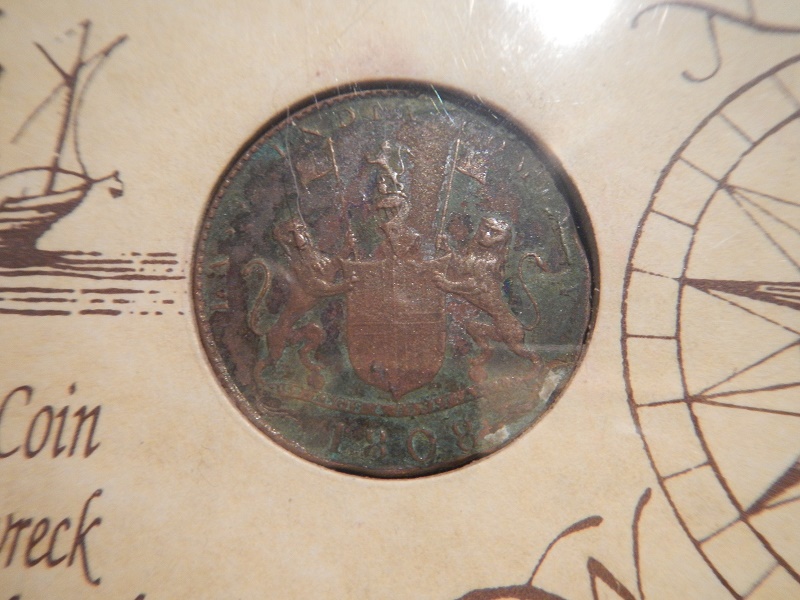
Admiral Alan Gardner, 1st Baron Gardner was a career sailor in the British Royal Navy. He is well known for negotiating during the Mutiny at Spithead in 1797, and introducing lemon juice to prevent scurvy. He had a East Indiaman named after him, which was built in 1796, and sank on the Goodwin Sands in 1809. There were a large amount of coins which were stored in tightly sealed barrels on board. They were recovered in 1986, and examples like these two, were sold to the general public. They were mounted in plastic containers with nice graphics, and the back story of the Admiral Gardner. They also came with COA’s.gardnercoin1-1 gardnercoin1-2 gardnercoin1-3 gardnercoin1-4 gardnercoin1-5 gardnercoin2-1 gardnercoin2-2 gardnercoin2-3 gardnercoin2-4

Moving away from coins, we move to this item from the SS Larchmont. The SS Larchmont was built in 1885 at Bath, Maine. It was a 252 foot long steamer that sailed from New York to Providence, Rhode Island. February 11, 1907, Larchmont collided with the Harry P. Knowles in a blizzard, and sank in 10 minutes. Between 10 and 19 people of the over 200 people on board survived. This brass item was pulled from the wreck site, and has been mounted to a wooden base with a brass plaque on it. I’m not sure what exactly it is.larchmont1 larchmont4 larchmont3 larchmont2 larchmont5

No other shipwreck is as well known and has inspired so much intrigue as the Titanic. Launched in 1912, and ironically, despite the fact that it was lauded as being “unsinkable,” it sank during its first voyage. While the ship and most of the heavier items sank to the bottom of the Atlantic Ocean, lighter items, such as wooden items floated and drifted for a while. This small sliver of wood was found during the search for survivors.titanic-wood1 titanic-wood2

In 1985, Jean-Louis Michel of IFREMER and Robert Ballard of the Woods Hole Oceanographic Institution found the wreckage of the Titanic at the bottom of the sea. Since his initial discovery, many artifacts have been recovered, including this piece of coal, which was sold at the Titanic artifact exhibition tour.titanic-coal1 titanic-coal2

Next week, we look at a remnant from a once-promising career.

The Signature of the Man Who Changed Fried Chicken Forever

sandersBy David G. Firestone

Going off topic today, but I’ve wanted to do this for a while. September 18 1968, was an uneventful day during an eventful year. While the rest of America listened to Harper Valley PTA, red Testimony of Two Men, or watched Hang ‘Em High, one lucky person got to meet, and get an autograph from a man who changed the face of fast food, fried chicken, and the cooking industry, all at the same time.

Even if you’ve never eaten at KFC, you know that Col. Harland Sanders founded the company, and came up with the famous “Secret Recipe.” You might not know that he was a jack of all trades prior to KFC. He was a military man, a railroad man, an amateur lawyer, an insurance sales man, a ferryboat operator, and, by 1930, a Shell gas station attendant in Corbin, Kentucky. That Shell gas station was the best thing to ever happen to Harland Sanders, but at the time, he didn’t know it. He served food, including his chicken, country ham, and steaks in the living quarters of the service station.

Sanders’ temper was well documented, having lost no fewer than three jobs due to disagreements or brawls with people, including one in a courtroom during his law practice. During an encounter with Matt Stewart, a competitor, a shootout took place. The story goes like this, Sanders painted an advertising sign to lure more customers to his station, which enraged Smith, who painted over Sanders’ sign. Sanders and two Shell officials caught Smith in the act, and the shootout occurred. Smith was shot in the shoulder, and wound up killing one of the Shell officials. Smith was sent to prison for murder, and Sanders had the market all to himself. Around that same time, Sanders was named a “Kentucky Colonel,” and was recommissioned one in 1950. He began to call himself Colonel Sanders, and the name stuck.

During the World War 2, he was worked as a supervisor in Seattle, and later ran government cafeterias. He had already perfected his now legendary “Secret Recipe” and discovered that frying in a pressure cooker made the chicken more moist and flavorful than pan frying. After the war, he returned to his kitchen, and in 1952, franchised his chicken to Pete Harman of South Salt Lake, Utah. A sign panted named Don Anderson came up with the name “Kentucky Fried Chicken” for the new Utah restaurant. This would be a turning point, as Sanders, who had failed at most of his businesses, found the recipe for success, no pun intended…he just didn’t know it yet.

In 1956, he sold the Corbin Restaurant that he had called home for so long. Realizing he needed money, he started his quest to franchise Kentucky Fried Chicken. Initially, it was slow going, but people began to see that Kentucky Fried Chicken would work, and, by the 1960’s, over 600 locations had opened, in the US, Canada, England, and Mexico. In 1964, an aging Sanders could not handle the stress of managing the restaurants, and sold Kentucky Fried Chicken to John Brown, and Jack Massey for $2 million, over $15 million in 2016 dollars.

Sanders was the mascot of KFC, and continued to appear on packaging, and advertising. Sanders himself wore the white suit and black string tie which he would forever be associated with. Sanders was, in real life, a foul-mouthed control freak, who would visit franchises to make sure that the chicken was being prepared correctly, and would snap if he found that it wasn’t. He remained active, even after being diagnosed with acute leukemia, and was active until his death from pneumonia on December 16, 1980, at the age of 90.

On that rather uneventful day, September 18, 1968, someone met Col. Harland Sanders, and got his autograph.sandersTorn from, appropriately enough, a chicken advertisement, this 7 inch long piece of paper was signed by Sanders, “Sincerely, Col Harland Sanders, 9/18/1964.” While the paper has aged with time, but the signature is still bold. It also looks as though there was something else written, either by Sanders, or an unknown hand, as at the top right corner, there is an underlined S. What was written, has been lost to history.

Next week, I will examine some unique items from the bottom of the sea.

Race Rock…Not the Musical Kind

racerockBy David G. Firestone

I’ve talked about the promotional advantages of driver suits and racing suits before. True, a racing sponsorship can pay a lot of dividends. According to this article from Fox, “A new study conducted jointly by the Los Angeles-based media agency Wasserman and Buffalo, New York-based Nervve showed that Denny Hamlin’s Daytona 500 victory was worth $1.9 million in earned media value for his primary sponsor, FedEx.”

But where racing suit design differs than regular work design is that the sponsor or team can design the suit in ways which most normal companies wouldn’t be able to. Denny Hamlin’s suit can be designed for maximum sponsor exposure. While Denny for some reason doesn’t wear TV logos on the sleeves, if any FedEx employee were asked to wear a uniform similar to Denny’s suit or the teams pit shirts, the company would be a laughing stock.

While racing suit design for promotional appeal is a new concept in marketing, mechanics in auto racing have been around since day one. Mechanics make the cars run, and keep them running. They have to work on cars and wear special clothes, as the fluids in the car can ruin most street clothes. This Race Rock Racing team suit is a perfect example of the fusion of both.racerockAs much as I have searched, I haven’t been able to find any information on Race Rock as an auto racing team. However, they were apparently a racing team. This suit was a mechanics suit designed for them. The suit is made from Jupiter, Florida based RJ’s Racing Equipment. It feels like it’s a single layer of Nomex, but could also be polyester. It isn’t SFI certified.

The front has a CART patch and RACE ROCK RACING TEAM embroidered into the chest,a checkered flag stripe, and a yellow stripe across the chest with a PPG patch and a BILSTEN SHOCK ABSORBERS patch sewn into the yellow stripe.racerock-rchest racerock-lchest racerock-flogoThe belt, and legs are unadorned.racerock-belt racerock-legs

The shoulders have yellow unadorned epaulets, racerock-rshoulder racerock-lshoulderand short sleeves with MOPAR PERFORMANCE RACING TEAM and CHAMPION SPARK PLUG patches on the right sleeve, and VALVOLINE RACING and HOLLEY patches on the left sleeve.racerock-rsleeve racerock-lsleeveThe back of the suit has a giant RACE ROCK RACE TEAM logo embroidered into it. Other than that, there are no designs present at all.racerockb racerock-blogoWhile racing has been used as a promotional tools for decades, the innovation of the driver suit as a promotional tool is something that has taken the racing world by storm. Hell, you wouldn’t be reading this if you didn’t find racing suit design interesting, and I wouldn’t be writing it. Next week, we will look at the signature of an innovator who created a product known throughout the world, and revolutionized a whole industry.

When is a Paint Scheme Not a Paint Scheme?

buecherwrap-1By David G. Firestone

Although the commonly used term is “paint scheme,” paint rarely, if ever is used on the sides of cars. What is used is vinyl wrap. The schemes are printed on vinyl, and then applied to the car. This saves time, and weight. It also makes the complex schemes of today possible. Here is video of Kyle Busch’s 2013 M&M’s Toyota Camry having the wrap applied…

There are a number of places that will supply wraps, the biggest, and most well known is Pro Cal Professional Decals. Located in Concord, North Carolina, Pro Cal supplies vinyl wraps to many teams, including Roush Fewnay Racing, Hendrick Motorsports, Chip Ganassi, Richard Petty Motorsports, Stewart-Haas Racing, Richard Childress Racing, Kalitta Motorsports, and KB Racing Technologies. Pro Cal also does commercial vehicle wraps and signage.

I was able to get my hands on one example of a vinyl wrap, this Chris Buescher side from the 2014 Buckle Up 200 Pres. by Click It or Ticket at Dover on Saturday, May 31, 2014. Buescher raced the #60 Ford Eco-Boost Ford Mustang to an 8th place finish. This is a spare vinyl side from the car he raced that day.buecherwrap-1 buecherwrap-2I’m not sure why this wasn’t used, I’m thinking that the black that has rubbed on the side was why Roush Fenway rejected it. The wrap itself is huge, over 10 feet long, and about 4 feet high. It has 3M adhesive on the back to attach it to the car. It has additional decals for the door numbers, posts, and front of the car. buecherwrap-3 buecherwrap-4 buecherwrap-5 buecherwrap-6 buecherwrap-7 buecherwrap-8There are also decals to add some of the stripes. It also comes with a squeegee made by Lidco Products, a Saint Paul, Minnesota based squeegee company.buecherwrap-9 buecherwrap-10While the majority of NASCAR uses vinyl decals, we still call them paint schemes. The term “vinyl scheme” doesn’t sound as good. No matter what technologies we use to design a car, we will call them a paint scheme.

Next week I’m going to examine an odd racing suit.

John “Shorty” Miller Helps Explain a Logical Fallacy Away

shorty-1By David G. Firestone

I started watching 10 Things in Tucson. For those who don’t know, 10 Things is a show staring comedian Jamie Lee, and it discusses 10 Things you might not know. In one particular episode, I got really upset. The discussion concerns the fact that NASCAR doesn’t require a driver’s license to race. Jamie could not wrap her mind around the fact that NASCAR drivers don’t need a driver’s license to race.

What she and the writers glazed over is the fact that that NASCAR and almost all racing sanctioning bodies issue “competitor licenses.” Competitor licenses are significantly harder to obtain than a standard driver’s license, and the sanctioning bodies make the rules for obtaining them difficult on purpose, so that the average joe can’t buy a race car on eBay, and drive it in a race. As you get higher and higher in the racing ranks, the requirements become stricter, and harder to obtain.

This is not a new phenomenon. This goes back to the 1960’s. As time has worn on, the need for such regulation has become paramount, as auto racing has grown in popularity over the last 30 years. Many fans would love to race with their favorite drivers, but the fact is that due to their lack of experience and skill, this could cause a lot of problems. Race car drivers have skills capabilities that the average joe could only dream of having, and the competitor license makes sure that those who can do, and those who can’t watch.

John “Shorty” Miller was a NASCAR and ARCA competitor in the 1960’s and 1970’s. He was one of the founders of the Dayton Auto Racing Fan Club, or DARF, and is in the DARF Hall of Fame. In 1976, he was involved with ARCA, and was issued this license.shorty-1This ARCA license is slightly bigger than a regular driver’s license, is two sides, and folds in half. Issued on December 14, 1974, the license states that “The undersigned hereby acknowledges that he is familiar with, and agrees to abide by the rules and regulations of the Automobile Racing Club of America Inc. in all competitive events sponsored by ARCA. This license is non transferable and is revocable for cause by the Automobile Racing Club of America Inc. It is further agreed that all decisions of the Commission will be final.” It is then signed by Miller, and an ARCA Secretary.shorty-1 shorty-2\The license also comes with two copies of the “Competitor Liaison Bureau Summary of Plan Explanation and Limitations” which discusses the insurance payouts for accidental death or injury if said driver is killed or injured in an ARCA event.shorty-4 shorty-3It also comes with a copy of the 1976 ARCA Rule Book, which contains 12 pages of rules, which covers a lot of ground, but leaves so much open, it’s not funny.shorty-5 shorty-6 shorty-17 shorty-16 shorty-15 shorty-14 shorty-13 shorty-12 shorty-11 shorty-10 shorty-9 shorty-8 shorty-7 shorty-18The competitor license is a necessary tool to make sure that the drivers are capable of racing. That’s why they are hard to get. Next week, we will discuss something that is very easy to get.

One of the Greatest Families in Drag Racing

pedregon-1By David G. Firestone

When “Flaming” Frank Pedregon passed away in 1981, he had no idea his sons would become some of the most respected drivers in Funny Car. Fast forward to 2016, and one son Tony has 43 event wins, third on the all time win list, and two championships, and the other Cruz has 33, and two championships, including the only Funny Car championship not won by John Force. The Pedregons have gone down as one the greatest families in the history of drag racing.

The first brother to have real success in Funny Car was Cruz. He started racing in 1987 in a top alcohol dragster, moved to top alcohol funny car, then to top fuel in 1991, and in 1992 won the Funny Car championship. The biggest rivalry in drag racing in the 1990’s was John Force vs. Cruz Pedregon. Both were driving Pontiac Firebirds for a while, with Cruz driving this Interstate Batteries/Hot Rod car, represented by this 1/32 die-cast.pedregon-1 pedregon-2 pedregon-3 pedregon-4 pedregon-5 pedregon-6 pedregon-8 pedregon-9 pedregon-10 pedregon-11John Force was not going to be denied, and decided to get in Cruz’s head by hiring Tony as a driver. By 1993, both Pedregon brothers were racing in full time funny cars Tony and John did not have the best of relationships. Both John and Tony were racing the same design car, but Tony would have to, on occasion, throw a race for John. This is a 1:24 scale mock-up of his Castol funny car from his days with John Force.tpedregon-1 tpedregon-2 tpedregon-4 tpedregon-5 tpedregon-6 tpedregon-7 tpedregon-8 tpedregon-9 tpedregon-10 tpedregon-11In 1998, Tony won 2 events, one at Texas, the other at Denver. During that season, he wore these Simpson Holeshot drag boots.pedregonboots-1These boots are unlike most racing shoes because they are designed to cover both the shoe, and the end of the leg of the driver suit. Why would funny car drivers wear such boots? Well, to answer that, let’s look at the design of the inside of a funny car. This is a Ron Capps diecast, but it shows how the car is set up.capps-15The driver sits almost on top of the rear axle, with the 10,000 horsepower engine, and nitromethane fuel tank directly in front. Should there be an engine explosion, which isn’t uncommon, the fire would blow back into the driver. There are firewalls in place, but those can’t always be counted on to protect the driver from the full effects of fire in the time it takes to get a funny car stops. That’s where these boots come in. They will give that little extra bit of help to the driver in exiting the car.pedregonboots-1 pedregonboots-2 pedregonboots-3 pedregonboots-5 pedregonboots-7 pedregonboots-9They are rated 15, not bad for 1998 standards, but would have a 20 rating in 2016. Both boots have been signed by Pedregon and he added the inscription “’98.”pedregonboots-4 pedregonboots-8Both have Simpson warranty tags, and the right boot has an SFI tag 3/3 tag.pedregonboots-6 pedregonboots-10 pedregonboots-11In 2002, the Pedregon brothers formed Cruz Pedregon Racing, Inc., and both have had driver duties. This visor was used by one of the brothers, and autographed by both. It’s designed for a Simpson Bandit-style helmet. The Pedregon brothers didn’t use “The Clydesdale Effect” with this visor.pedregonvisor-1 pedregonvisor-2 pedregonvisor-3The last item is a parachute bag used by Frank Pedregon Jr. It’s designed to hold the parachute on the back of the car, and was from the car when Frank hit Scotty Canon.pedregonbag-1 pedregonbag-6 pedregonbag-5 pedregonbag-4 pedregonbag-3 pedregonbag-2The Pedregon brothers are unique individuals in the history of the NHRA. Next week, we will look at some stuff from one of the most unique characters in the history of ARCA.

Gripping the Wheel With James Buescher

bueschergloves-1By David G. Firestone

While I like to analyze driver suits, as you all know, I like collecting and analyzing many other kinds of racing memorabilia, and uniform items. I’m not discriminatory on which series I collect, and I’ll take a chance with anything. This pair of James Buescher race-used and signed gloves are an example of one of those items.

Buescher is the 2012 Camping World Truck Series Champion, who has won 6 races in his career. He’s transitioned to the Xfinity Series as well. He won the 2012 DRIVE4COPD 300 at Daytona, which was notable for Danica Patrick wining the pole, and the huge wreck on the last lap. Those successes, along with some success in the ARCA Racing Series, means he will be in the Sprint Cup within the next few years. These are a pair of his race-used gloves.bueschergloves-1 bueschergloves2It’s not easy to figure out when these gloves were used, but a little video research can go a long way. Based on my research, I can safely say that these gloves were used before 2011, possibly after, as video footage and photograph research clearly show Buescher wearing this style of gloves in 2010, but switching to a different design in 2011. I’ll give Buescher credit where credit is due, he was really good with glove color matching sponsors. Since there are a number of sponsors using this color scheme, it doesn’t seem too far fetched that they were used post-2010.

The gloves themselves are a pair of Simpson Competitor gloves, size Large. The gloves are in great condition. They both meet SFI 3.3/5 Requirements, which will protect Buescher from 2nd degree burns for 10 seconds. They are black, with yellow accents.bueschergloves-3 bueschergloves-7 The grips on the palms are yellow, and have Simpson logos on them.bueschergloves-6 bueschergloves-10

The hems have SFI Certification as well as size tags.bueschergloves-5 bueschergloves-9Buescher has signed both gloves, with the inscription “31.”bueschergloves-4 bueschergloves-8James Buescher, along with his older brother Chris are both NASCAR champions. Next week, we’ll look at a series of memorabilia from another group of championship winning brothers…

A Hidden Treasure in Tucson

2016-2-4-franklinautomuseum-51By David G. Firestone

Tucked away in Tucson, hidden on an unpaved road, is a museum that every car guy should see before he dies. It’s a museum devoted to a unique marque of automobile, one so rare, most people have never heard of it. I’m speaking of the Franklin Auto Museum. It’s devoted to the Franklin Automobile Company, which existed from 1904 to 1934, producing some of the most luxurious and innovative cars to date.

The H. H. Franklin Manufacturing Company was founded by H. H, Franklin in 1893 as a die casting manufacturer. In 1900, they expanded in to the automobile industry with the aquision of the talents of John Wilkinson, an engine designed. In 1902, the first Franklin Motor Car was built. By 1904, Franklin was a full-fledged automobile manufacturer.

Franklin cars were advanced, with air-cooled engines, constant level carburetors, and made use of a 4 cylinder straight engine. As time progressed, they shifted from 4 cylinder straight to a V-12 engine, which their aircraft engine subsidiary was innovative in making. Franklin focused on luxury models, often costing significantly more than other models. This focus was the main design aspect of most of their cars. A Franklin was somewhat of a status symbol, but as the economy began to fall, the sales slowed, money was lost, and, by 1934, after 30 years, the company ceased production of cars. Their aircraft engine production continued until 1975, when it was sold to the Government of Poland, and all operations were moved to Poland, where it operates to this day.

One of the children who was driven around in a Franklin was Thomas Hubbard, who was such a fan of Franklins, he would restore them for collectors. He began to buy and restore them for himself. His collection grew, and, as he began to grow older, decided that he should open a museum devoted to the history of the Franklin Automobile Company. After he passed away, that museum opened, and continues to operate to this day.

The collection is very impressive, with examples ranging from 1904, to one of the last cars ever sold in 1934. Three buildings make up the complex. The first one features many of the later models, including this yellow 1925 coupe with a rumble seat, 2016-2-4-franklinautomuseum-4 2016-2-4-franklinautomuseum-5 2016-2-4-franklinautomuseum-3one of the few 1934 Franklins in existence, 2016-2-4-franklinautomuseum-16 2016-2-4--franklinautomuseum-15to H.H. Franklin’s car that he used in New York, complete with remnants from restoration.2016-2-4-franklinautomuseum-51 2016-2-4-franklinautomuseum-49 2016-2-4-franklinautomuseum-50The second building resembles a traditional garage, and has some of the newer cars, and some of the older cars, including this 1933 Olympic Coupe,2016-2-4-franklinautomuseum-24 2016-2-4-franklinautomuseum-25 2016-2-4-franklinautomuseum-23this 1934 Sedan with matching luggage,2016-2-4-franklinautomuseum-21 2016-2-4-franklinautomuseum-22 2016-2-4-franklinautomuseum-20and this 1946 Lincoln V-12 Coupe, which is for sale for $26,500. 2016-2-4-franklinautomuseum-33 2016-2-4-franklinautomuseum-34 2016-2-4-franklinautomuseum-35The third building features many of the really old cars, some as old as 1904. This was my favorite room, as many of the designs are so contradictory to car designs today, that it stunned me that people would willing to drive them.

This is a perfect example of one of those cars, a 1909 Model XD Touring Sedan, which was designed by Ransom E. Olds, who would later go on to found Oldsmobile. It’s a quaint looking car, that was designed before it was decided which is the driver side. 2016-2-4-franklinautomuseum-63 2016-2-4-franklinautomuseum-62The musuem also has a number of hidden treasures and vintage items, such as this vintage Dixie gas pump,2016-2-4-franklinautomuseum-6and this old stock ticker.2016-2-4-franklinautomuseum-65There are too many amazing things to list, so here is a slide show.

The museum is open from Mid October to Memorial Day, Wednesday through Saturday, 10am to 4pm. Admission is $10 for adults, $8 for Seniors, $5 for teenagers and students, and free for those under 12. This is the video of my tour, and I highly recommend that you take the tour as well.

Next week, we go back to racing, with something worn by a former NASCAR champion…

My Travels to Tucson

2016-2-2-mine-9By David G. Firestone

My parents have a condo in Tucson, Arizona, so every winter, I leave the bitter cold of Chicago for a week, and take my base of operations from “The Hauler,” which is my new nickname for my office, to Tucson. I love living in Chicago, but the cold during winter can be too much. Each year, we look for things to do in Tucson that I can’t do in Chicago. Last year, I went to the Pima Air and Space Museum, and the Penske Racing Museum. The year before that, I went to the Titan Missile Museum.

This year, I had three specific goals. I wanted to go to the Asarco Mineral Discovery Center, The Dragoon Brewery, and the Franklin Auto Museum. I also, as always, wanted to have some great Southwestern food. I got all three done, and then some!

I took Amtrak’s Texas Eagle down, as I always do. It’s a three day trip, and this year, I upgraded to a “Superliner Roomette” which is my own small room. It was well worth the price, where I have my own little private room, a whole bed, instead of a reclining seat, and a giant picture window.2016-1-29-amtrak-6 Meals are included, so I didn’t have to pay for food for the entire trip, and I have to say, the food was great.2016-1-29-amtrak-7 2016-1-29-amtrak-8I got in on Sunday, and met up with my parents, had dinner, and got back to sleep. Monday was spent puttering around. On Tuesday, we went to the ASARCO Mineral Discovery Center. It’s a small museum and tour of the ASARCO Mission Mine. Mission Mine is an open pit mine in Pima, Arizona. According to ASARCO “Each year the mine has the capacity to process about 260,000 tons of copper concentrates which yields 132,700,000 pounds of copper and 1,234,000 ounces of silver.” The tour is about an hour long, and it goes into detail into how the mine takes copper ore, which looks like this:IMG_0793and turns it into 99.999% pure copper, the percentage needed for electrical wiring, which looks like this:IMG_0794We drove around the mine area in a tour bus, and passed by the pit. 2016-2-2-mine-7There is a small area for the tour, which features a giant tire for photos. I’m 6’1” and that tire makes me look small. 2016-2-2-mine-9There is an overlook area for the tour group, and it is REALLY far away from the mine. 2016-2-2-mine-8See those two dump trucks circled? Those are 51 feet long, 30 feet wide, and 24 feet tall! Then you go to the south mill, where the ore is ground down to the required size, and extracted using the flotation system. 2016-2-2-mine-1 2016-2-2-mine-2 2016-2-2-mine-3 2016-2-2-mine-4 2016-2-2-mine-5 2016-2-2-mine-13 2016-2-2-mine-6Pine oil is used to help separated the copper from the ore, so the whole area smells like pine oil, which isn’t a bad smell at all.

Once you get back, you can wander around the small outdoor exhibit area, and see various artifacts from the history of Arizona mining. 2016-2-2-mine-17 2016-2-2-mine-28 2016-2-2-mine-27 2016-2-2-mine-26 2016-2-2-mine-25 2016-2-2-mine-24 2016-2-2-mine-23 2016-2-2-mine-22 2016-2-2-mine-21 2016-2-2-mine-20 2016-2-2-mine-19 2016-2-2-mine-18We then went to the Desert Diamond Casino for lunch, and went home. We then went out to celebrate my mom’s birthday that night for dinner.

Wednesday, we went to the Dragoon Brewing Company taproom. 2016-2-3-dragoon-2I spend the afternoon trying different kinds of their beer. I tried the Stronghold Session American mild, which a little bitter for my taste. The Biere Del Bac is a Belgian-style quad, and I had that and a brandy barrel-aged version. The best by far was the Scout Porter, which is a mesquite-smoked porter. 2016-2-3-dragoon-3I wound up buying a 32 ounce can, which I downed after dinner. 2016-2-3-dragoon-8I also got a couple of pictures of the taproom, and the fermenters. 2016-2-3-dragoon-4 2016-2-3-dragoon-5 2016-2-3-dragoon-7For dinner, I had some damn good barbecue at Brush Fire, where I had some brisket and pork bellies with Sweet-n-Bold sauce. 2016-2-3-brushfire-1 2016-2-3-brushfire-2 2016-2-3-brushfire-3On Thursday, I went to the Franklin Auto Museum, but I’m gonna save that for next week…stay tuned!

The Infinite Hero Foundation-A Great Cause, and a Great Driver!

beckman-1By David G. Firestone

Editor’s Note: I will be traveling to Tucson, Arizona this week, and I’m getting ready to fly for the first time in 11 years as you read this. I will have the Friday Feature and Throwback Thursday items next week, but no tracker or grades. In the meantime, here is my Friday Feature for the week.
I wrote about the Infinite Hero Challenge Coin program last year, and I’m going to revisit it. I’ve learned some more information about Infinite Hero Coins, that I didn’t have before, so I’m going to add this new info, for the sake of completeness.

Infinite Hero quickly realized that Oakley was a great partner, and began working with them to come up with some unique merchandise as a part of the partnership. The Infinite Hero Foundation was founded in 2011, and quickly acquired a partnership with Oakley. This resulted in a series of merchandise items sold by Oakley, with proceeds going to help the Foundation.

I’m not into sunglasses myself, but many people are, and Oakley has a lot of fanboys. So, once these glasses began to hit shelves, they sold quickly. This is a review from 4 years ago, of one such pair.

Notice the coin in the box? Of course you did. Aside from glasses and boots, Oakley realized that the coin would sell too. So sometime, I’m guessing 2012-2013, this coin was sold.ihc-2013-1It is quite thick, and has a ridged edge. One side featured “Courage, Honor, Virtue, Heroism,” around a globe design with an Oakley logo. Oakley is a partner with the Infinite Hero Foundation. The other side features an Infinite hero Foundation logo. The coin was placed in a round, flat plastic container, with black foam braces. The coin lacks the blue enamel that the coin that comes with the glasses coin, and future coins, and has a very plain look. I do like the plain look.ihc-2013-1 ihc-2013-2 ihc-2013-3 ihc-2013-4In April 2014, they started appearing on the side of Jack Beckman’s funny car.  Terry Chandler, who also sponsors Tommy Johnson Jr.’s Make a Wish Foundation Funny Car, is the financial backer of the car.  She pays for Infinite Hero to race on the sides of the car.  This also began the NHRA coin program. This is a new form of racing memorabilia I have never seen before, though it’s a great idea. When Jack Beckman gets into his funny car to race, he carries at least 5 Infinite Hero Challenge Coins in the pocket of his driver suit. Once the race is over, he will autograph them and sell them at the track and on eBay. They cost $100 with all proceeds going to the Infinite Hero Foundation.

The idea of items carried in a pocket is not a new one. NASA has done this for years. Many space shuttle flights carried first day covers in the storage bay. When the shuttle landed, the covers were removed, and sold to collectors. I’m a little surprised this hasn’t been done before with auto racing, because I think that it would create a new memorabilia market.

The 2014 design that Jack used was identical to the one sold in stores, but the Infinite Hero Foundation logo has a purple enamel present. Jack autographed the plastic case.ihc-2014-1 ihc-2014-3 ihc-2014-2 ihc-2014-4A redesigned coin of the same size was introduced for 2015. The Oakley logos are gone. One side features a design similar to the globe design, but the globe design has been replaced with an American Flag design. “Courage, Honor, Virtue, Heroism” has been replaced with “Duty, Honor, Innovation, Courage.” The new emblem on the reverse side has one of the across bands removed. The new packaging is an upgrade, with the circular plastic cylinder replaced with an attractive box. It comes with a card that Jack Beckman autographed, and on the reverse it has the Infinite Hero Foundation Pledge. The first one is from The CARQUEST Auto Parts NHRA Nationals at Phoenix on February 22, 2015, where Jack was eliminated in the first round. ihc-2015-2 ihc-2015-3 ihc-2015-4 ihc-2015-5 ihc-2015-6 ihc-2015-7The second one is from the Summit Racing Equipment NHRA Nationals in Norwalk, Ohio, where Beckman won the event, beating Courtney Force in the final round.ihc-2015-2-1 ihc-2015-2-7 ihc-2015-2-6 ihc-2015-2-5 ihc-2015-2-4 ihc-2015-2-3 ihc-2015-2-2The Infinite Hero Foundation is a worthwhile charity, designed to help our nations veterans. I fully support them, and I encourage my readers to try and buy at least one of these coins. Jack Beckman is a great spokesman for the Infinite Hero Foundation. I reached out to him for an interview about his racing uniforms, and he happily obliged…

DGF-Could you explain, from a driver’s perspective, how you want your suit to fit?

JB-It really depends on the kind of vehicle you are driving. Top Fuel dragsters you are more sitting on the ground, funny cars you are sitting more upright. Sponsors want their logos front and center, so we have to work around that. I also don’t like my suit to be too baggy, because when they put the seven point harness on, it will fold over.

DGF-You wear an SFI 20 rated suit, how many layers of Nomex does your suit have?

JB-Well, the SFI rating is only based on how long the suit will protect the wearer. In testing, a 20 rated suit will protect the wearer for up to, I think, 40 seconds, and that is based on how long it takes the mannequin in the testing facility to sense the fire. Older generations of suit would need 12 layers to do what the new materials could to in 6 or 7 layers. If there were an amazingly durable material, you could have it in one or two layers.

DGF-When a suit is burned so that the Nomex is discolored, do you feel anything?

JB-The discoloration is from the dye in the suit, but not really. The big screens and the slow motion video are astounding though. We as drivers experience it in the moment, but watching it on the big screen, you see so many more things than you never would notice otherwise. When the body gets lifted during the explosion, the firewall that’s to shield the fire coming back from the engine is no longer there. Then you can feel it get warm. But the materials today and the construction of the suit, they’re just light years better than one and two generations ago, to the point that I don’t ever want to say that there’s a “routine fire” but you could have one that looks pretty darn impressive on the big screen, and get out of the car 100% unscathed.

DGF-My next question, it’s a hypothetical one, but it is one I think I need to ask, For most of your career, you have worn Impact driver suits. If you were to switch manufacturers, let’s say to Simpson, would you be able to notice the difference?

JB-Hmm…interesting question. If they are using different materials, maybe. The older style Impact suits, when I first started running funny car in 2006, were much stiffer, it was a different material, it was bulkier, more constrictive. I believe, along manufacturers lines, you might still have a choice of material there. The construction methods are all very similar, and sizing, it’s an individual thing. You can check a box on your order form that says “small” “medium” or “large,” or you can send them custom measurements and they’ll build it to that. So I don’t think you would notice with the newest light weight material for manufacturer to manufacturer. That said, you’d have to stick me in a room with a blind fold, and have me try on every men’s suit so I could give you an answer with some authority.

DGF-Along those same lines, would you have any concerns going into the switch?

JB-Well they all have to meet the same criteria. Here’s the thing, the NHRA rule book mandates a minimum amount of protection. When they tell you, if you drive a fuel funny car, you need a 3.2-20 suit, which includes a certain spec of gloves and over-boot worn on top of your driver shoes. They don’t tell you that you have to wear thermal underwear underneath. Up until 4 years ago, they didn’t tell you that you needed to wear a head sock under your helmet. You don’t have to wear inner-liner gloves under your fire gloves. I wear all that stuff. So it’s up to the driver if they want more protection than the minimum.

The fire suit manufacturers have to prove that their equipment satisfies a certain spec. There is no spec higher for drag racing that the 20. But it’s possible that some of the suit manufacturers make them to a higher level spec. I’ve been in some pretty big fires, and have walked away, I singed my eyebrow once, when the concussion blew my visor up on the helmet. Aside from that, I have had zero injuries, which gives me a lot of confidence in the equipment I wear. I feel that I have tested several times, and it’s passed with flying colors every time. Now the other manufacturers have to meet that same spec.

DGF-Do you, over the course of an event, wear the same suit for every run, or do you switch them out occasionally?

-Typically at the beginning of the year, we will have two suits constructed, just in case one gets in a fire, and gets disfigured. I had a sleeve changed out, and it wasn’t a safety issue, it had melted some of the sponsor logos. Typically, I won’t switch suits until we get to The Countdown, because the funny car suits tend to get run down, and dirty from the continual clutch dust, run after run. I just want a fresh looking suit for the photo shoot, once I get to The Countdown. Then I’ll save the suit I wore for the first 18 races as a backup suit. I will wear the same suit the whole weekend long. The only thing I rotate out over the course of a weekend are the thermal underwear and the head sock because once I get out of the car, they’re sweaty, and I’ll hang them up to dry, and put fresh ones on for the next run, and keep rotating them.

DGF-When you are getting into your uniform prior to a run, start to finish, how long does it take to get everything on?

JB-It’s no longer…getting suited up is really no longer than getting street clothes on. I’ve got thermal underwear, top and bottom, so that would be like putting on underwear and a t-shirt. I’ve got my driving shoes…I’m sorry, I put on my firesuit, driving shoes, my over-boots-so it’s almost like a pair of slip-om rain galoshes over your tennis shoes. The thing that’s a little more time consuming is once your getting ready to get into the car, is getting the head sock on, getting that tucked down into the collar of the jacket, my helmet on, and strapped. I wear glasses, so I put those on. Inner gloves have to go on, outer gloves have to go on. I’ve got to walk over to the car, duck down underneath, get in, and then, the 7-way harnesses, as well as the fact that I’m wearing a head and neck protection device, they make it really tight, once you are in the cockpit, and the crew guys are working in some pretty constrictive spaces. The body’s still on the car, so they’re ducking under that. You’ve got this bulky firesuit, so you’re taking up most of the cockpit. They’re getting these straps laid out on you, they gotta plug the radio in, plug the air hose into the helmet, get all the straps buckled in, then get you tightened, so that can take a good amount of time, but I’ll tell you, you get in a pretty good rhythm with this thing.

I typically get suited up and walk over to the car five pairs from when we run. If we were pinched for time, we could do it with two pairs to go. But I don’t like to do that for a couple of reasons. The first one is that you just hate to feel rushed, but I’m okay with that, psychologically it doesn’t affect me. I don’t like doing that to the crew guys because typically, once they’ve got me strapped into the car, they’ve got a couple other tasks that they need to do as we’re towing up to the starting line. I don’t want to rush them, and have them feel any extra anxiety about the things they need to get done.

DGF-Alright, you mentioned gloves, shoes, and over-boots, how long do those items typically last over the course of a season?

JB-I’ll typically put my firesuit on with my driving shoes, and my boots on in the tow vehicle, I’ll walk up to the starting line, inspect things, walk back to the tow rig, so I’ll put a couple of miles a year on my driving shoes. The only thing that wears them out, as you can imagine, is the sole if you walk enough steps. Other than that, you can get a full season out of them. The over-boots, it really depends. If you have a fire, since they’re typically near the source of the fire, I would replace them after that. They get pretty beat up with the clutch dust on them, and blowing them out run after run, so I’ll typically use two pairs of them over the course of a season. Same thing with the gloves. Putting them on and off is what eventually wears them out. I like wearing the tight gloves which means the crew guy is rolling them up, stretching them over my hand, pulling them back down over the cuff of the firesuit, and that takes its toll on them. We’ll make 170 runs over the course of a year, so after 100 runs, it’s usually time to replace those.

DGF-I’d like to talk about your helmet visor for a second, because I’ve noticed that there are a lot of drivers who black out part of their visors to create tunnel vision, so they can only focus on their lane. Are you one of those drivers?

JB-The Clydesdale Effect? Like blinding the horses so they don’t get spooked? No, I’ve tried that in the past, and I’m a big proponent of doing anything that you think will make you perform better. If you think a red glove will make you drive better than a blue glove, it will. It’s psychological more than it’s mechanical. There is definitely a value in removing distractions, when you get up to the starting line. But to do that, you’d better have three visors prepared. Let’s say you wear a clear visor, and the helmet rolls out of the tow vehicle in the staging lane, and the visor gets scratched. You’d better have another clear visor, with the blinders in place. Because if you swap it out for one without them, that’s gonna screw you up, probably, right? You did it for psychological purposes, and now somethings change. Ponoma is a track where we really face, Sonoma it happens too, but Ponoma is probably the worst, we get very high glare conditions, and you have to go to a dark visor. So you’d better have a dark visor prepared for that, and a clear one ready to go in case the clouds come in. So I’m fine with that. I feel like whatever a driver needs to do to keep them in a mental zone, where their performance is at a top level. That’s not to say in two years, I might decide that that works better for me. I’ve tried yellow visors, clear visors, light tint, dark tint, glasses, no glasses, and the reality is that I’m pretty much the same without them. But I do the one that I feel like, removes the most distractions, and therefore, puts me at a higher level of focus.

DGF-Alright Jack, this is my last question. I’m a memorabilia guy, and do you keep uniforms, or other items from special moments in your career that have special meaning to you?

JB-Yeah, it’s funny you ask that, because my wife is so clean and organized, and not sentimental. And I don’t get to keep anything. I get some bitchin’ souvenirs from fans, and I bring them home and say “where do you think that’s gonna go?” So I’ve got a little pile of stuff there. Yes, I do keep all my helmets. I’ve only ever sold…I’m sorry, let me rephrase that, I’ve only ever…not kept…two of my helmets. One of those I gave to my good friend Ronnie Swearingen, and last I checked, it was on display, with the rest of his helmet collection at the Garlitts museum. The other one was I had a duplicate helmet painted because a gentleman really, really, REALLY liked the design, and I told him “I’m not getting rid of helmets.” He paid to have a duplicate made, and I wore it for one race. Firesuits, Schumacher gets them back at the end of the year, and puts them on eBay. But if we do multiple suits, usually I can keep one of them.

DGF-Alright Jack, thank you very much, it was an interesting interview.

JB-You know it’s interesting, I’ve done thousands of interviews, which typically means, when I do an interview not much is unique. Yours was a completely unique interview.