Formula One Month Starts With Odds and Ends

mariussadisplay-7By David G. Firestone

This week, I finally get to start Formula One Month. Formula One is the biggest auto racing sanctioning body in the world. Nobody can deny that. Races can see over 300,000 spectators at the track, and 58 million viewers on television. Teams cover over 50,000 miles in travel distance and many engineers work on the car while never leaving their race shop. The cars are more sophisticated than any other racing vehicle in the world. Formula One has proven to be the great auto racing group in the world.

The merchandise table is a key to their success. While the pricing of items is a little suspect, fans will wear their affiliations on their shirts. But as I discussed a few weeks ago, the race-used memorabilia market in F1 is significantly different than in NASCAR and the NHRA. NASCAR is very big in body pieces or “sheet metal.” The NHRA is very big in engine parts. While F1 has some of these available, they are much more pricey than their NASCAR and NHRA counter-parts. Formula One isn’t run by dumb people, they do realize that there is a demand for these items.

These items come to sale sometimes. One such way these items come to market is when a team changes names or goes belly up. While many items can be salvaged, some items can’t be, and are sold to collectors. One such example is this this Virgin Racing interview backdrop from 2011.mariussadisplay-1The backstory on this is that Virgin Racing was founded as Manor Racing, and carried a Virgin sponsorship in 2010. In 2011, Marussia Motors, a Russian sports car company bought a stake in the team, and the team was re-branded as Marussia Virgin Racing. With the new team came the inclusion of the Marussia logo into the team. Their run as a team was unimpressive one, with neither driver scoring points. The team became Marussia F1 from 2012 to 2014, when the team shut down due to financial issues. In 2015, the team was re-branded to “Manor Marussia F1 Team.” After 2015, Marussia ceased to exist, and ceased their F1 team, and the team was re-branded to Manor Racing.

This interview backdrop is a portable one, specifically made for team members or special guests to stand in front of while giving an interview. It’s almost 4 feet wide, and well over 6 feet tall. It consists of a cloth container with the backdrop inside. It’s in great condition.mariussadisplay-2 mariussadisplay-3 mariussadisplay-4 mariussadisplay-6 mariussadisplay-5It’s almost 4 feet wide, and well over 6 feet tall. It consists of a cloth container with the backdrop inside. The backdrop has a balance leg, and the cloth part rolls up. A collapsible pole holds it up. I’ve given a demonstration of the effect they are going for…mariussadisplay-7Now while F1 is not as readily selling body pieces, they do sell them. Teams will change their designs due to rule changes, and they will sell the old body pieces. What I’ve noticed is that a lot of teams will encase the pieces in Lucite or something similar. I think that this might have to do with secrecy. The teams want to make money, but they don’t want to give their hands away on what they make their cars out of. I also like the idea of a body panel in Lucite. It looks good, and makes a good fit for an office.

This Red Bull piece is one such example. redbull-1The piece is just under 2.5 inches long, and is encased in a piece of Lucite which is 3.5 inches by 3 inches by 1 inch. It’s blue, with red and white logos, and the three championships etched into the glass. The top has Infiniti Red Bull Racing etched into it. This would place it between 2013 and 2015. It comes with a small COA and a small blue pouch. Other than that, there is no information about when it was used, or who by.redbull-2 redbull-3 redbull-4 redbull-5 redbull-6 redbull-7 redbull-8I get that the limited number of engines used by an F1 team, and the restrictions on how many parts can be used limit what could be sold, but there is a genuine market for these parts. I’m also wondering why F1 doesn’t market race-used tires. That would be a gold mine for F1, Perelli, and the teams, and collectors will love them. I also get that because the body on an F1 car doesn’t get changed as often as NASCAR, the market for body pieces is limited. I just wish prices were lower because I would buy more items.

While body pieces and parts are in limited supply, uniforms and uniform items are in decent supply, and are decently priced. I’m going to get more into uniform design in the coming weeks. Next week, I’m examining an undershirt.

Guy Smith-Bland Name, Great Driver!
smithundershirtBy David G. Firestone

Endurance car racing has had many forms in the US. One of the most noted sanctioning bodies was the American LeMans Series. Founded in 1999 by Don Panoz, owner of Road Atlanta and the brains behind the Petit Le Mans, the American LeMans Series or ALMS was one of the major sports car racing series, in addition to the Grand-Am Road Racing. From 1999 to 2013, American LeMans raced LeMans Prototypes and Grand Touring classes in a number of rovals, and road courses. In 2014, American LeMans and Grand Am merged to create the WeatherTech SportsCar Championship, which is run by IMSA.

As I mentioned last week, sports car racing doesn’t have the visibility of NASCAR or F1, but they do have a large and dedicated fanbase. Also, while NASCAR tends to have American based drivers, sports car racing attracts drivers from all over the world. One such driver is British driver Guy Smith. While he has a boring name, he has had a great career, winning the 24 Hours of LeMans in 2003 for Team Bentley in the Bentley Speed 8 LeMans Prototype. Prior to racing in sports cars, he raced in the Indy Lights series, then he raced in Champ Car. While racing sports cars, he would alternate between ALMS and Grand Am.

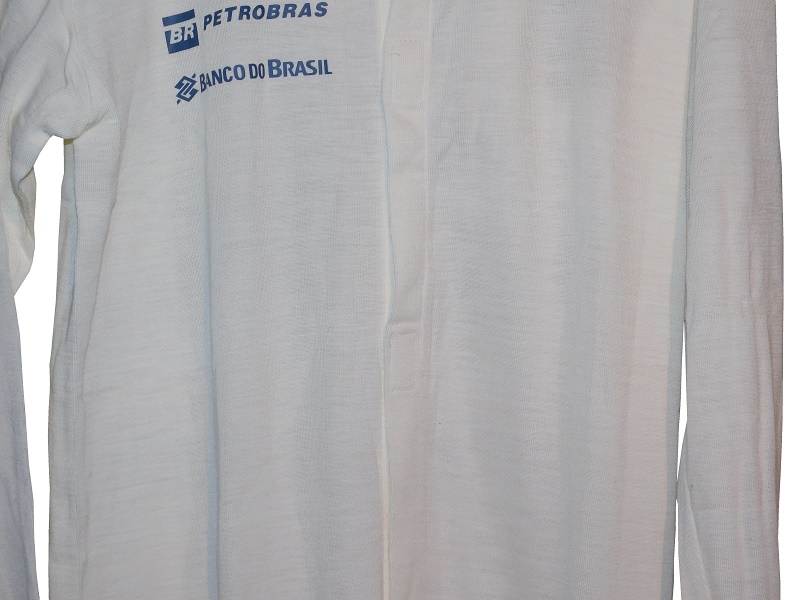
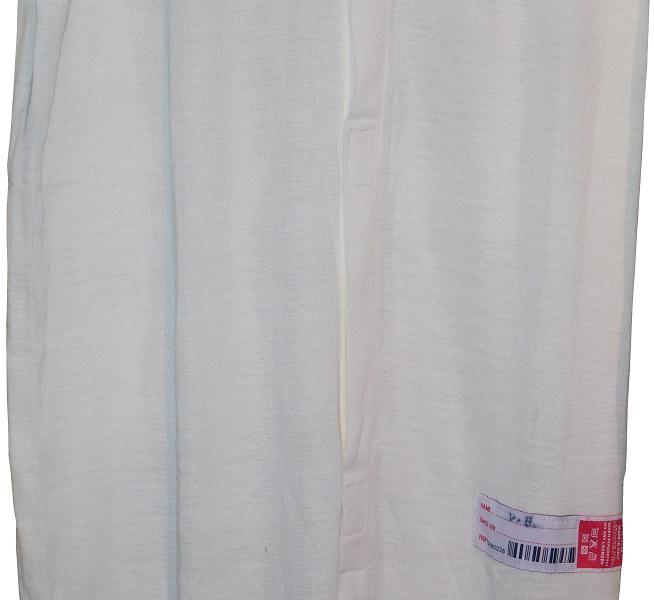
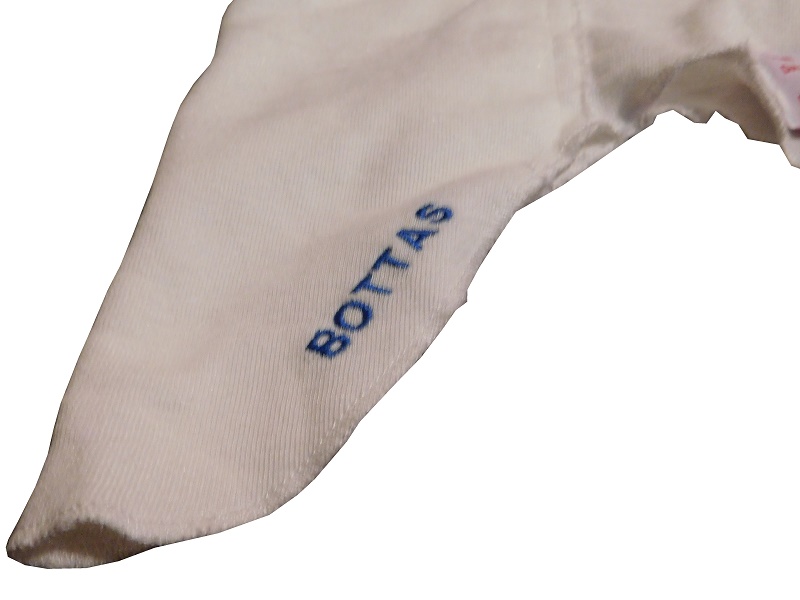
In 2005, Smith signed with Dyson Racing. Together, Smith and Dyson would go on to have a successful partnership for many years. The partnership has 6 wins, 42 podiums, and the 2011 championship. In 2011, the team won a single race, The 2011 Northeast Grand Prix at Lime Rock Park in Lakeville, CT, but with 7 podiums in 9 races, they solidly won the championship. During that season, Smith wore this undershirt.smithundershirtThe shirt shows light use, with some very light stains. Guy has signed the front of the shirt and added “Lime Rock 2011”smithundershirtThe thick front collar has a Stand 21 tag sewn into it. The tag has the FIA Certification as well as the Stand 21 logo.smithundershirt-collarThe front has DUNLOP, BP BIOFUELS, THETFORD, MAZDA, DYSON RACING, and CASTROL logos heat-pressed into the white material. Guy has signed the area under the Castrol logo, and added “Lime Rock 2011.”smithundershirt-flogo smithundershirt-sigThe bottom-left side of the shirt features a Stand 21 tag, and sewn into the inside is a wash tag that indicates that the shirt is “50% Aramid 50% Viscose.”smithundershirt-tag1 smithundershirt-tag2The shoulders and sleeves are in a black cloth, as opposed to the white front and back. They have no logos or patterns adornment.smithundershirt-rshoulder smithundershirt-rsleeve-1 smithundershirt-rsleeve2 smithundershirt-lshoulder smithundershirt-lsleeve1 smithundershirt-lsleeve2The back of the shirt is plain white.smithundershirtb smithundershirt-neck smithundershirt-blogoI’m noting something that I noticed. The shirt is 50% Aramid and 50% Viscose. What I find odd is that a racing undershirt would be certified when it is made of material that isn’t known for its fire retardant properties. I had never heard of Viscose prior to this, and from what I’ve been able to find, it’s more of a material used for a t-shirt or shorts, than for a racing shirt. Also, unlike the items I will examine in the coming weeks, this shirt is decently thick, and quite hefty.

It’s also worth noting that the reason there are sponsor logos on the shirt is so the driver doesn’t have to wear his firesuit up while on camera and the sponsors can still get exposure. I will discuss stuff of similar design in the coming weeks. What I’ve noticed is that while it’s practical, it is only being used in NASCAR by Jamie McMurray,

Embed from Getty Images

and Kyle Larson of Ganassi Racing.

Embed from Getty Images

I’m really wondering why this isn’t the standard in NASCAR like it is in Formula 1. It makes logical sense from a comfort perspective, and a sponsor exposure perspective. Every suit is designed with maximum sponsor exposure in mind. I can’t understand why an undershirt wouldn’t receive the same treatment.

Next Week, Formula 1 Month starts!

Paul Gentilozzi…From Owning IndyCar to Racing Jaguars

gentilozzi-1By David G. Firestone

IndyCar fans hate Tony George with a passion that is hard to describe. In fact, George founded the Indy Racing League after getting kicked out of the CART board of directors. This started the IRL/CART civil war known as “The Split.” The Split, which lasted from 1995 to 2009, more or less devalued the sport to the point that the sport not only lost money during the biggest auto racing boom in history, but also lost sponsors, drivers, and fans to NASCAR. Even today, television and attendance numbers are still down.

I’m convinced that some of the damage could have been prevented in 2003, when Gerald Forsythe, Paul Gentilozzi, and Kevin Kalkhoven purchased the assets of CART. They created Open Wheel Racing Series LLC, which later became Champ Car World Series LLC. From 2004 to 2009 they operated the Champ Car World Series, which kept The Split going, and kept draining the sport. Had Tony George bought CART’s assets, the split could have been eliminated, and maybe the sport could be in a better place. Then again, knowing Tony George, that probably wouldn’t have happened.

Gerald Forsythe is the former owner of Forsythe Championship Racing which was a long time team in IndyCar. Kevin Kalkhoven bought the remains of Pac West Racing, and turned it into KV Racing Technologies, which is still opperational today. Paul Gentilozzi is a real-estate magnate who races cars in his spare time. He won the 1994 24 Hours of Daytona with three other drivers in a Nissan 300ZX. He also won the GTS class in the 2002 24 Hours of Daytona in a Jaguar XKR. He raced Jaguar XKRs for many years, with some success.

From 2009 to 2011, Gentilozzi raced a black and green Jaguar XKR. He did not have much success, with a high finish of 9th at Mid Ohio in 2010. One of his pit crew members wore this Jaguar Green helmet during that time.gentilozzi-1The helmet has numerous scratch marks present, and has obviously been repainted, as the old Savage Designs paint job is still visible underneath the green paint. Some of the scratch marks reveal that the helmet was blue.gentilozzi-1 gentilozzi-2 gentilozzi-3 gentilozzi-4 gentilozzi-5

The inside of the helmet has a radio connection, with the earpieces and wires, but no microphone. The straps are all intact as well.gentilozzi-6While Gentilozzi was primarily a sports car racer. He raced LeMans, and Sebring, in addition to IMSA. While IMSA and other sports car racing groups don’t get the same level of coverage as NASCAR or IndyCar, they have good sized fan bases who are very devoted. Next week, we will examine an undershirt from 2011.

Interview Hats are The Latest Trend in Fashion These Days

nhrahat1-1By David G. Firestone

With the rise of racing as a televised sport, sponsors and sanctioning bodies are eager to get their brands on television. This has given rise to an interesting industry, the interview cap. These are caps worn by drivers and/or crew members for interviews. In Formula 1, the drivers on the podium are issued caps with Pirelli logos, feathers on the brim, P-Zero on the left side, and the rank and location on the left side. IndyCar drivers are issued Firestone branded caps. NASCAR will issue hats to the drivers in victory lane, some drivers choose to wear their own sponsor caps, and then, the hat dance takes place.

The story behind these interview hats in drag racing is interesting. Mello Yello and the NHRA give these hats out to drivers at events, and there are a series of different colors. There are four different sets of interview hats. For qualifying and round winners who don’t wear a sponsor hat after getting out of a car for an interview, they are given a black hat. nhrahat-blackFor 2016 the orangenhrahat-orange and graynhrahat-grey hats were eliminated. They are all of the same design. For the driver who qualifies #1, they are given a green hat, with a #1 Qualifier patch with their respective class.nhrahat1-1I got a #1 qualifier interview cap from The Thunder Valley Nationals. It’s a one-size fits all green cotton hat. It has the old Mello Yello Drag Racing Series logo embroidered on the front, a #1 Qualifier patch on the side, and an NHRA logo above the Velcro strap, and the venue name BRISTOL on the Velcro strap. I got it signed by Tony Schumacher, Ron Capps, Tommy Johnson Jr., Fast Jack Beckman, Erica Enders-Stevens, JR Todd, Alexis DeJoria, John Hale, TJ Zizzo, Antron Brown, Terry McMillen, Hector Arana Sr. Clay Millican, Hector Arana Jr., Angelle Sampey, Robert Hight, Leah Pritchett, and John Force.nhrahat1-1 nhrahat1-2 nhrahat1-3 nhrahat-6 nhrahat1-5 nhrahat1-6 nhrahat1-7The drivers who win the event get a yellow cap, with a winner patch to wear, similar in design to the #1 qualifier hat. The cap color is yellow, on the patch, the word WINNER replaces #1. As with the qualifyer hat, the race venue is embroidered into the back strap. This example is an unused winner circle hat, with no class on the side, or race venue on the back strap. It comes signed by Tony Schumacher, Antron Brown, Shawn Langdon, Ron Capps, Tommy Johnson Jr., Jack Beckman, and Matt Hagan.nhrahat2-1 nhrahat2-2 nhrahat2-3 nhrahat2-4 nhrahat2-6 nhrahat2-7The drivers who win the championship get a white hat.

Most NHRA drivers wear these hats during interviews, except for John Force who prefers to wear his own hat for an interview after he qualifies #1 or wins. The white hat for the championship was possibly inspired by Force. Though I haven’t found any concrete evidence of that. Drivers do not keep these hats for themselves, even the championship ones, and they often find their way on to eBay. They are popular to get signed by drivers at events.

We are going to keep the headgear train rolling with a post next week about a helmet.

Another Look At Jack Beckman

2016 Route 66 Nationals-50By David G. Firestone

I wrote about the Infinite Hero Challenge Coin program last year, and I’m going to revisit it. I’ve learned some more information about Infinite Hero Coins, that I didn’t have before, so I’m going to add this new info, for the sake of completeness. I’m also going to add some of the other Jack Beckman Infinite Hero Challenge Memorabilia, instead of just the coins.

Launched in 2011, The Infinite Hero Foundation “…is to combat the most difficult front line issues – mental and physical – facing returning military heroes and their families.” Military personnel returning from overseas deployment face long term employment, mental and physical problems that the majority of Americans don’t understand. They work with other non-profit veterans groups and give out grants to help service men and women cope with these long term problems.

Like many veterans groups, Infinite Hero uses auto racing as a way to promote their cause. But unlike most groups Infinite Hero came up with a new and unique way to raise funds. Infinite Hero uses an emblem that, according to their site, “The Infinite Hero emblem incorporates the color purple to honor those who have been wounded in battle, the Greek cross to signify aid, and the infinity symbol to represent the conviction that the sacrifices of heroes should always be remembered. The Infinite Hero Foundation thanks our founding corporate partner Oakley for their leadership and guidance in creating the Infinite Hero logo.”

Infinite Hero quickly realized that Oakley was a great partner, and began working with them to come up with some unique merchandise as a part of the partnership. The Infinite Hero Foundation was founded in 2011, and quickly acquired a partnership with Oakley. This resulted in a series of merchandise items sold by Oakley, with proceeds going to help the Foundation.

I’m not into sunglasses myself, not anymore, but many people are, and Oakley has a lot of fanboys. So, once these glasses began to hit shelves, they sold quickly. This is a review from 4 years ago, of one such pair.

Notice the coin in the box? Of course you did. Aside from glasses and boots, Oakley realized that the coin would sell too. So sometime, I’m guessing 2012-2013, this coin was sold.

It is quite thick, and has a ridged edge. One side featured “Courage, Honor, Virtue, Heroism,” around a globe design with an Oakley logo. Oakley is a partner with the Infinite Hero Foundation. The other side features an Infinite hero Foundation logo. The coin was placed in a round, flat plastic container, with black foam braces. The coin lacks the blue enamel that the coin that comes with the glasses coin, and future coins, and has a very plain look. I do like the plain look.ihc-2013-1 ihc-2013-4 ihc-2013-3 ihc-2013-2In April 2014, they started appearing on the side of Jack Beckman’s funny car. Terry Chandler, who also sponsors Tommy Johnson Jr.’s Make a Wish Foundation Funny Car, is the financial backer of the car. She pays for Infinite Hero to race on the sides of the car. This also began the NHRA coin program. This is a new form of racing memorabilia I have never seen before, though it’s a great idea. When Jack Beckman gets into his funny car to race, he carries at least 5 Infinite Hero Challenge Coins in the pocket of his driver suit. Once the race is over, he will autograph them and sell them at the track and on eBay. They cost $100 with all proceeds going to the Infinite Hero Foundation.ihc-2014-1The idea of items carried in a pocket is not a new one. NASA has done this for years. Many space shuttle flights carried first day covers in the storage bay. When the shuttle landed, the covers were removed, and sold to collectors. I’m a little surprised this hasn’t been done before with auto racing, because I think that it would create a new memorabilia market.

The 2014 design that Jack used was identical to the one sold in stores, but the Infinite Hero Foundation logo has a purple enamel present. Jack autographed the plastic case.ihc-2014-1 ihc-2014-4 ihc-2014-3 ihc-2014-2Also in 2014, this 1/24 scale die cast was produced. It is a full replica of Beckman’s funny car. Valvoline was a primary sponsor, and this was the only season Infinite Hero and Valvoline were together on the car. It’s also the only time that Infinite Hero Challenge appeared on the older Dodge funny car body. In 2015, the current body was introduced, and Pennzoil replaced Valvoline. Jack has autographed the windshield.beckman-1 beckman-2 beckman-3 beckman-4 beckman-5 beckman-6 beckman-7 beckman-8 beckman-9 beckman-10 beckman-11 beckman-12A redesigned coin of the same size was introduced for 2015. The Oakley logos are gone. One side features a design similar to the globe design, but the globe design has been replaced with an American Flag design. “Courage, Honor, Virtue, Heroism” has been replaced with “Duty, Honor, Innovation, Courage.” The new emblem on the reverse side has one of the across bands removed. The new packaging is an upgrade, with the circular plastic cylinder replaced with an attractive box. It comes with a card that Jack Beckman autographed, and on the reverse it has the Infinite Hero Foundation Pledge. The first one is from The CARQUEST Auto Parts NHRA Nationals at Phoenix on February 22, 2015, where Jack was eliminated in the first round.ihc-2015-2 ihc-2015-3 ihc-2015-4 ihc-2015-4 ihc-2015-5 ihc-2015-6 ihc-2015-7 ihc-2015-2-8The second one is from the Summit Racing Equipment NHRA Nationals in Norwalk, Ohio, where Beckman won the event, beating Courtney Force in the final round.ihc-2015-2-1 ihc-2015-2-7 ihc-2015-2-6 ihc-2015-2-5 ihc-2015-2-4 ihc-2015-2-3 ihc-2015-2-2Also in 2015, these hero cards were produced. Hero cards are given away at racing events and driver appearances. They have Jack’s picture, and information about the driver, team, and the Infinite Hero Challenge.beckman-1 beckman-2 beckman-3 beckman-4For 2016, the coins got a major makeover. The Infinite Hero logo is now bigger. The words “Reimagine” and “Recovery” are stamped near the logo, and on the opposite side, a picture of Jack’s funny car replaces the flag motif. It should also be noted that the coin is slightly smaller, because it isn’t as tight in the coin case as the previous version. The Infinite Hero Pledge accompanies the coin. Also changed from 2016, Jack doesn’t sign the box and the pledge, he just signs the pledge.ihc-2016-1 ihc-2016-6 ihc-2016-5 ihc-2016-4 ihc-2016-3 ihc-2016-2 ihc-2016-7Hero cards are given away at racing events and driver appearances. They have Jack’s picture, and information about the driver, team, and the Infinite Hero Challenge. For 2016, a new card design was introduced. It has updated information, as well as the updated paint scheme introduced at the beginning of the season.beckman-9 beckman-10 beckman-11 beckman-12The Infinite Hero Foundation is a worthwhile charity, designed to help our nations veterans. I fully support them, and I encourage my readers to try and buy at least one of these coins.

All Hail John Hale!

2016 Route 66 Nationals-42By David G. Firestone

Racing uniforms stand out from every other uniform in sports because every aspect of the uniform without exception is specifically designed to protect the driver first, and look good second. Unlike in baseball, football, or hockey, where a couple of the visible items protect the wearer, every piece of the uniform, from helmet to boots is designed to protect the driver. One of the more vulnerable areas a driver has is their hands. If a drivers hands are injured, they can’t control their cars, or exit their cars in the event of a wreck. Funny Car drivers have the toughest glove setup in all of auto racing.

Ranked as #27 on the list of the NHRA’s 50 Greatest Funny Car Driver by Motorsport.com, Big Jim Dunn raced for over 40 years as a driver. He could win races driving some of the tougher cars in the series. Dunn began racing in 1953, at the age of 19. By 1965, he was running in Top Fuel, and by 1969, after winning the NHRA Division 7 championship, he switched to Funny Car. He raced until 1990, when he retired as a driver, and switched to team owner. He’s had success as a crew chief, technical adviser, and a team owner. His son Mike has 22 wins, was a long time announcer for the NHRA television team on ESPN, and is currently the president of the IHRA.

At the beginning of the 2015 season, Dunn had to fire driver Jeff Arend due to Grime Boss leaving as a sponsor. Replacing Arend was John Hale. Hailing from Addison, Texas, John Hale currently races for Jim Dunn Racing. He is also active in the Nostalgia Funny Car series in the NHRA. Although he doesn’t have a race win, he finished in the runner up position at the Gatornationals in 2015. He also won a Wally for his Hubert’s lemonade scheme at Norwalk in 2016.2016 Route 66 Nationals-43Funny Car drivers wear two sets of gloves while driving. One set is similar to what firefighters are wearing. The other is a thick set of gloves that extend all the way up to just below the elbow. They require a crew member to help put them on. This set of gloves worn by John Hale is a perfect example of those gloves.halegloves-1These Simpson SFI 20 rated gloves show decent use with scuff marks and material loss. These gloves are changed several times per year, due to wear. John has autographed both gloves.halegloves-2The right glove has some material loss on the palms, the tag has been destroyed by race use, and John has autographed the glove on the top, near the Simpson logo.halegloves-3 halegloves-4 halegloves-5 halegloves-6 halegloves-7The left glove features some light wear on the palms, like the right glove, the tag has been destroyed through race-use, and John signed the bottom of the glove, near the top of the cuff.halegloves-8 halegloves-9 halegloves-10 halegloves-11 halegloves-12John also signed this Hubert’s Lemonade hero card. It’s interesting in that it’s a dual-sided card, where both sides of the card are exactly the same.hale-1 hale-2Funny car drivers wear 20 pounds of equipment while racing 2,600 lb, 10,000 horsepower cars at 330 MPH. The dangers of failure are all too obvious. There have been many drivers that have given their lives for the sport they love. Next week, I’ll show some of the perks of winning a national event in the NHRA.

Calming The Wild Thing

Scelzichute-1By David G. Firestone

When Del Worsham won the Funny Car championship last year, he joined an exclusive group. He is one of three drivers to win the Top Fuel and Funny Car championships in the Mello Yello Drag Racing Series. Worsham won the Top Fuel championship in 2011. He joins Kenny Bernstein who won the Funny Car championship in 1985, 1986, 1987, and 1988, switching to top fuel in 1992, and winning the championship in 1996 and 2001. The other driver to achieve this is Gary Scelzi, who won Top Fuel in 1997, 1998, and 2000. Sclezi switched to Funny Car in 2002, and won Funny Car in 2005.

Gary Scelzi, known as “Wild Thing” hales from Fresno, California, where in 1979, he co-founded Scelzi Enterprises, Inc., a truck body manufacturer with his two brothers. He got into drag racing, and made his way to the Mello Yello Drag Racing Series, then known as Winston Drag Racing. Scelzi was a championship-caliber driver in a sea of very talented drivers. He was a respectable driver in Top Fuel. In 2001, he lost his Winston sponsor for Top Fuel, and moved to Funny Car with a new sponsor, White Caps, and a new Toyota Celica. The Celica wasn’t a good move, and Sclezi left the new team midway through the season.

In 2003, Scelzi signed with Don Scumacher Racing to race a Dodge funny car sponsored by Oakley, and he took to it like a duck to water. In 2005, he won his first, and only Funny Car championship, beating a very strong John Force Racing team of John Force and Robert Hight. 2005 was the first time that a non-John Force Racing car won the Funny Car championship since 1992. Scelzi retired in 2008, after a long career to focus on his family business, and his midget racing team.

One of the best tools at a drag racer’s disposal is the parachute, and for Scelzi, that was no different. You can’t be the first driver to reach 330 MPH in a funny car without a good parachute to stop the car. Scelzi raced with many different parachutes throughout his career, and this 12′ x 12′ Mopar example from his days with Don Schumacher Racing. It shows heavy use with numerous scuff marks, and holes. It also has a lot of stains as well. I had to photograph this on my front lawn to show the full scale of the suit.Scelzichute-1The silver MOPAR lettering shows wear, with popped stitching, and lots of staining across the letters.Scelzichute-2The very center of the parachute has the opening that lets air through the center, and has the straps where the pilot chute is attached.Scelzichute-4All four corners of the cross-form parachute show wear, in the form of scuff marks and holes.Scelzichute-3 Scelzichute-7 Scelzichute-5 Scelzichute-6While some parachutes had logos on both sides, this one only has the Mopar logo on one side.Scelzichute-8The cord that attaches the parachute to the car is still present, and wrapped in a silver Nomex material to prevent damage in the event of a fire.Scelzichute-9 Scelzichute-10Gary Scelzi is the first funny car driver to reach 330 MPH. It proves that race cars are getting faster all the time. The parachutes are proof that race cars are getting safer as well. Next week, I will examine another critical piece of safety for funny car drivers…the gloves.

Coin Down Chicago Bears!

bearscoin-9By David G. Firestone

As the Chicago Bears hold their home opener this week, I felt it would be prudent to go off-topic this week. This will be the last off-topic Friday Feature for 2016. I will have some stuff for next year, but it will be more spread out…more on that later.

2004 was not a great year for Chicago sports. The Blackhawks, Bulls, Cubs, Fire, and White Sox all missed the playoffs, while having mediocre to awful seasons. The Cubs and White Sox were dead by September, and while the Bulls and Blackhawks were getting started, it became clear rather quickly that they had nothing, and their seasons weren’t going to go anywhere. The Fire have always been the odd group out in Chicago sports. When they won the MLS Cup in October 1998, nobody in Chicago noticed or cared. But like the rest of the sports in Chicago, the season they had was not great in 2004.

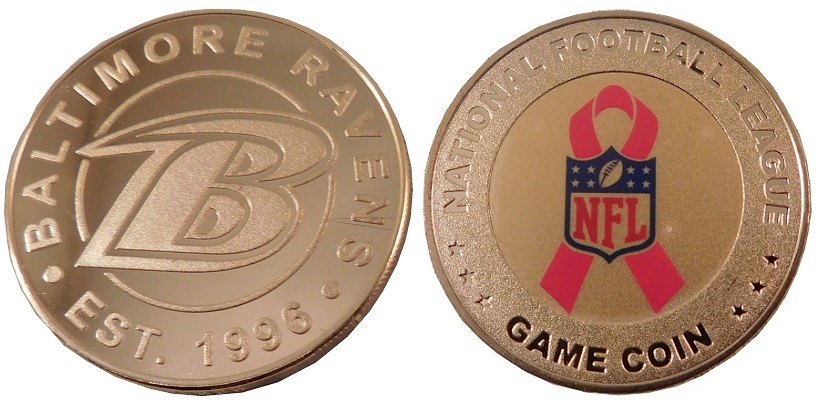
The bright spot was supposed to be football. The Bears had a decent roster, a new set of alternate uniforms, and a brand new coach in Lovie Smith. The NFC North wasn’t as strong as other conferences. So it is into this season the Bears started on September 12, 2004. The Bears began their season at home against the Lions. Before the game, they lost the coin toss, and went on to lose the game. The coin toss was conducted with this Chicago Bears coin.bearscoin-9 bearscoin-10The Highland Mint Bears coin isn’t of the Opening Day variety commonly used, but comes with a box, and full PSA/DNA authenticationbearscoin-1 bearscoin-2The HEADS side of the coin features a Chicago Bears “Wishbone C” logo, and CHICAGO BEARS EST 1920 stamped into it.bearscoin-3 bearscoin-4The back of the coin features the pre-2007 NFL shield, and has OFFICIAL GAME COIN 2004 stamped into it.bearscoin-5 bearscoin-6The coin is stamped #531. There were a total of 5000 made, and while other examples of game-used toss coins are numbered 0001, this isn’t surprising as any one of the 5000 coins made could find their way onto the field.bearscoin-7 bearscoin-8Game used coins are an interesting aspect of the memorabilia market, because there is a discussion about if they are “game used” or “pregame used.” I’m wondering if there should be a separate category for “pregame used” memorabilia. MLB and the NHL both have special warm up jerseys worn prior to games. Should they be called “game worn” when they never saw action during an actual game?

The coin itself could realistically be called “game used” because it directly affects the outcome of the game. It decides which team gets the ball first. It it is used in an overtime situation, it decides who gets the ball first in overtime. So my solution is that to have a separate sub-category in game-used sports memorabilia called “pregame used” memorabilia. This sub-category would consist of items used in pregame warmups, batting practice, or practice, but never actually used in games.

Truth be told, I have no idea why I like game-used coins. I used to collect coins, but I haven’t really done so for many years. I don’t always understand why I find things interesting, but I’m probably like a lot of people in this respect. We all have things that interest us, but we can’t really explain why they interest us.

OK, enough football stuff, next week, we go back to drag racing parachutes.

One of the Best Tools At A Drag Racer’s Disposal

By David G. Firestone

Most people associate parachutes with skydiving, para sailing, or military operations, but they have been critical over the course of auto racing as well. For those who follow drag racing or land speed records, parachutes being deployed at the end of the run is a common, and reassuring sight. Dragsters and funny cars can go from zero to 320 MPH in 3.87 seconds. There is no way these cars could stop as effectively without perfect parachute design. Most people also don’t realize that there are two very distinct designs used in drag racing, the Simpson design, and the Stroud design.

The most commonly known form of drag racing parachute is the cross-form style of parachute. This was the parachute developed from a French design used to air drop supplies during war time. It came to racing in 1958 by Bill Simpson, then 18 years old, after a drag racing crash. Legendary drag racing driver and innovator Don Garlits instantly knew this was a perfect design, and was Simpson’s first customer. Thus the Simpson Race Products company was born. The proof that this is an effective design is that aside from materials and size, there have been no modifications to the design in almost 58 years of continuous operation.

This example came from TJ Zizzo’s Peal Anti-Freeze dragster. TJ was sponsored by Peak from 2008 to 2013. The blue PEAK chutes can be seen on his car during that time. The canopy is 12 feet by 12 feet square. The cross-form chute canopy has an opening in the very center, for air to go through. The pilot chute is attached here as well. Pilot chutes are universally used to deploy parachutes. When the cords are pulled, and the chute is released, the pilot chute deploys, which catches air and pulls the primary chute behind it. The chutes are strapped to a bar at the back of the car, the straps pre-covered in Nomex to prevent fire damage, then packed into a bag, before the race.

The Stroud design came from necessity. The cross-form has been proven effective in the faster cars, namely top fuel, and funny car in the professional classes, as well as top alcohol and top alcohol funny cars in the amateur classes. These are great at stopping cars over 200 MPH. However, there are a number of categories in drag racing where the cars run under 200 MPH and the cross-form deploys too roughly, and would drag the car up. This problem was confirmed by Bill Simpson himself. When he first tested the cross-form at 100 MPH the car took off, and he was hospitalized and arrested. Bob Stroud, who is an engineer who has made a number of designs to airborne parachutes worked on the problem, and came up with the current design in the 1980’s. While Stroud developed the chute, many companies have made design changes.

For a time, these designs were relegated to the amateur classes of the NHRA. It was in May of 1990, at the AC-Delco Southern Nationals at Atlanta Dragway that the Stroud design came to the professional leagues, stopping Warren Johnson at the end of his races. It should also be noted that at that time, many drivers simply didn’t deploy their chutes at the end of a run. While their design has evolved over time, it still remains the standard for cars that race up to 205 MPH. This example comes from Dave Connolly’s 2014 Chevy Camaro. It measures 8 feet square. Dave autographed it after he finished using it. It has the same pilot chute design as the cross-form.

These parachutes and pilot chutes are massive, but are packed into a bag which measures 9 inches square. There are two designs that are used to launch a parachute. There is the empty box design, which mounts to the back of the car, and is opened by pulling the cable. The second is a pneumatic launcher, used with smaller cross form, and most Stroud chutes. Drag racing parachutes are almost always packed by the drivers themselves. As one driver so elegantly phrased it, “If doesn’t work, I have nobody to blame but myself.” How do drivers pack their own chutes? I’ll let driver Rickie Jones explain that:

Next week, I’m gonna go a bit off-topic, but it will be interesting!

Everyone Has Seen These, But Not Everyone Has Seen These Up Close

lottery-2By David G. Firestone

After The Vest Project, I need to go off topic for a bit. I’m going to discuss something I’ve done on The Driver Suit Blog Before. I don’t know where my fixation on lottery memorabilia came from I don’t know why I find this stuff interesting. I guess it had to do with the way I grew up. Up until my grandfather came to live with us at age 10, we only had free television. In the Chicago suburbs, that meant we had WBBM Channel 2, WMAQ Channel 5, WLS Channel 7, WGN Channel 9, WTTW Channel 11, and WFLD Fox 32. There were others, if you were lucky with your rabbit ears, but those were the ones we got. As such, we would watch the news on WGN, which was what my family liked.

A part of those newscasts were the Lottery drawings, which fascinated me, but I can never remember our family playing the lottery. Again, it goes back to what I said during my first Lottery column, when I said that “Human beings all have hope, but human beings need something to hope for, and something to inspire hope. For many, religion is that outlet. For others, it is their sports teams. For many, the hope that they could win millions in the lottery is that beacon of hope.”

The history of the lottery in the United States dates back to the 1600’s, while Europe was colonizing North America. Many colonies saw gambling as harmless fun, but as English investors waned to profit from the New World, this changed quickly. As time went on, each of the 13 original colonies had a lottery system in place to help fund the colonies. It became a civic duty to play the lottery. Recessions, scandals, and corruption had almost eliminated the lottery in the United States by 1868.

In 1934, Puerto Rico, then a US colony, started a legal lottery. It would take 30 years, but in 1964, New Hampshire started a lottery. Since then, 44 of 50 states, as well as Puerto Rico, Washington DC, and the US Virgin Islands have lotteries. Alabama, Mississippi, and Utah don’t have lotteries due to religious objections. Nevada has the gambling industry, and they don’t want competition, and Alaska and Hawaii, not being mainland states, aren’t worried about losing tickets out of state.

The lottery takes several forms. Scratch off tickets, first introduced in the 1970’s, are a very popular method of playing the lottery. There are many different kinds of games, with different rules. Pick 3, pick 4, main drawing, and Powerball have their origin in “numbers games.” Numbers games were popular in poorer areas of the country, especially urban areas. The game works by drawing balls that had numbers to pick the winner. A similar game was popular in South Florida and Cuba called “Bolita” or “little ball” was where betters would bet on which number would be pulled out of a bag containing 100 numbered balls.

All the pre 1934 lotteries had one major drawback that kept them from being as accepted as it is today. They were easily rigged, and people lost money on the racketeering that took place around them. Today, the equipment, the drawing, the tickets, and every other aspect is heavily supervised and regulated so that this kind of cheating is not possible. The level of security for a drawing is high, due to the amount of money involved.

One thing that I learned about lottery security is that most of the people directly involved don’t know what equipment is going to be used. 90 minutes before the drawing, the equipment is determined, tested, the host rehearsed, and by the time that is all done, the broadcast is almost ready to start. Though security is high, and equipment is tested, there is always the case that something can go wrong. Do a quick search for “lottery blooper” on YouTube, and you get several examples, including this one:

Security is also high because the amount of money can entice people to cheat, even those inside the system. The chance for cheating can’t be avoided either, as the Pennsylvania Lottery discovered on April 24, 1980, when the winning number for the Daily Number was 666, which tipped off the lottery officials that something was off. It turned out that Nick Perry, the announcer for the lottery drawing, and a group of people replaced the standard lottery balls with latex paint. Of the 10 lottery balls, 8 were replaced with these new balls, so there would reduce the number of possible combinations to eight: 444, 446, 464, 466, 644, 646, 664, and 666. The 666 combination seemed odd, so an investigation was conducted, the guilty parties were caught, and to this day, the number 666 in the Pennsylvania Lottery is referred to as a “Nick Perry.”

Another result of the amount of money involved being as high as it is, is that the equipment has to be specially designed under very secure conditions. Only a few companies have the ability to produce the equipment that is used, and the equipment itself is insanely expensive. One company that was very innovative in designing lottery equipment was Beitel Displays of Lawrenceville, New Jersey. Though they are credited with designing the

Criterion, which is the design basis of most, if not all, big lottery machines. Though this was a lucrative business, it was only a side business, since Beitel Displays was primarily in business to design displays and exhibits for trade shows and companies.

According to a 1992 Lawrenceville Journal article concerning the company: “Mr. Beitel can count customers in 27 states, including New York, Connecticut and Pennsylvania, as well as Washington. His machines are in 40 countries, from South Africa to Iceland. He does not play the lottery.

The National Basketball Association conducts its annual lottery draft using a Beitel machine and the Virginia Slims Tournament sets its teams using one of the machines.

Next January, the European Community will become a Beitel customer when it begins its “Eurogame” lottery, using the Criterion machine, with a potential audience of 100 million people. Mr. Beitel expects the political changes in Eastern Europe to create another surge of business.

Poland is one of Mr. Beitel’s newest customers and he and the vice president of the lottery products division, Tracey S. Herrera, have been negotiating with representatives from Bulgaria, Hungary and Czechoslovakia.”

Such was the influence of Beitel Displays, that one of their main engineers founded SmartPlay in 1993, and four years later, acquired the the rights and licenses to all their products. SmartPlay is based in Ohio, and manufactures the equipment used for state and national lotteries.

The Criterion was a major contribution, but it had a setback, in that it needed special rubber balls to operate. These balls are very carefully made, and very carefully matched up into a set. One such example is this set of Beitel Criterion balls of unknown vintage. lottery-1This kit of 30 rubber lottery balls is custom-made, with each ball costing $60 each. According to the SmartPlay website, “The weight of each ball is measured in Grams (g). Each ball weighs between 77.80 and 79.50 grams. The variation of each ball in any given set is +/- .60 grams from the average weight of all balls within that set.” Though most of the balls don’t show that much abuse, some show more than others. Each ball is stamped with “BEITEL USA.”lottery-1 lottery-2 lottery-3 lottery-4 lottery-20 lottery-33 lottery-34The interesting thing I noticed about these balls is that they have no bounce to them whatsoever. In the machine, they can bounce, because they are either being blown around, or something is spinning them, but when you try to bounce one on a table, they just land.

Wining the lottery is the ultimate hope of those who play the lottery, as winning the race is the ultimate goal of those who race cars, as watching their favorite driver win is the ultimate goal of those who watch racing. Next week, I will begin a two-part series about one of the best tools at a drag racer’s disposal.