On this, the last Friday Feature of Formula One Month, I’ve saved the best for last. I really do mean the best here. With 91 wins, 155 podiums, 1,566 career points, 68 pole positions, and 29 total Formula One records including wins, podiums, championships, and pole positions, Michael Schumacher is one of, if not the greatest drivers in the history of Formula One. His 91 career wins is 40 wins total over the next driver, Alain Prost, who has 51 wins. From 1991 to 2006, Schumacher raced for Jordan, and Bentiton, winning two championships for Bentition, before moving to Ferrari in 1996. After being disqualified from the World Championship for is actions at the European Grand Prix, Schumacher returned to a 2nd place finish in 1998, then down to a 5th place finish in 1999.
Then in 2000, while still with Ferrari, he began his 5 Championship run from 2000 to 2004. After two more successful years, Schumacher retired in 2006. From 2007 to 2009, Schumacher held a number of position in Ferrari, including team adviser, and road car driver. When Mercedes restarted their Formula One team, they gave Schumacher a chance to drive, next to Nico Rosberg. Schumacher took it, and for three seasons, he raced again in Formula One. This didn’t go so well, with Schumacher not winning, and only scoring one podium. After the 2012 season, Schumacher retired for a second time, this time for good.
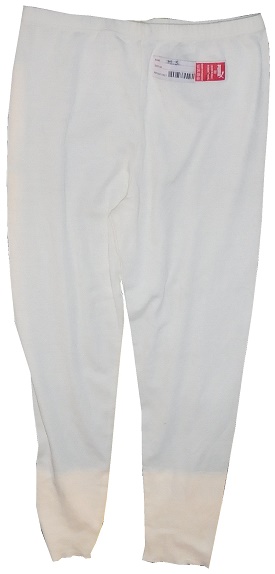
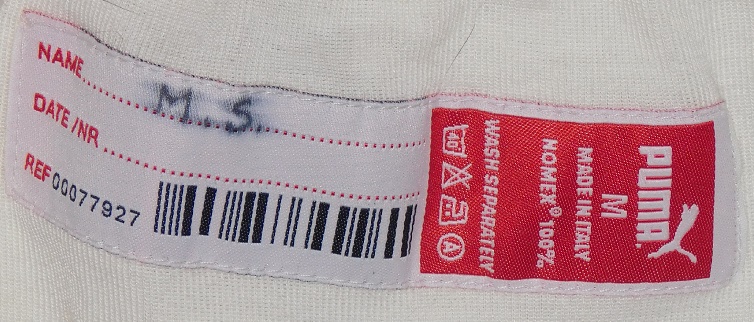
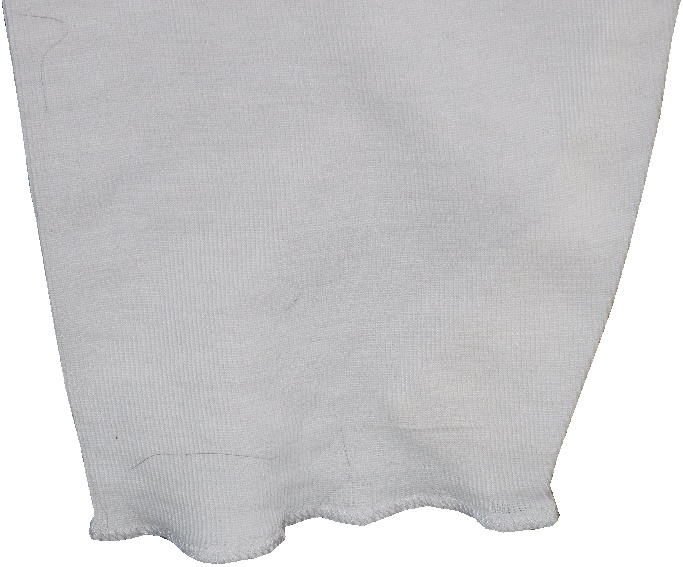
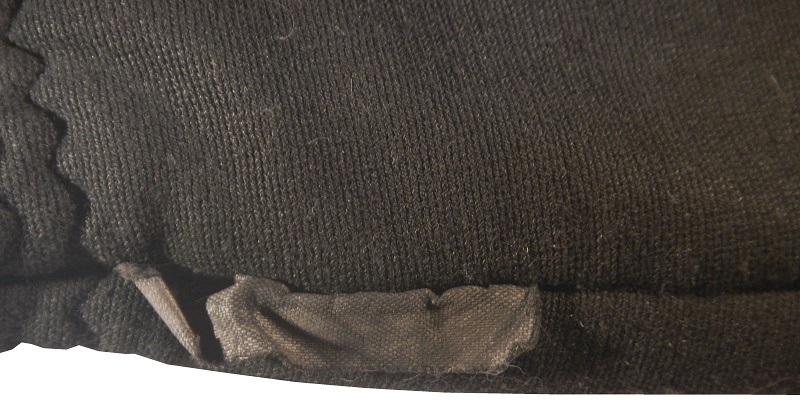
Schumacher was known for wearing Sparco suits while with Bentition, and OMP suits with Ferrari. When he returned from retirement, he wore Alpinestars with Mercedes in 2010, and 2011. In what was his final season before his second and final retirement, he wore Puma suits for 2012. This pair of pants, worn under the driver suit, is attributed to Schumacher.The lightweight Nomex Puma pants are in good condition, and show some light wear.The waist shows some light wear, and has a Puma wash tag with M.S. written in Sharpie. This appears to be the same writing as the Valtteri Bottas undergarments.The cuffs are hemmed, but the hem is very hard to see.The back of the pants don’t show any wear to speak of.On the center, just below the hem on the back of the pants is the Puma FIA 8856-2000 Compliance tag.I’d like to believe that Schumacher could have had one more run in Formula One in him, but tragedy struck. On December 29, 2013, Schumacher and his son Mick were skiing off-piste on the Combe de Saulire below the Dent de Burgin above Méribel in the French Alps, when he fell, and hit his head on a rock. Despite wearing a ski helmet, Schumacher suffered serious brain injuries, leaving him unable to walk, and having serious memory problems, and unable to speak. He may never walk again, and certainly will never race again. It’s a tragic and sad end to a racing legend’s career, and maybe his life.
Although his life has more or less been ruined through his skiing accident, his life will forever be known for Formula One, and his legacy as one of the greatest of all time has been cemented. I can only wish him and his family the best in his recovery.
With Formula One Month now complete, I’m going to shift focus to one of my December traditions…The Paint Schemies! That takes place next week!
Formula One Month continues this week with a familiar theme. Last week I discussed a Kazuki Nakajima race-worn undershirt from his time with Williams Grand Prix Engineering. This week, I’m going to keep the Williams undergarment theme going with a look at one of their current drivers.
Born in Nastola, Finland in 1989, Valtteri Bottas finished 8th in the 2005 Karting World Cup. By the end of 2008, he had won the 2008 Formula Renault Eurocup and the 2008 Formula Renault Northern European Cup, the first driver to do that since Filipe Albuquerque in 2006. In 2009, he advanced to Formula 3, where he won the Championship despite not winning a race. That same year, he won the 2009 Masters of Formula 3. In 2010, he became a test driver for Williams, and raced in the GP3 series, claiming the 2011 Championship.
In 2013, his big break came when he got the call to race for recently re-branded Williams-Martini Racing. He was teamed with Pastor Maldonado for that season. He had some success, including stating third in the Canadian Grand Prix, finishing 8th in the United States Grand Prix, and finishing 4th in the Championship.
2014 saw Williams-Martini Racing release Maldonado and replace him with Felipe Massa. Bottas and Williams had a great season, with Bottas scoring 6 podiums, Massa scoring 3, and the two sharing the Etihad Airways Abu Dhabi Grand Prix podium behind race winner and Champion Lewis Hamilton.
2015 saw a setback for Bottas, after suffering a soft tissue damage to his lower back, and was not medically cleared to race at the season-opening Australian Grand Prix. This would be a bad omen for the season, as Bottas was only able to score two podiums, one at the Canadian Grand Prix, the other at the Mexican Grand Prix. Although he finished 5th in the points standings, it was clear he wasn’t as strong as he previously was in 2014.
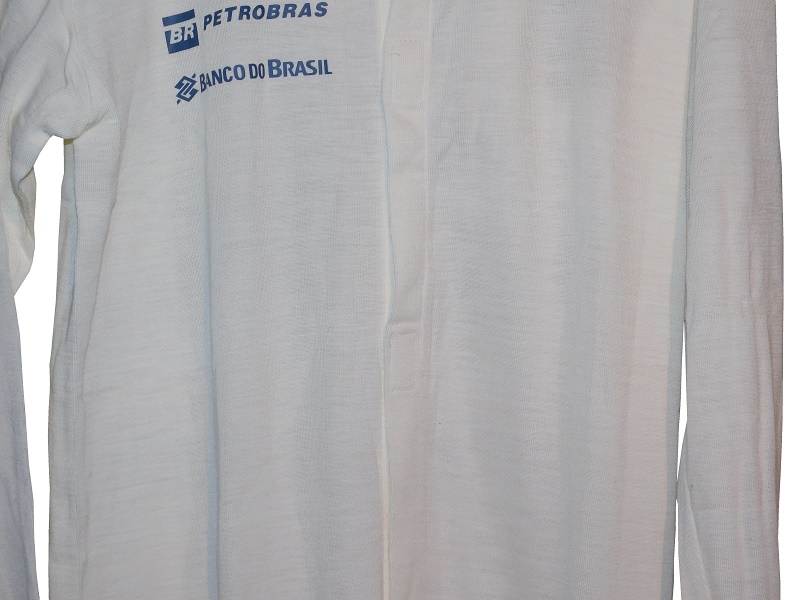
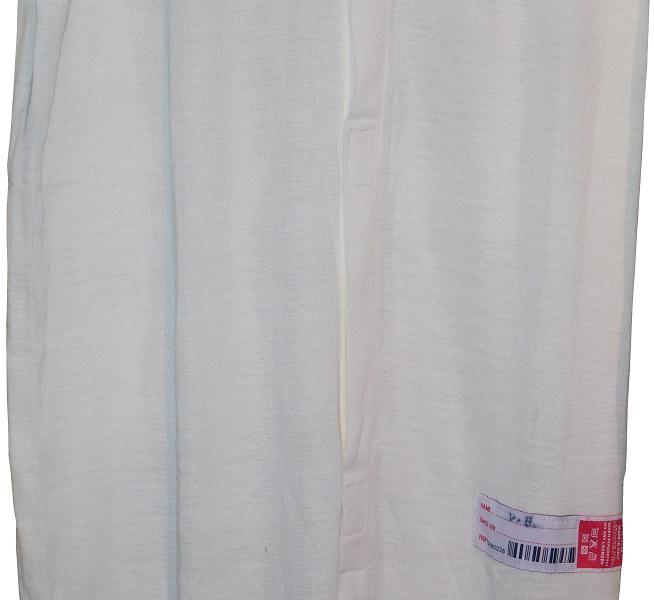
Going back to 2014, Bottas’ best season in Formula One. That season, drivers were allowed to pick their car numbers. The number they chose would be the one they raced with for their careers. Bottas chose 77 because the 7’s look like T’s, and he could use “Bo77as” That was also the first season Martini joined Williams, and changed the car and uniforms to have a more traditional look. During that season, Bottas wore this set of Puma long-johns and balaclava.The long-johns show some light use.The collar is a Velcro-closure with a pre-2015 Experian logo screen-printed on the front. The opening extends down the front, and ends just above the last logo on the right side. The right chest features Mercedes-Benz, RANDSTAD, BP PETROBAS, and BANCO DE BRAZIL logos heat pressed into the lightweight Nomex material.The left chest features a MARTINI logo pressed into the Nomex.There are no logos on the torso, nor is there a belt.Near where the belt would be is a Puma wash tag/warranty label with V.B. written on it in Sharpie.The legs have standard cuffs, and have no adornment at all.Being a set of long-johns, there are no epaulets or adornments of any kinds on the shoulders.
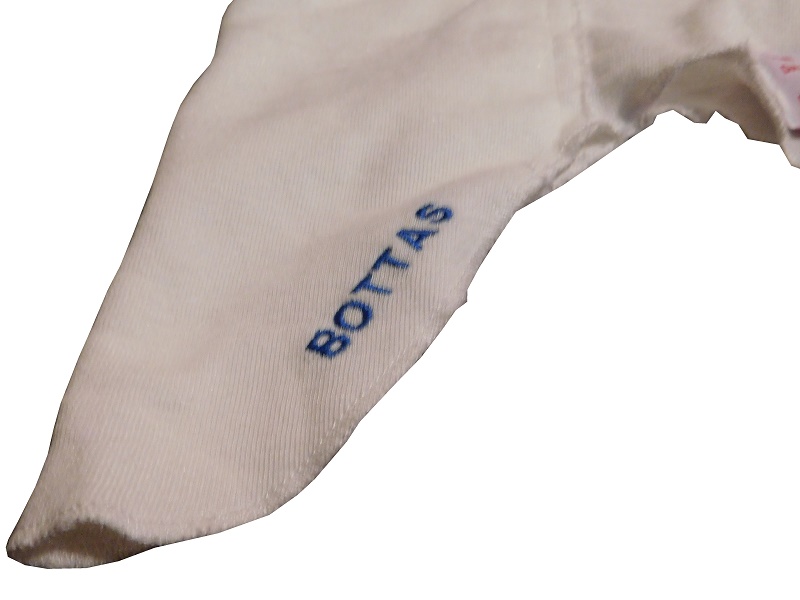
The right sleeve has EXPERIAN, WIHURI, and ORIS SWISS WATCHES logos pressed into the upper arm. There are no television logos on the ends of the sleeves. The left sleeve features GENWORTH, KEMPPI, PIRELLI, and THOMSON REUTERS logos pressed into the upper sleeve. No television logs are present at the end of the sleeve.The back of the long-johns show some very light use.The back of the neck features a Puma FIA tag, and WILLIAMS MARTINI RACING logos. The back torso features RANDSTAD and Puma logos. Around the same time Bottas wore the long-johns, he also wore this balaclava. It shows decent use. BOTTAS is sewn into the material on the left side.The front of the balaclava features a Puma logo below the nose-hole, and heaving stain around where the nose and mouth area.The right side shows some use, and has a small opening in the side.The back of the balaclava has some light staining, a Puma wash tag, and a Puma FIA safety tag sewn into it.Valtteri Bottas is poised for great things in Formula One. He has the talent, he has the drive, and he has had a lot of success in racing. Next week, I’m going to discuss a pair of pants worn by the most successful driver in the history of Formula One.
Formula One Month continues, and now we are in my area of expertise. We’re going to talk about uniforms. I talked a few weeks ago about how teams are beginning to add logos to their undershirts in American auto racing. Formula One has take this to a whole new level. For this and next week, we are going to get into this.
Williams F1 has an interesting history. Although the current version was founded in 1977, Frank Williams started his first team in 1969. That team, Frank Williams Racing Cars, never achieved any real success in Formula One. Even after bringing in Walter Wolfe as an owner in 1976, the team wasn’t doing well at all, and Williams left in 1977. The old team became Walter Wolfe Racing, and lasted until the 1970 season. In 1977, Williams founded Williams Grand Prix Engineering, and the team eventually took off. Williams Grand Prix Engineering currently has 7 Formula One Drivers Championships, 9 Manufacturers Championships, and 114 race wins. They have had some great drivers, like Alain Prost, Nigel Mansell, Ayrton Senna, and KeKe Rosberg. Other drivers they have had haven’t done well, like Kazuki Nakajima.
Born in Okazaki, Aichi, Japan, Kazuki Nakajima, son of Satoru Nakajima, raced through the ranks of Japanese karting, won the Suzuka Formula ICA karting champion in 1999, and was picked up by Toyota as a developmental driver. He won Formula Toyota in 2003, advanced to Japanese Formula Three in 2004, and had a decent amount of success. After moving to the Formula Three Euroseries in 2006, he raced alongside Sebastian Vettel, and finished seventh in the points. Nakajima also raced in GP2 and the Japanese GT300 series during this time.
In 2007, Nakajima was signed as a test driver for Williams F1. He was one of two test drivers, along with Narain Karthikeyan. They were the test drivers, and Nico Rosberg and Alexander Wurz were the race drivers. Wurz retired from F1 just before the 2007 Chinese Grand Prix, the final race of the season, and Nakajima took over the Williams seat. In 2008, Nakajima raced the full season with Williams, and their sponsors, with All Saints clothing on as a new sponsor. Nakajima failed to score a single point in any capacity. In 2009, Nakajima raced a second season for Williams F1, and after a second season with no points scored, he left Williams. He was scheduled to race for Stefan GP, but due to a ruling by Formula One, Stefan GP wasn’t allowed to race for the 2010 season. Nakajima left Formula one.
2008 in Formula One will forever be known for “Crashgate.” Crashgate, also known as the “Singapore Sling” was when Nelson Piquet Jr. intentionally spun and crashed on lap 14 of the 2008 Singapore Grand Prix to give teammate Fernando Alonso an advantage. This advantage worked well because Alonso started 15th and won the race. While ignored at the time, it would later emerge that Renault F1 had ordered Piquet to crash. The investigation destroyed Renault as an F1 team, with Alonso winning the following Japanese Grand Prix, which is their last win in F1 as a team. Two engineers who were involved, Flavio Briatore and Pat Symonds, were banned for life from Formula One, though this was later reduced on appeal. In the end, Lewis Hamilton of McLaren would win his first Championship.
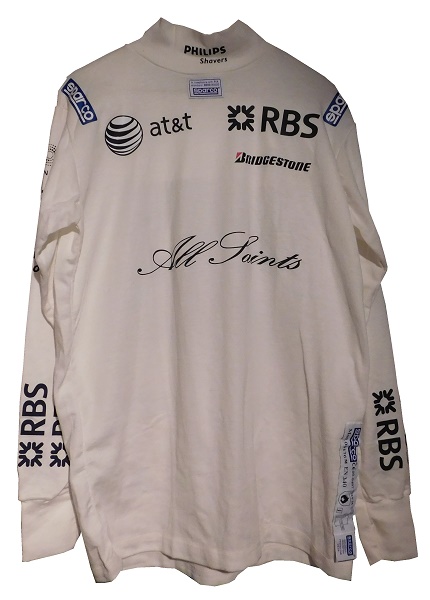
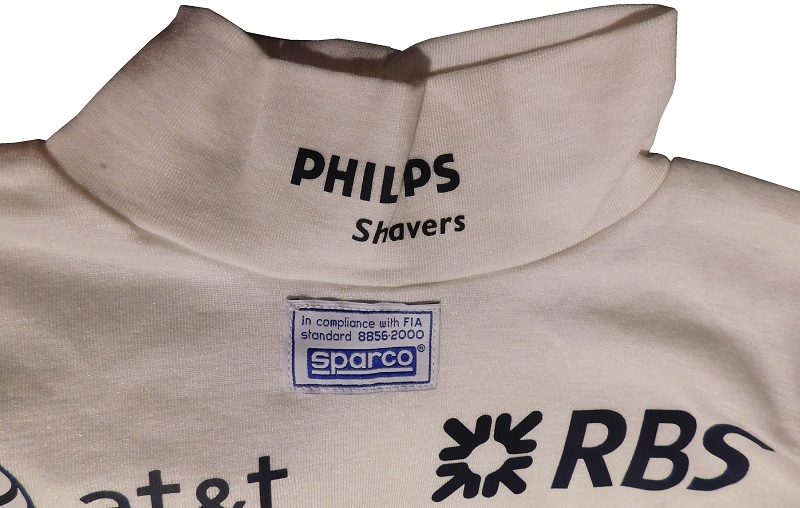
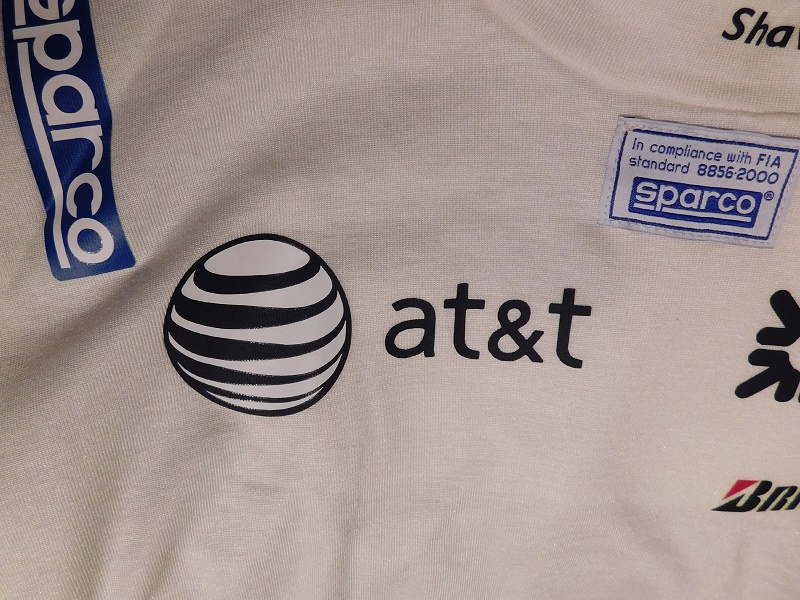
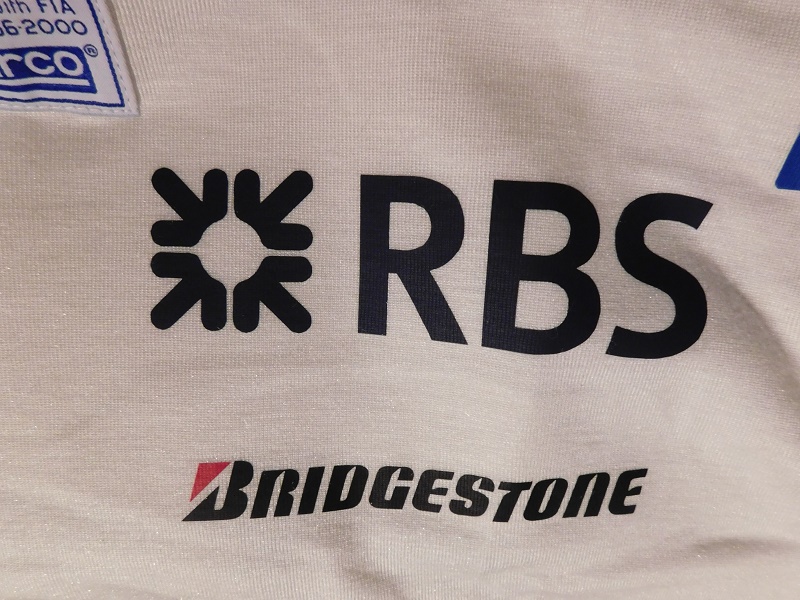
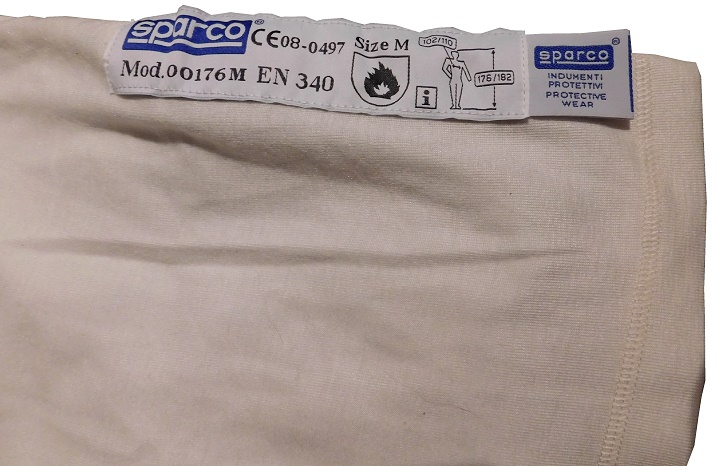
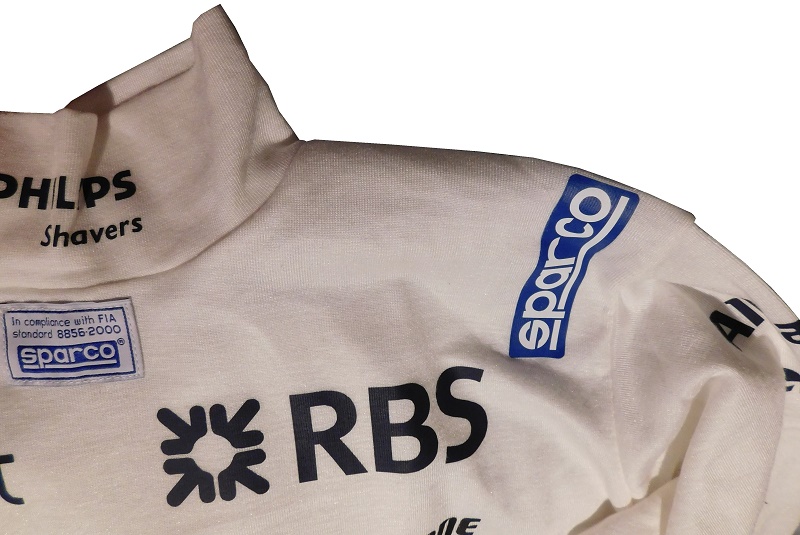
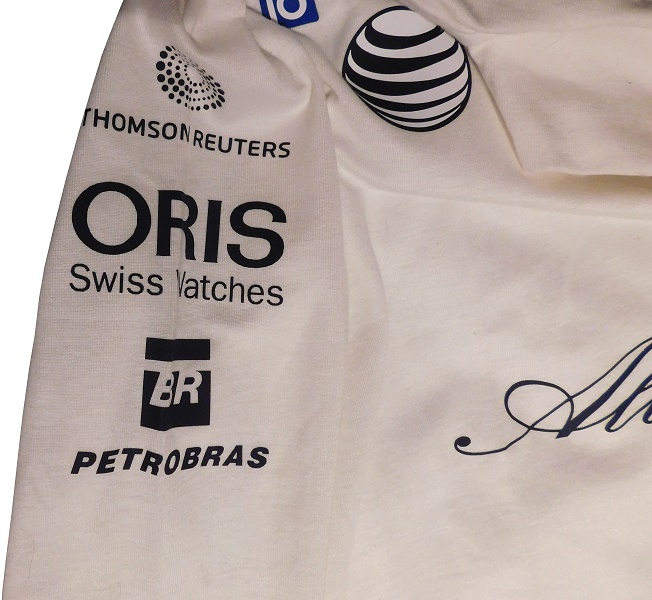
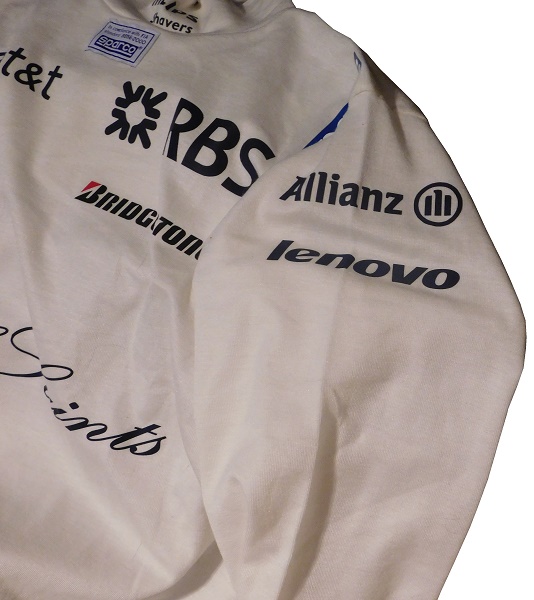
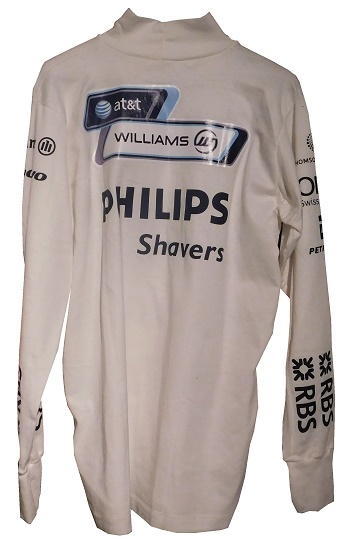
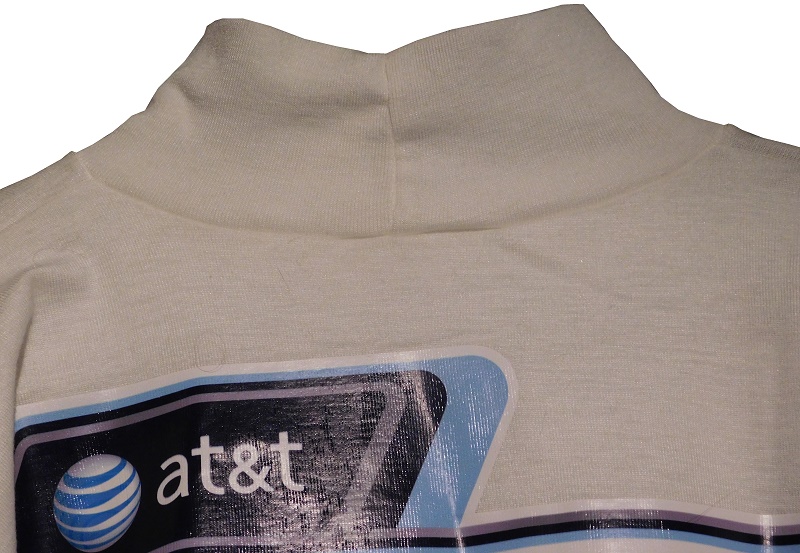
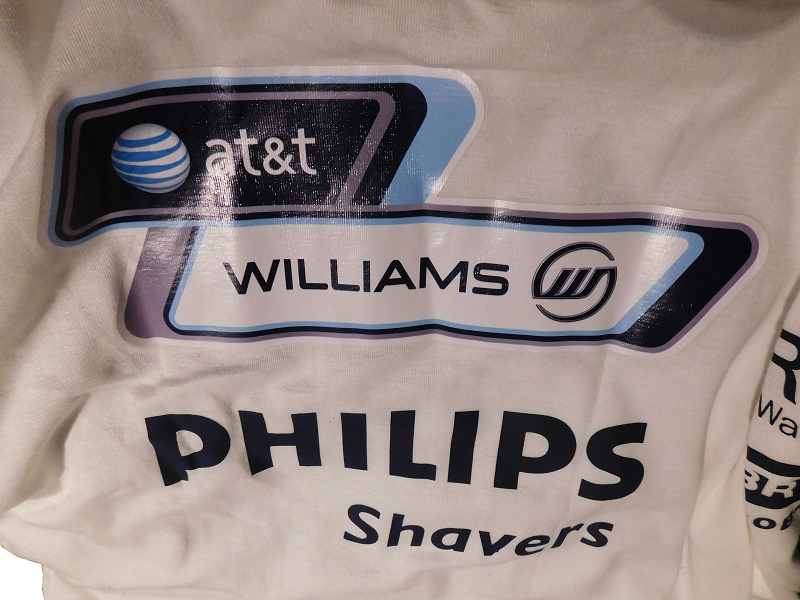
As I said above, Formula One is really focused on logo placement on uniforms. Drivers are given special undershirts that mirror the logo placements on driver suits. This is done so that the driver can wear the suit pulled up to the waist, for comfort, without taking sponsor exposure away. This example is a Kazuki Nakajima undershirt from 2008.The shirt shows light use, not uncommon, as Nomex undershirts are often rotated by the driver. The Nomex here is a much lighter and thinner version than NASCAR or the NHRA uses.
The front collar features a Phillips Shavers logo heat pressed into the fabric. There is no cowl tag. There is a Sparco FIA compliance tag sewn into the area just below the neck.The right chest features an AT&T logo heat-pressed into the Nomex material.The left chest features an RBS logo and a Bridgestone logo.The front torso has an All-Saints logo present.The left side has a Sparco inventory tag, which also has wash instructions. The tag is sewn in a vertical style, as opposed to a jock-tag style attachment.The shoulders have Sparco logos in epaulet position, but have no epaulets or other adornment.The right sleeve features THOMSON REUTERS, OTIS WATCHES, and BR PETROBAS logos heat pressed on the upper arm, and RBS logos present on the end of the sleeve in television position.The left sleeve features ALLIANZ and LENOVO logos on the upper sleeve, and RBS logos in television position.The back of the shirt doesn’t show any wear to speak of.The back of the neck has no adornment present.The back of the shirt has two logos. A WILLIAMS AT&T logo on top, and a PHILLIPS SHAVERS logos underneath.Going back to the Guy Smith article, I just don’t get why in the world NASCAR isn’t doing this more. Sponsors would love them, fans would love them, driver would love them, it works out well for everyone. Granted, there are some teams that are doing this, but why all the top teams aren’t is mind boggling. I’d also like to point out that this would help the NASCAR memorabilia market. American racing fans would love to own one of these custon shirts, yet for some strange reason, they never seem to happen. Do you honestly think that fans wouldn’t want to own a race-worn undershirt from their favorite driver? Fans will buy anything, and I mean ANYTHING with their favorite driver’s name and/or number on it. These would sell very well. I’m totally lost why this isn’t a fixture in NASCAR.
Next week, we will stay with Williams F1, but in a more recent example, from one of their current drivers.
This week, I finally get to start Formula One Month. Formula One is the biggest auto racing sanctioning body in the world. Nobody can deny that. Races can see over 300,000 spectators at the track, and 58 million viewers on television. Teams cover over 50,000 miles in travel distance and many engineers work on the car while never leaving their race shop. The cars are more sophisticated than any other racing vehicle in the world. Formula One has proven to be the great auto racing group in the world.
The merchandise table is a key to their success. While the pricing of items is a little suspect, fans will wear their affiliations on their shirts. But as I discussed a few weeks ago, the race-used memorabilia market in F1 is significantly different than in NASCAR and the NHRA. NASCAR is very big in body pieces or “sheet metal.” The NHRA is very big in engine parts. While F1 has some of these available, they are much more pricey than their NASCAR and NHRA counter-parts. Formula One isn’t run by dumb people, they do realize that there is a demand for these items.
These items come to sale sometimes. One such way these items come to market is when a team changes names or goes belly up. While many items can be salvaged, some items can’t be, and are sold to collectors. One such example is this this Virgin Racing interview backdrop from 2011.The backstory on this is that Virgin Racing was founded as Manor Racing, and carried a Virgin sponsorship in 2010. In 2011, Marussia Motors, a Russian sports car company bought a stake in the team, and the team was re-branded as Marussia Virgin Racing. With the new team came the inclusion of the Marussia logo into the team. Their run as a team was unimpressive one, with neither driver scoring points. The team became Marussia F1 from 2012 to 2014, when the team shut down due to financial issues. In 2015, the team was re-branded to “Manor Marussia F1 Team.” After 2015, Marussia ceased to exist, and ceased their F1 team, and the team was re-branded to Manor Racing.
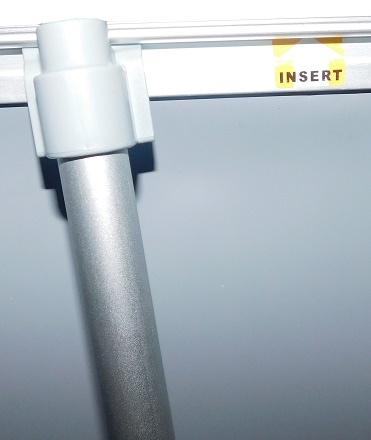
This interview backdrop is a portable one, specifically made for team members or special guests to stand in front of while giving an interview. It’s almost 4 feet wide, and well over 6 feet tall. It consists of a cloth container with the backdrop inside. It’s in great condition.It’s almost 4 feet wide, and well over 6 feet tall. It consists of a cloth container with the backdrop inside. The backdrop has a balance leg, and the cloth part rolls up. A collapsible pole holds it up. I’ve given a demonstration of the effect they are going for…Now while F1 is not as readily selling body pieces, they do sell them. Teams will change their designs due to rule changes, and they will sell the old body pieces. What I’ve noticed is that a lot of teams will encase the pieces in Lucite or something similar. I think that this might have to do with secrecy. The teams want to make money, but they don’t want to give their hands away on what they make their cars out of. I also like the idea of a body panel in Lucite. It looks good, and makes a good fit for an office.
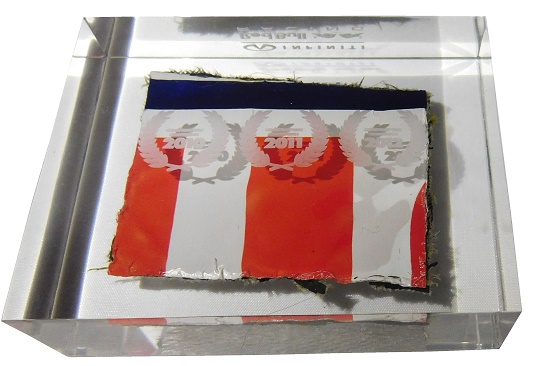
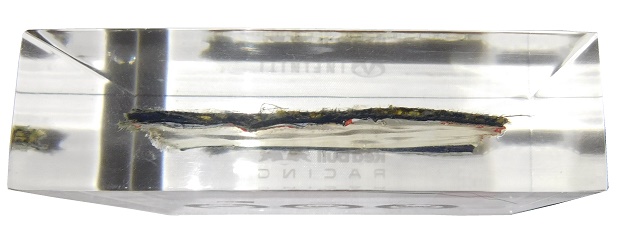
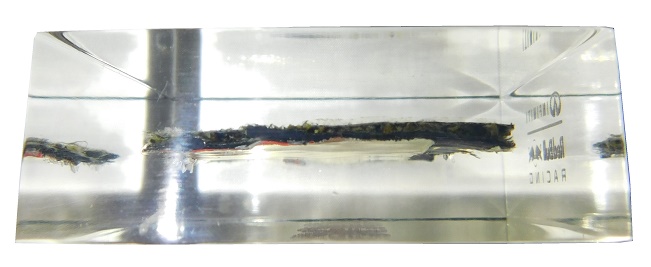
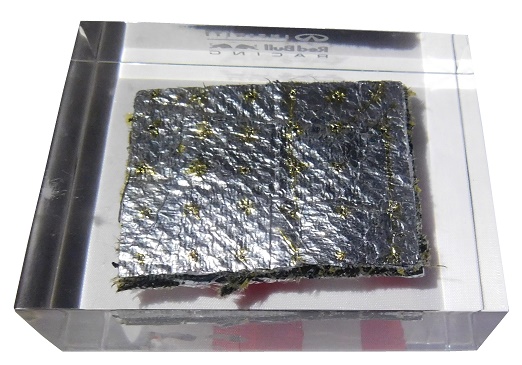
This Red Bull piece is one such example. The piece is just under 2.5 inches long, and is encased in a piece of Lucite which is 3.5 inches by 3 inches by 1 inch. It’s blue, with red and white logos, and the three championships etched into the glass. The top has Infiniti Red Bull Racing etched into it. This would place it between 2013 and 2015. It comes with a small COA and a small blue pouch. Other than that, there is no information about when it was used, or who by.I get that the limited number of engines used by an F1 team, and the restrictions on how many parts can be used limit what could be sold, but there is a genuine market for these parts. I’m also wondering why F1 doesn’t market race-used tires. That would be a gold mine for F1, Perelli, and the teams, and collectors will love them. I also get that because the body on an F1 car doesn’t get changed as often as NASCAR, the market for body pieces is limited. I just wish prices were lower because I would buy more items.
While body pieces and parts are in limited supply, uniforms and uniform items are in decent supply, and are decently priced. I’m going to get more into uniform design in the coming weeks. Next week, I’m examining an undershirt.
Endurance car racing has had many forms in the US. One of the most noted sanctioning bodies was the American LeMans Series. Founded in 1999 by Don Panoz, owner of Road Atlanta and the brains behind the Petit Le Mans, the American LeMans Series or ALMS was one of the major sports car racing series, in addition to the Grand-Am Road Racing. From 1999 to 2013, American LeMans raced LeMans Prototypes and Grand Touring classes in a number of rovals, and road courses. In 2014, American LeMans and Grand Am merged to create the WeatherTech SportsCar Championship, which is run by IMSA.
As I mentioned last week, sports car racing doesn’t have the visibility of NASCAR or F1, but they do have a large and dedicated fanbase. Also, while NASCAR tends to have American based drivers, sports car racing attracts drivers from all over the world. One such driver is British driver Guy Smith. While he has a boring name, he has had a great career, winning the 24 Hours of LeMans in 2003 for Team Bentley in the Bentley Speed 8 LeMans Prototype. Prior to racing in sports cars, he raced in the Indy Lights series, then he raced in Champ Car. While racing sports cars, he would alternate between ALMS and Grand Am.
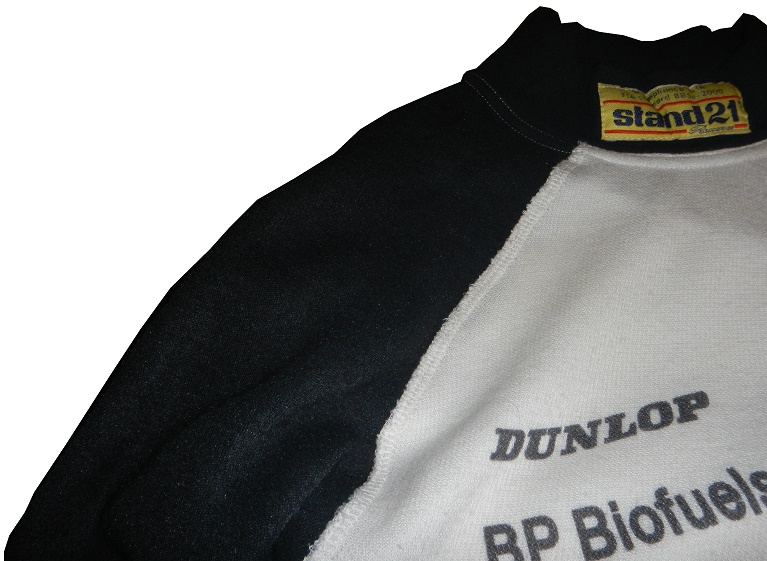
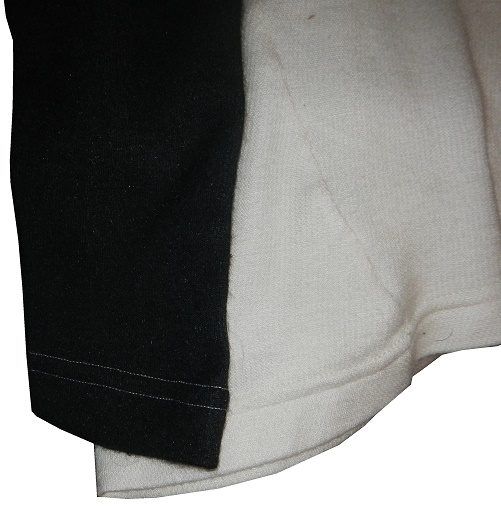
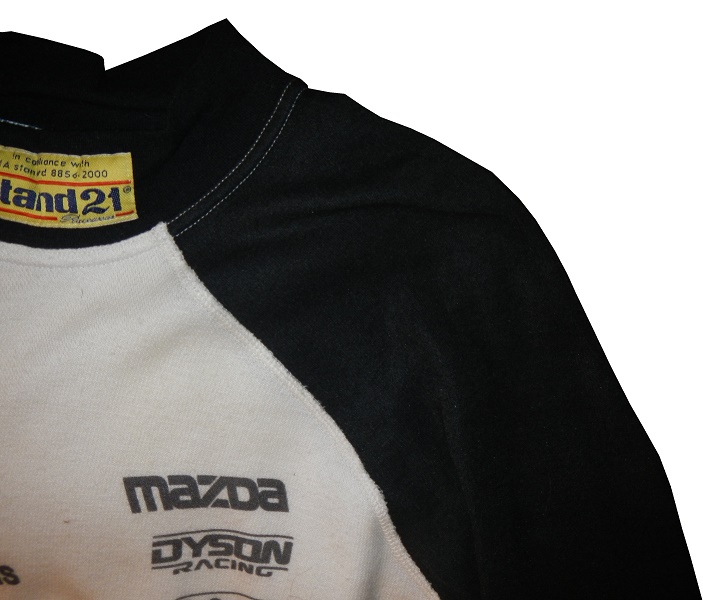
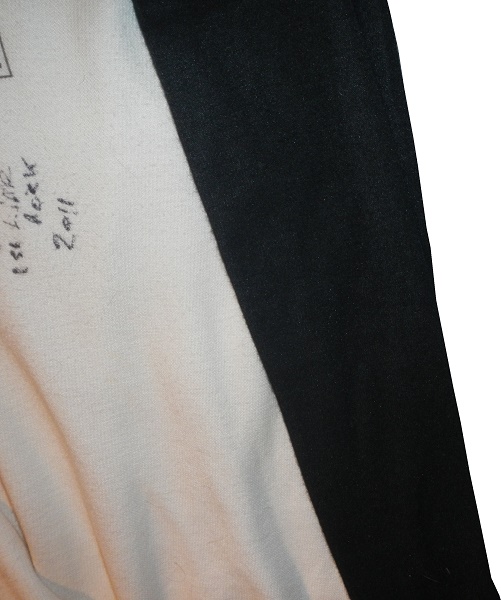
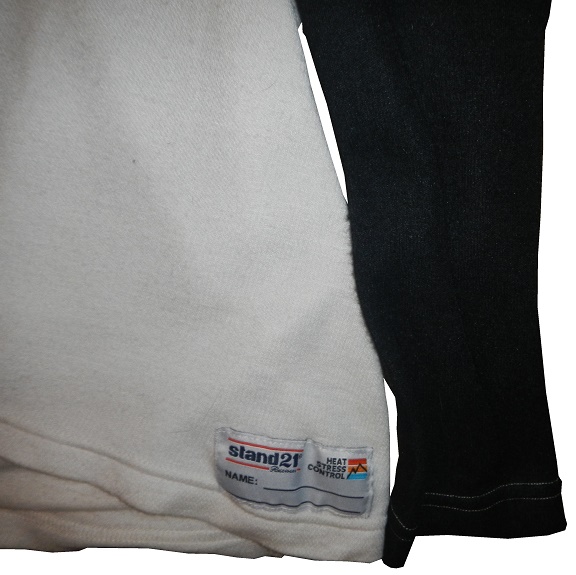
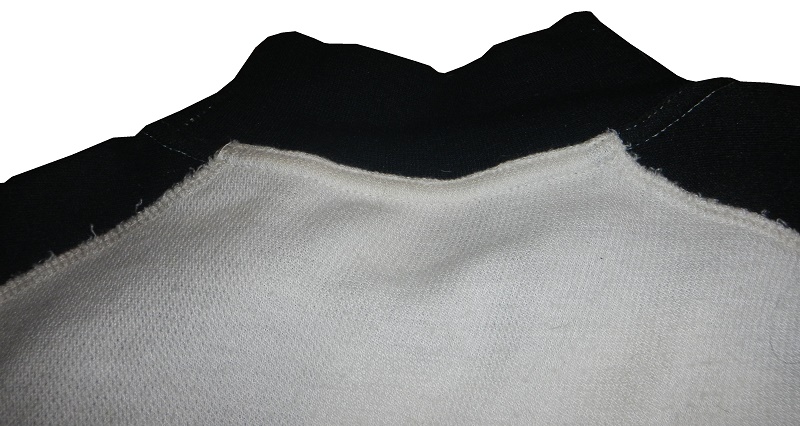
In 2005, Smith signed with Dyson Racing. Together, Smith and Dyson would go on to have a successful partnership for many years. The partnership has 6 wins, 42 podiums, and the 2011 championship. In 2011, the team won a single race, The 2011 Northeast Grand Prix at Lime Rock Park in Lakeville, CT, but with 7 podiums in 9 races, they solidly won the championship. During that season, Smith wore this undershirt.The shirt shows light use, with some very light stains. Guy has signed the front of the shirt and added “Lime Rock 2011”The thick front collar has a Stand 21 tag sewn into it. The tag has the FIA Certification as well as the Stand 21 logo.The front has DUNLOP, BP BIOFUELS, THETFORD, MAZDA, DYSON RACING, and CASTROL logos heat-pressed into the white material. Guy has signed the area under the Castrol logo, and added “Lime Rock 2011.”The bottom-left side of the shirt features a Stand 21 tag, and sewn into the inside is a wash tag that indicates that the shirt is “50% Aramid 50% Viscose.”The shoulders and sleeves are in a black cloth, as opposed to the white front and back. They have no logos or patterns adornment.The back of the shirt is plain white.I’m noting something that I noticed. The shirt is 50% Aramid and 50% Viscose. What I find odd is that a racing undershirt would be certified when it is made of material that isn’t known for its fire retardant properties. I had never heard of Viscose prior to this, and from what I’ve been able to find, it’s more of a material used for a t-shirt or shorts, than for a racing shirt. Also, unlike the items I will examine in the coming weeks, this shirt is decently thick, and quite hefty.
It’s also worth noting that the reason there are sponsor logos on the shirt is so the driver doesn’t have to wear his firesuit up while on camera and the sponsors can still get exposure. I will discuss stuff of similar design in the coming weeks. What I’ve noticed is that while it’s practical, it is only being used in NASCAR by Jamie McMurray,
I’m really wondering why this isn’t the standard in NASCAR like it is in Formula 1. It makes logical sense from a comfort perspective, and a sponsor exposure perspective. Every suit is designed with maximum sponsor exposure in mind. I can’t understand why an undershirt wouldn’t receive the same treatment.
IndyCar fans hate Tony George with a passion that is hard to describe. In fact, George founded the Indy Racing League after getting kicked out of the CART board of directors. This started the IRL/CART civil war known as “The Split.” The Split, which lasted from 1995 to 2009, more or less devalued the sport to the point that the sport not only lost money during the biggest auto racing boom in history, but also lost sponsors, drivers, and fans to NASCAR. Even today, television and attendance numbers are still down.
I’m convinced that some of the damage could have been prevented in 2003, when Gerald Forsythe, Paul Gentilozzi, and Kevin Kalkhoven purchased the assets of CART. They created Open Wheel Racing Series LLC, which later became Champ Car World Series LLC. From 2004 to 2009 they operated the Champ Car World Series, which kept The Split going, and kept draining the sport. Had Tony George bought CART’s assets, the split could have been eliminated, and maybe the sport could be in a better place. Then again, knowing Tony George, that probably wouldn’t have happened.
Gerald Forsythe is the former owner of Forsythe Championship Racing which was a long time team in IndyCar. Kevin Kalkhoven bought the remains of Pac West Racing, and turned it into KV Racing Technologies, which is still opperational today. Paul Gentilozzi is a real-estate magnate who races cars in his spare time. He won the 1994 24 Hours of Daytona with three other drivers in a Nissan 300ZX. He also won the GTS class in the 2002 24 Hours of Daytona in a Jaguar XKR. He raced Jaguar XKRs for many years, with some success.
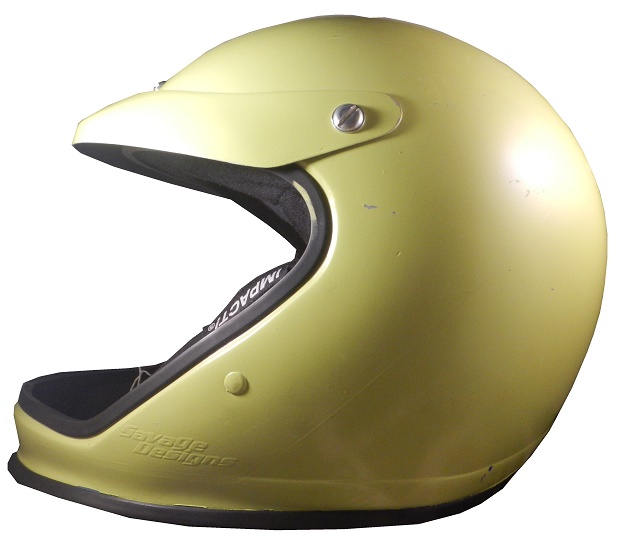
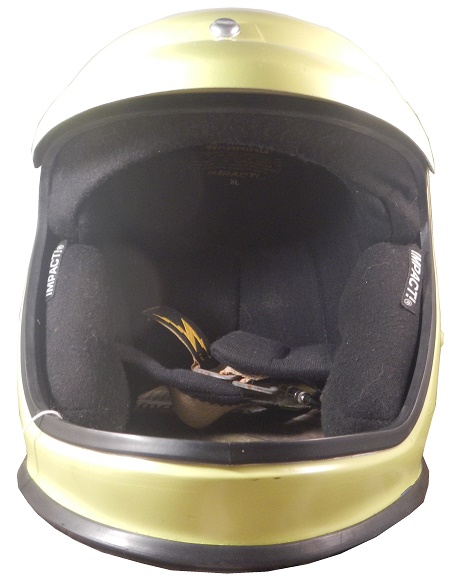
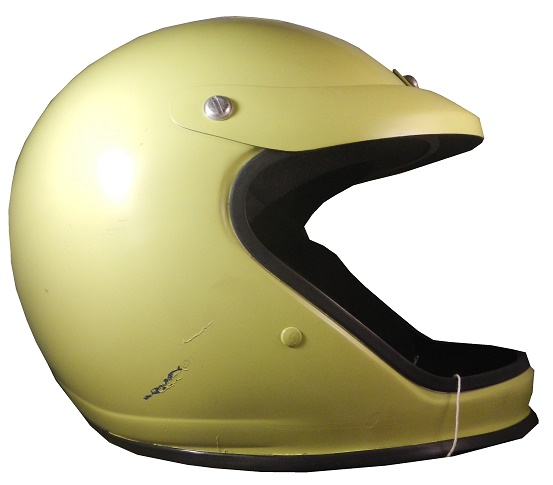
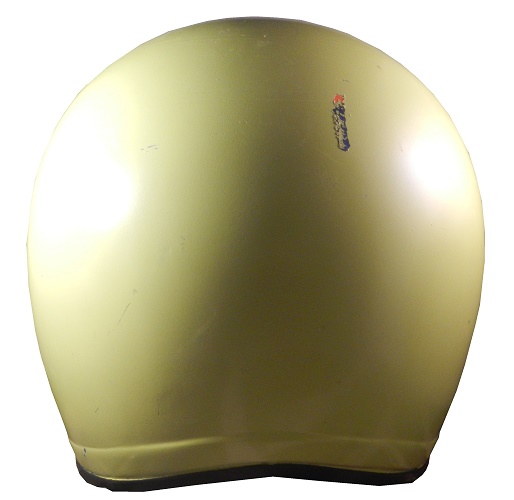
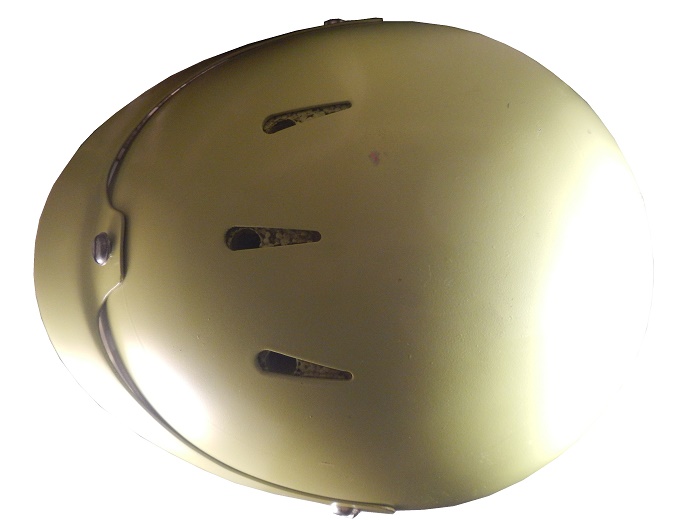
From 2009 to 2011, Gentilozzi raced a black and green Jaguar XKR. He did not have much success, with a high finish of 9th at Mid Ohio in 2010. One of his pit crew members wore this Jaguar Green helmet during that time.The helmet has numerous scratch marks present, and has obviously been repainted, as the old Savage Designs paint job is still visible underneath the green paint. Some of the scratch marks reveal that the helmet was blue.
The inside of the helmet has a radio connection, with the earpieces and wires, but no microphone. The straps are all intact as well.While Gentilozzi was primarily a sports car racer. He raced LeMans, and Sebring, in addition to IMSA. While IMSA and other sports car racing groups don’t get the same level of coverage as NASCAR or IndyCar, they have good sized fan bases who are very devoted. Next week, we will examine an undershirt from 2011.
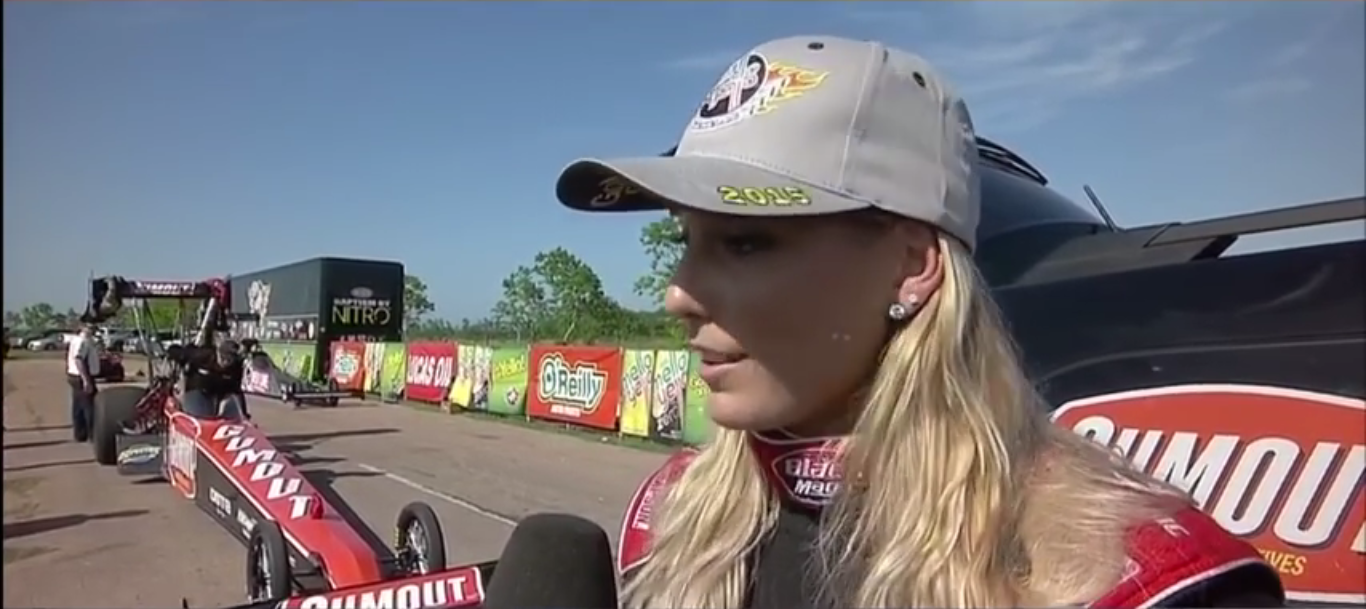
With the rise of racing as a televised sport, sponsors and sanctioning bodies are eager to get their brands on television. This has given rise to an interesting industry, the interview cap. These are caps worn by drivers and/or crew members for interviews. In Formula 1, the drivers on the podium are issued caps with Pirelli logos, feathers on the brim, P-Zero on the left side, and the rank and location on the left side. IndyCar drivers are issued Firestone branded caps. NASCAR will issue hats to the drivers in victory lane, some drivers choose to wear their own sponsor caps, and then, the hat dance takes place.
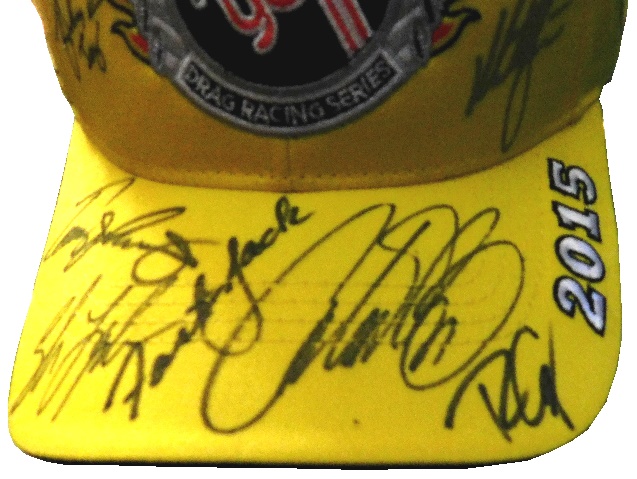
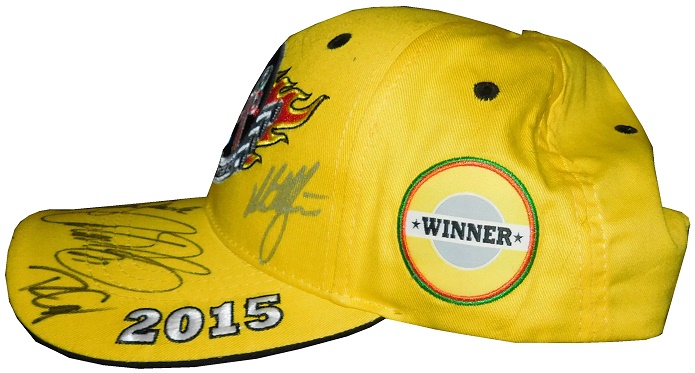
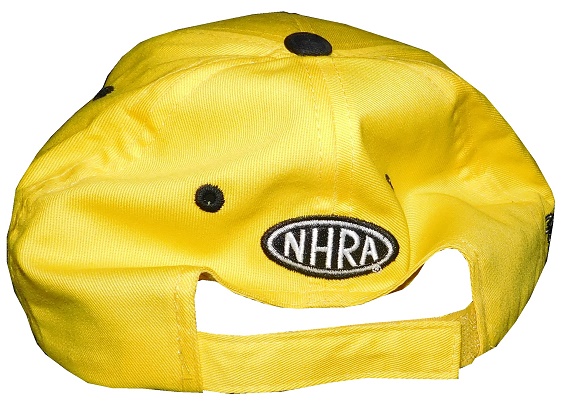
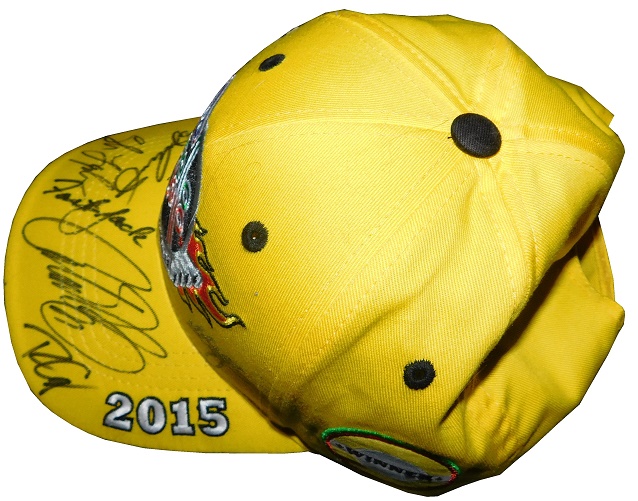
The story behind these interview hats in drag racing is interesting. Mello Yello and the NHRA give these hats out to drivers at events, and there are a series of different colors. There are four different sets of interview hats. For qualifying and round winners who don’t wear a sponsor hat after getting out of a car for an interview, they are given a black hat. For 2016 the orange and gray hats were eliminated. They are all of the same design. For the driver who qualifies #1, they are given a green hat, with a #1 Qualifier patch with their respective class.I got a #1 qualifier interview cap from The Thunder Valley Nationals. It’s a one-size fits all green cotton hat. It has the old Mello Yello Drag Racing Series logo embroidered on the front, a #1 Qualifier patch on the side, and an NHRA logo above the Velcro strap, and the venue name BRISTOL on the Velcro strap. I got it signed by Tony Schumacher, Ron Capps, Tommy Johnson Jr., Fast Jack Beckman, Erica Enders-Stevens, JR Todd, Alexis DeJoria, John Hale, TJ Zizzo, Antron Brown, Terry McMillen, Hector Arana Sr. Clay Millican, Hector Arana Jr., Angelle Sampey, Robert Hight, Leah Pritchett, and John Force.The drivers who win the event get a yellow cap, with a winner patch to wear, similar in design to the #1 qualifier hat. The cap color is yellow, on the patch, the word WINNER replaces #1. As with the qualifyer hat, the race venue is embroidered into the back strap. This example is an unused winner circle hat, with no class on the side, or race venue on the back strap. It comes signed by Tony Schumacher, Antron Brown, Shawn Langdon, Ron Capps, Tommy Johnson Jr., Jack Beckman, and Matt Hagan.The drivers who win the championship get a white hat.
Most NHRA drivers wear these hats during interviews, except for John Force who prefers to wear his own hat for an interview after he qualifies #1 or wins. The white hat for the championship was possibly inspired by Force. Though I haven’t found any concrete evidence of that. Drivers do not keep these hats for themselves, even the championship ones, and they often find their way on to eBay. They are popular to get signed by drivers at events.
We are going to keep the headgear train rolling with a post next week about a helmet.
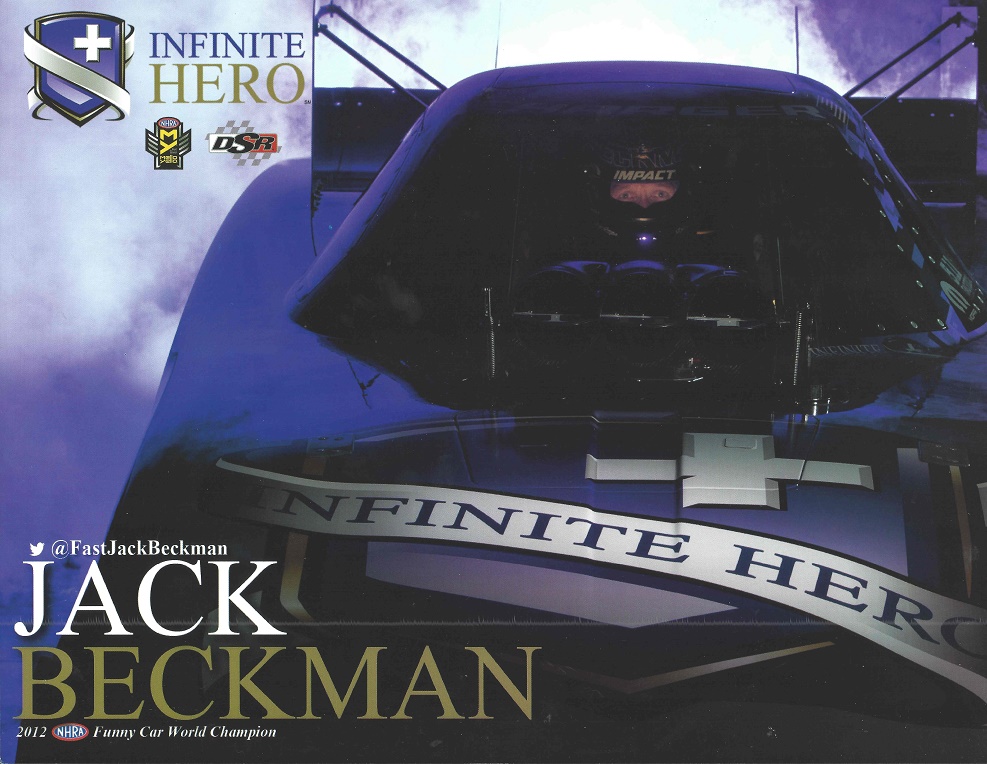
I wrote about the Infinite Hero Challenge Coin program last year, and I’m going to revisit it. I’ve learned some more information about Infinite Hero Coins, that I didn’t have before, so I’m going to add this new info, for the sake of completeness. I’m also going to add some of the other Jack Beckman Infinite Hero Challenge Memorabilia, instead of just the coins.
Launched in 2011, The Infinite Hero Foundation “…is to combat the most difficult front line issues – mental and physical – facing returning military heroes and their families.” Military personnel returning from overseas deployment face long term employment, mental and physical problems that the majority of Americans don’t understand. They work with other non-profit veterans groups and give out grants to help service men and women cope with these long term problems.
Like many veterans groups, Infinite Hero uses auto racing as a way to promote their cause. But unlike most groups Infinite Hero came up with a new and unique way to raise funds. Infinite Hero uses an emblem that, according to their site, “The Infinite Hero emblem incorporates the color purple to honor those who have been wounded in battle, the Greek cross to signify aid, and the infinity symbol to represent the conviction that the sacrifices of heroes should always be remembered. The Infinite Hero Foundation thanks our founding corporate partner Oakley for their leadership and guidance in creating the Infinite Hero logo.”
Infinite Hero quickly realized that Oakley was a great partner, and began working with them to come up with some unique merchandise as a part of the partnership. The Infinite Hero Foundation was founded in 2011, and quickly acquired a partnership with Oakley. This resulted in a series of merchandise items sold by Oakley, with proceeds going to help the Foundation.
I’m not into sunglasses myself, not anymore, but many people are, and Oakley has a lot of fanboys. So, once these glasses began to hit shelves, they sold quickly. This is a review from 4 years ago, of one such pair.
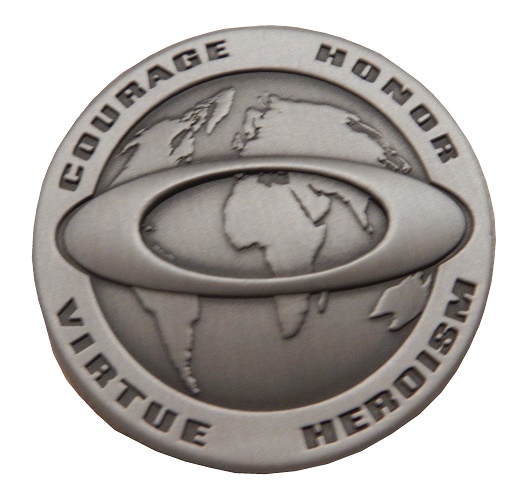
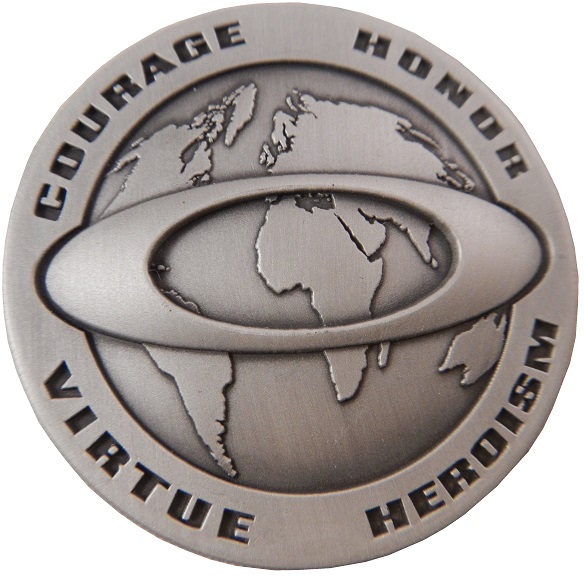
Notice the coin in the box? Of course you did. Aside from glasses and boots, Oakley realized that the coin would sell too. So sometime, I’m guessing 2012-2013, this coin was sold.
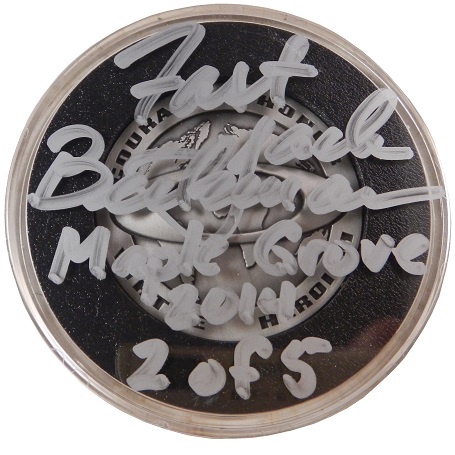
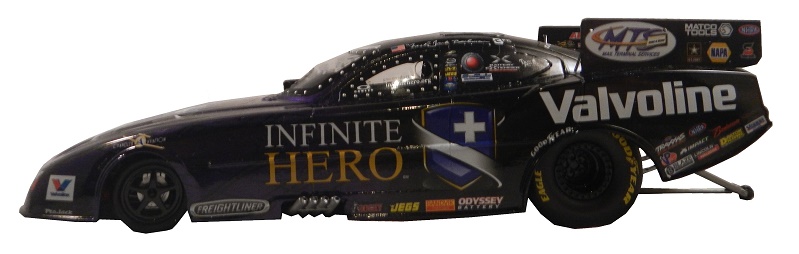
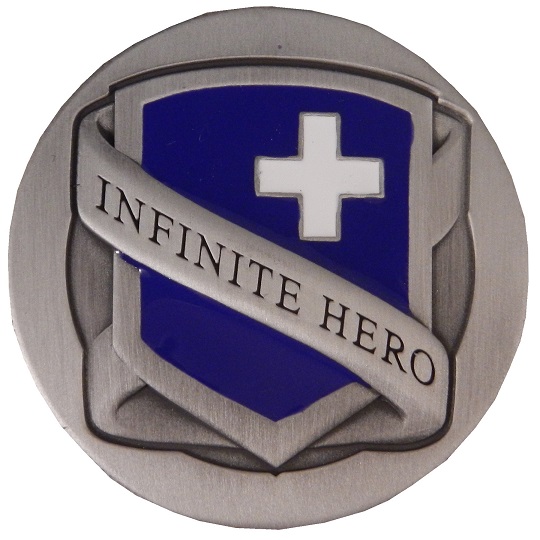
It is quite thick, and has a ridged edge. One side featured “Courage, Honor, Virtue, Heroism,” around a globe design with an Oakley logo. Oakley is a partner with the Infinite Hero Foundation. The other side features an Infinite hero Foundation logo. The coin was placed in a round, flat plastic container, with black foam braces. The coin lacks the blue enamel that the coin that comes with the glasses coin, and future coins, and has a very plain look. I do like the plain look.In April 2014, they started appearing on the side of Jack Beckman’s funny car. Terry Chandler, who also sponsors Tommy Johnson Jr.’s Make a Wish Foundation Funny Car, is the financial backer of the car. She pays for Infinite Hero to race on the sides of the car. This also began the NHRA coin program. This is a new form of racing memorabilia I have never seen before, though it’s a great idea. When Jack Beckman gets into his funny car to race, he carries at least 5 Infinite Hero Challenge Coins in the pocket of his driver suit. Once the race is over, he will autograph them and sell them at the track and on eBay. They cost $100 with all proceeds going to the Infinite Hero Foundation.The idea of items carried in a pocket is not a new one. NASA has done this for years. Many space shuttle flights carried first day covers in the storage bay. When the shuttle landed, the covers were removed, and sold to collectors. I’m a little surprised this hasn’t been done before with auto racing, because I think that it would create a new memorabilia market.
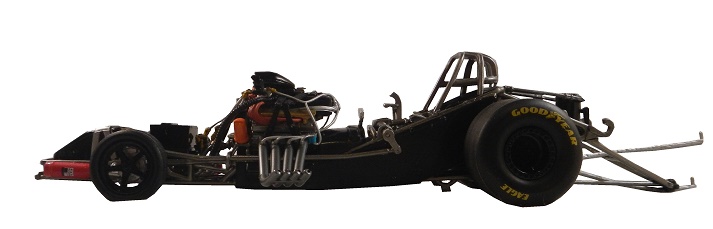
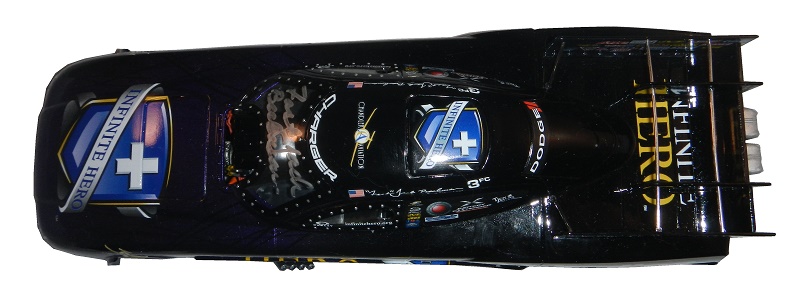
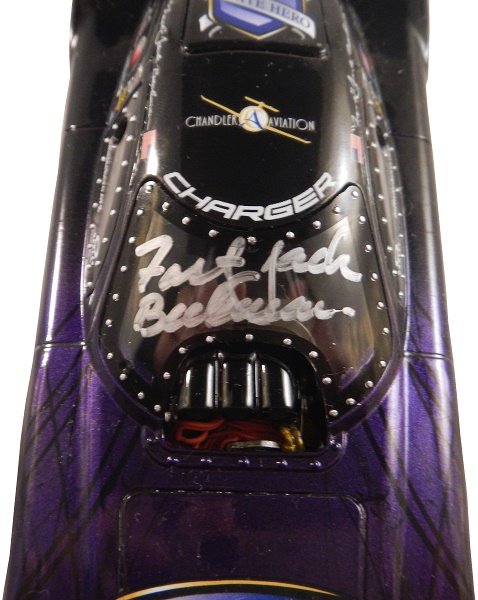
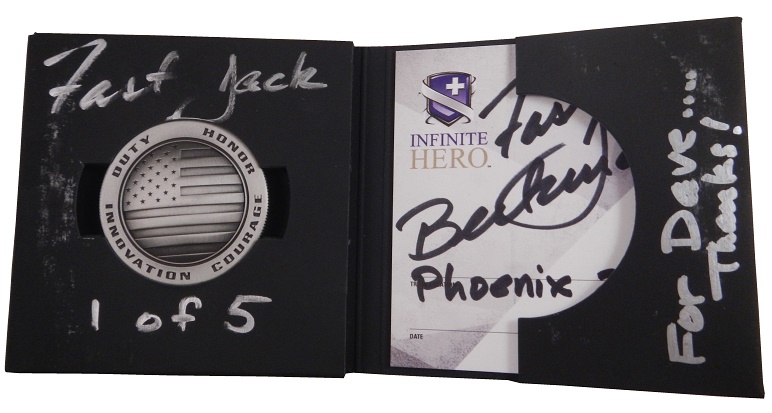
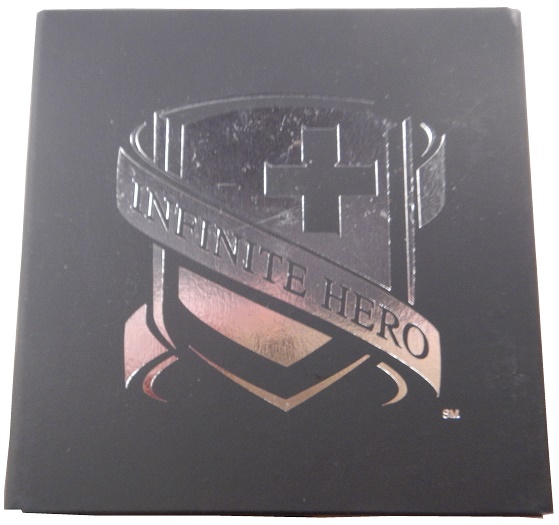
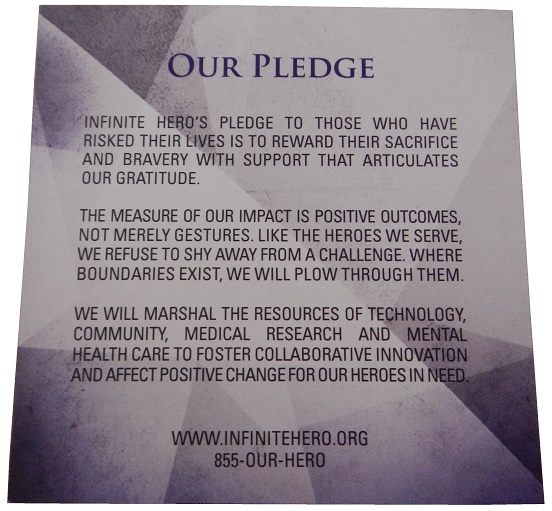
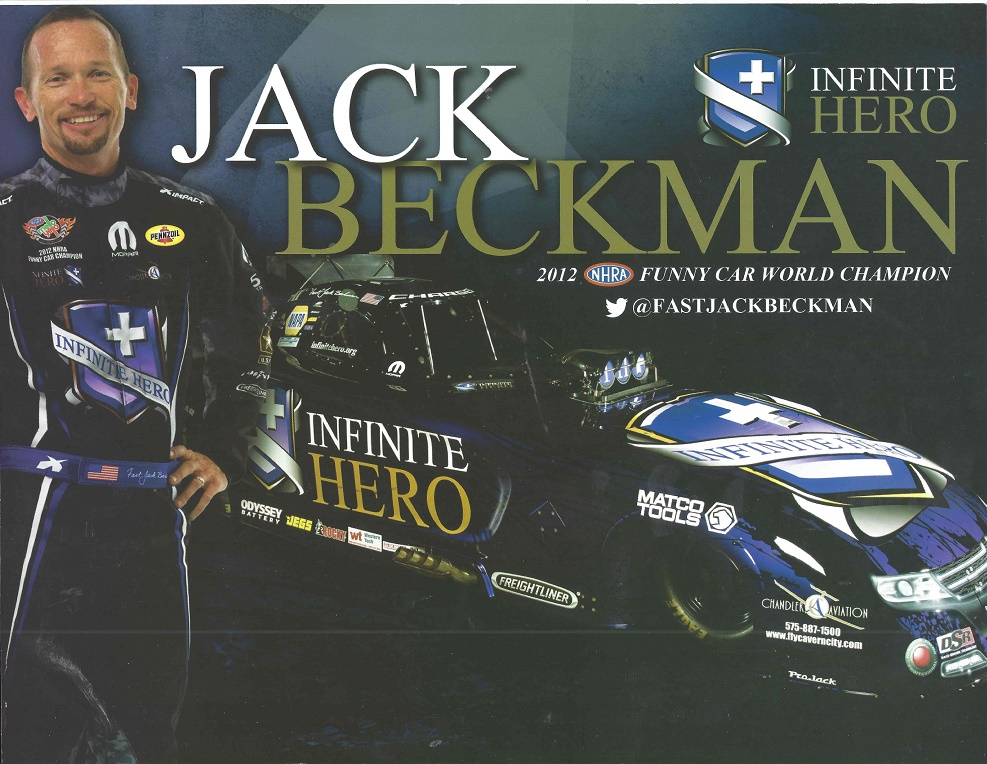
The 2014 design that Jack used was identical to the one sold in stores, but the Infinite Hero Foundation logo has a purple enamel present. Jack autographed the plastic case.Also in 2014, this 1/24 scale die cast was produced. It is a full replica of Beckman’s funny car. Valvoline was a primary sponsor, and this was the only season Infinite Hero and Valvoline were together on the car. It’s also the only time that Infinite Hero Challenge appeared on the older Dodge funny car body. In 2015, the current body was introduced, and Pennzoil replaced Valvoline. Jack has autographed the windshield.A redesigned coin of the same size was introduced for 2015. The Oakley logos are gone. One side features a design similar to the globe design, but the globe design has been replaced with an American Flag design. “Courage, Honor, Virtue, Heroism” has been replaced with “Duty, Honor, Innovation, Courage.” The new emblem on the reverse side has one of the across bands removed. The new packaging is an upgrade, with the circular plastic cylinder replaced with an attractive box. It comes with a card that Jack Beckman autographed, and on the reverse it has the Infinite Hero Foundation Pledge. The first one is from The CARQUEST Auto Parts NHRA Nationals at Phoenix on February 22, 2015, where Jack was eliminated in the first round.The second one is from the Summit Racing Equipment NHRA Nationals in Norwalk, Ohio, where Beckman won the event, beating Courtney Force in the final round.Also in 2015, these hero cards were produced. Hero cards are given away at racing events and driver appearances. They have Jack’s picture, and information about the driver, team, and the Infinite Hero Challenge.For 2016, the coins got a major makeover. The Infinite Hero logo is now bigger. The words “Reimagine” and “Recovery” are stamped near the logo, and on the opposite side, a picture of Jack’s funny car replaces the flag motif. It should also be noted that the coin is slightly smaller, because it isn’t as tight in the coin case as the previous version. The Infinite Hero Pledge accompanies the coin. Also changed from 2016, Jack doesn’t sign the box and the pledge, he just signs the pledge.Hero cards are given away at racing events and driver appearances. They have Jack’s picture, and information about the driver, team, and the Infinite Hero Challenge. For 2016, a new card design was introduced. It has updated information, as well as the updated paint scheme introduced at the beginning of the season.The Infinite Hero Foundation is a worthwhile charity, designed to help our nations veterans. I fully support them, and I encourage my readers to try and buy at least one of these coins.
Racing uniforms stand out from every other uniform in sports because every aspect of the uniform without exception is specifically designed to protect the driver first, and look good second. Unlike in baseball, football, or hockey, where a couple of the visible items protect the wearer, every piece of the uniform, from helmet to boots is designed to protect the driver. One of the more vulnerable areas a driver has is their hands. If a drivers hands are injured, they can’t control their cars, or exit their cars in the event of a wreck. Funny Car drivers have the toughest glove setup in all of auto racing.
Ranked as #27 on the list of the NHRA’s 50 Greatest Funny Car Driver by Motorsport.com, Big Jim Dunn raced for over 40 years as a driver. He could win races driving some of the tougher cars in the series. Dunn began racing in 1953, at the age of 19. By 1965, he was running in Top Fuel, and by 1969, after winning the NHRA Division 7 championship, he switched to Funny Car. He raced until 1990, when he retired as a driver, and switched to team owner. He’s had success as a crew chief, technical adviser, and a team owner. His son Mike has 22 wins, was a long time announcer for the NHRA television team on ESPN, and is currently the president of the IHRA.
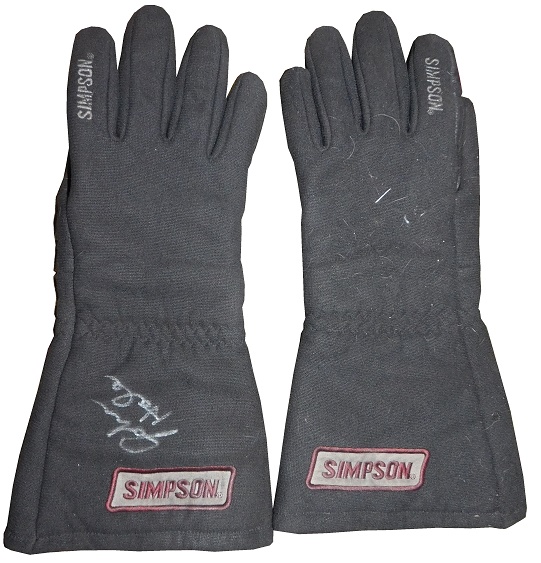
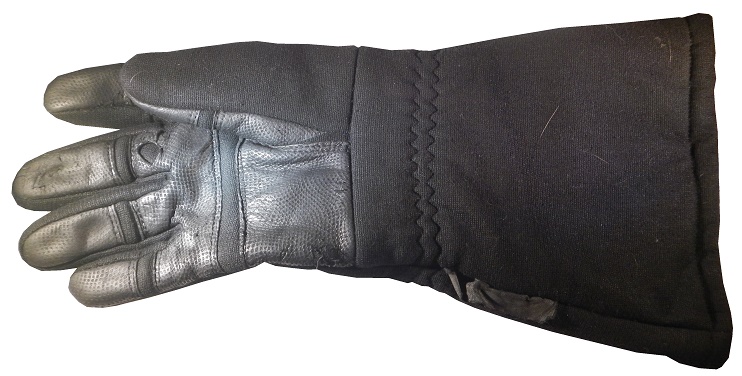
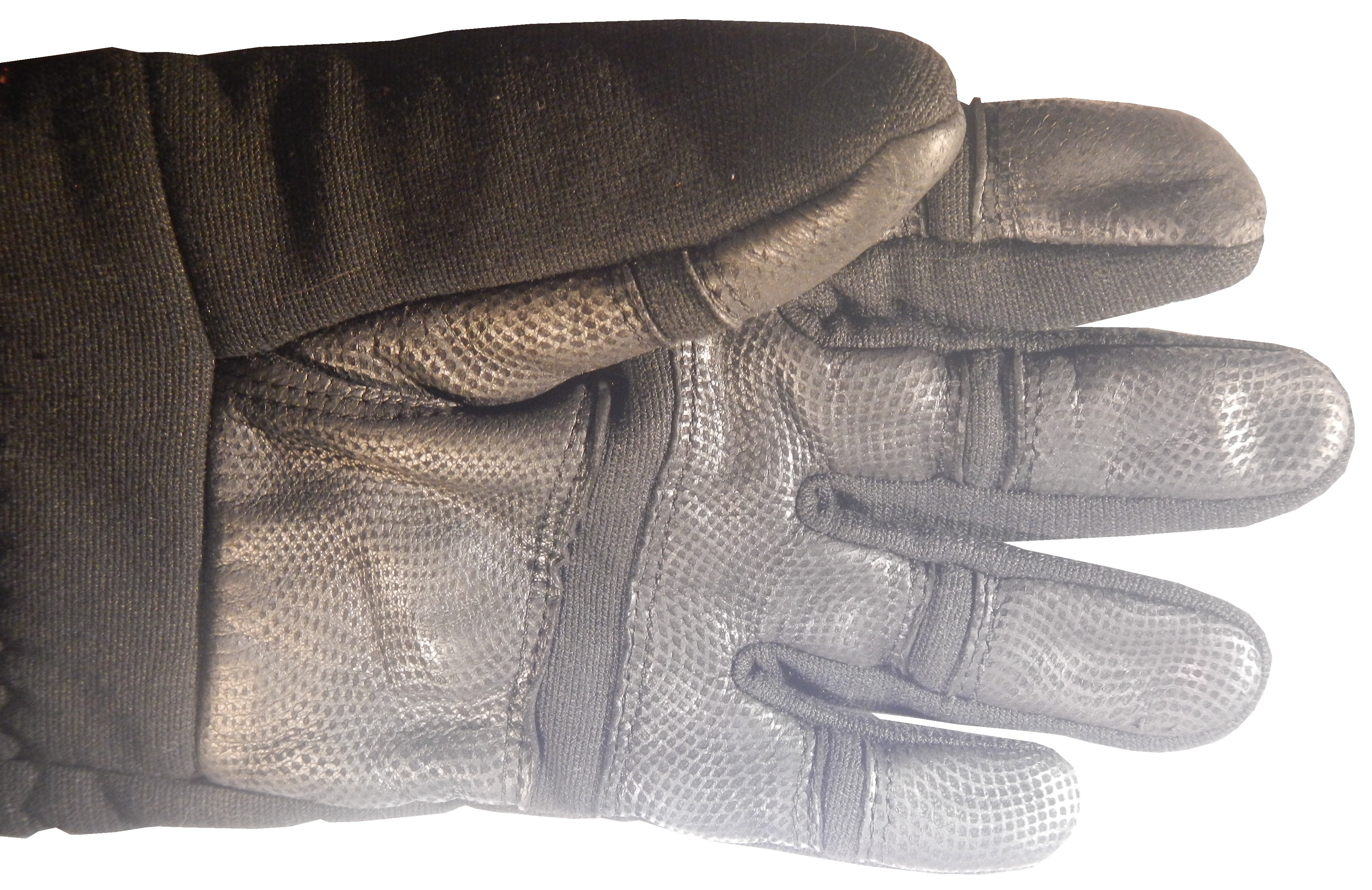
At the beginning of the 2015 season, Dunn had to fire driver Jeff Arend due to Grime Boss leaving as a sponsor. Replacing Arend was John Hale. Hailing from Addison, Texas, John Hale currently races for Jim Dunn Racing. He is also active in the Nostalgia Funny Car series in the NHRA. Although he doesn’t have a race win, he finished in the runner up position at the Gatornationals in 2015. He also won a Wally for his Hubert’s lemonade scheme at Norwalk in 2016.Funny Car drivers wear two sets of gloves while driving. One set is similar to what firefighters are wearing. The other is a thick set of gloves that extend all the way up to just below the elbow. They require a crew member to help put them on. This set of gloves worn by John Hale is a perfect example of those gloves.These Simpson SFI 20 rated gloves show decent use with scuff marks and material loss. These gloves are changed several times per year, due to wear. John has autographed both gloves.The right glove has some material loss on the palms, the tag has been destroyed by race use, and John has autographed the glove on the top, near the Simpson logo.The left glove features some light wear on the palms, like the right glove, the tag has been destroyed through race-use, and John signed the bottom of the glove, near the top of the cuff.John also signed this Hubert’s Lemonade hero card. It’s interesting in that it’s a dual-sided card, where both sides of the card are exactly the same.Funny car drivers wear 20 pounds of equipment while racing 2,600 lb, 10,000 horsepower cars at 330 MPH. The dangers of failure are all too obvious. There have been many drivers that have given their lives for the sport they love. Next week, I’ll show some of the perks of winning a national event in the NHRA.
When Del Worsham won the Funny Car championship last year, he joined an exclusive group. He is one of three drivers to win the Top Fuel and Funny Car championships in the Mello Yello Drag Racing Series. Worsham won the Top Fuel championship in 2011. He joins Kenny Bernstein who won the Funny Car championship in 1985, 1986, 1987, and 1988, switching to top fuel in 1992, and winning the championship in 1996 and 2001. The other driver to achieve this is Gary Scelzi, who won Top Fuel in 1997, 1998, and 2000. Sclezi switched to Funny Car in 2002, and won Funny Car in 2005.
Gary Scelzi, known as “Wild Thing” hales from Fresno, California, where in 1979, he co-founded Scelzi Enterprises, Inc., a truck body manufacturer with his two brothers. He got into drag racing, and made his way to the Mello Yello Drag Racing Series, then known as Winston Drag Racing. Scelzi was a championship-caliber driver in a sea of very talented drivers. He was a respectable driver in Top Fuel. In 2001, he lost his Winston sponsor for Top Fuel, and moved to Funny Car with a new sponsor, White Caps, and a new Toyota Celica. The Celica wasn’t a good move, and Sclezi left the new team midway through the season.
In 2003, Scelzi signed with Don Scumacher Racing to race a Dodge funny car sponsored by Oakley, and he took to it like a duck to water. In 2005, he won his first, and only Funny Car championship, beating a very strong John Force Racing team of John Force and Robert Hight. 2005 was the first time that a non-John Force Racing car won the Funny Car championship since 1992. Scelzi retired in 2008, after a long career to focus on his family business, and his midget racing team.
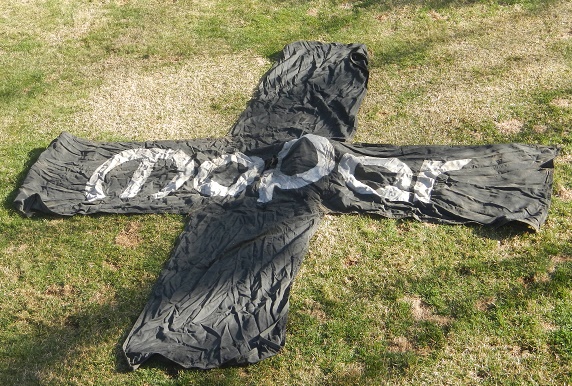
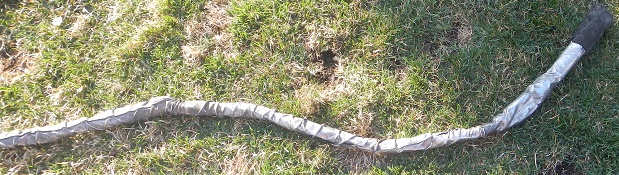
One of the best tools at a drag racer’s disposal is the parachute, and for Scelzi, that was no different. You can’t be the first driver to reach 330 MPH in a funny car without a good parachute to stop the car. Scelzi raced with many different parachutes throughout his career, and this 12′ x 12′ Mopar example from his days with Don Schumacher Racing. It shows heavy use with numerous scuff marks, and holes. It also has a lot of stains as well. I had to photograph this on my front lawn to show the full scale of the suit.The silver MOPAR lettering shows wear, with popped stitching, and lots of staining across the letters.The very center of the parachute has the opening that lets air through the center, and has the straps where the pilot chute is attached.All four corners of the cross-form parachute show wear, in the form of scuff marks and holes.While some parachutes had logos on both sides, this one only has the Mopar logo on one side.The cord that attaches the parachute to the car is still present, and wrapped in a silver Nomex material to prevent damage in the event of a fire.Gary Scelzi is the first funny car driver to reach 330 MPH. It proves that race cars are getting faster all the time. The parachutes are proof that race cars are getting safer as well. Next week, I will examine another critical piece of safety for funny car drivers…the gloves.

 By David G. Firestone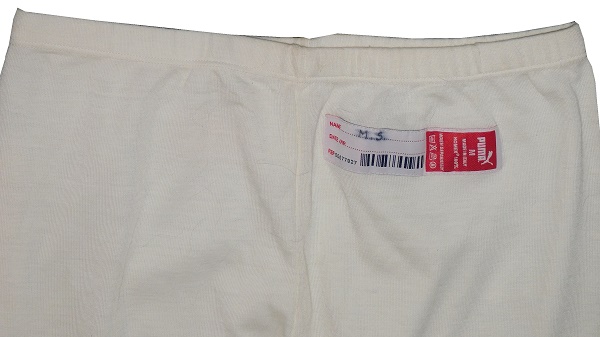
 The cuffs are hemmed, but the hem is very hard to see.
 The back of the pants don’t show any wear to speak of.
 On the center, just below the hem on the back of the pants is the Puma FIA 8856-2000 Compliance tag.
 I’d like to believe that Schumacher could have had one more run in Formula One in him, but tragedy struck. On December 29, 2013, Schumacher and his son Mick were skiing off-piste on the Combe de Saulire below the Dent de Burgin above Méribel in the French Alps, when he fell, and hit his head on a rock. Despite wearing a ski helmet, Schumacher suffered serious brain injuries, leaving him unable to walk, and having serious memory problems, and unable to speak. He may never walk again, and certainly will never race again. It’s a tragic and sad end to a racing legend’s career, and maybe his life.



























































 The Driver Suit Blog